Showing posts with label burma. Show all posts

Tuesday, June 25, 2019

Dalai Lama Meets with Iranian Business People

Meeting Members of a Group from Iran


Thekchen Chöling, Dharamsala, HP, India - At his residence this morning, His Holiness the Dalai Lama met 58 members of Iranian  CEOs of small and medium sized enterprises who describe themselves as messengers of peace. As His Holiness entered the room they greeted him with friendly applause.

“I’m very happy to meet people from Iran,” he told them. “Some people are suspicious of Iranians, but I recall that there are reports of links between Tibet and Persia during the time of King Songtsen Gampo during the 7th century. And whereas Persians were described as rich, the Mongolians were referred to as war-like.

“I have certain commitments. As just one among 7 billion human beings, who all want to live a happy life, I’m committed to helping people understand that this can be achieved if they cultivate a calm, happy mind based on love and compassion. Simply put, if you can be compassionate and warm-hearted, you’ll be happy.

“Secondly, as a Buddhist monk I feel a moral responsibility to promote inter-religious harmony. On a philosophical level there are all sorts of differences between religious traditions, but the common message of them all is the importance of cultivating love. I’m convinced that religious harmony is possible—look at India where so many religious traditions have lived side by side for thousands of years. Because I value religious harmony I’m happy to meet members of other faiths, so it’s a real honour for me to meet you Shia brothers and sisters today.

“These days to see people fighting and killing each other in the name of religion, whether in Egypt, Burma or Afghanistan, is really unthinkable. Next week in Delhi I’ll be attending a meeting to celebrate diversity among Indian Muslims. I’ve heard no reports of friction between Sunnis and Shias in India, so I’ve encouraged my friends in Ladakh to take more active steps to reconcile differences between their brothers and sisters of different denominations.

“When I meet people of different spiritual traditions, I remember that at a fundamental level we’re all the same as human beings. In the part of Tibet where I was born, we had Muslim neighbours and as children we played together joyfully with no differences between us. Once I reached Lhasa, our capital city, with the name Dalai Lama, I found there was a small Muslim community there too. They’d been there since the time of the 5th Dalai Lama who gave them land on which to build a mosque. There were almost no reports of disputes between local Buddhists and these Muslims, who were peaceable, cooked delicious food and spoke with an impeccable Central Tibetan dialect.

“I’m looking forward to the coming meeting and hope that representatives of the embassies of various Muslim countries will also attend. I believe it will be an opportunity to promote religious harmony.”

Among the questions put to him, His Holiness was asked if Buddhists don’t believe in God, how do they account for creation? He replied that like Jains, Buddhists believe in life after life with no beginning. Whether you have a happy or difficult life depends on how you’ve conducted yourself before. Being kind and compassionate to others and avoiding doing them harm are good causes for a happy life in the future. The important thing is to make life meaningful—His Holiness mentioned that he appreciates how thinking of your fellow beings as children of a merciful God can help you do that.

Asked his response to the harassment of Muslims in Burma His Holiness explained that when he first heard about it he was in Washington DC. He expressed his sadness at what was happening and appealed to the Burmese Buddhists not only to remember the Buddha, but also to reflect that if he was there, he would have protected these Muslims. His Holiness explained that he had also expressed his dismay to Aung San Suu Kyi, who replied that the situation was very difficult and there wasn’t much she could do. As a mark of his sympathy and concern for the well-being of these displaced people, he directed the Gaden Phodrang Foundation of the Dalai Lama to make a donation towards their relief and rehabilitation through the United Nations High Commissioner for Refugees. The Iranians showed their appreciation with another burst of applause.

Before the occasion came to an end, the visitors gathered around His Holiness in smaller groups to have their photographs taken together—clearly very happy to have met him.

Original link & photos: https://www.dalailama.com/news/2019/meeting-members-of-the-iranian-impacters-club

Tuesday, June 20, 2017

Dalai Lama Visits the San Diego Zoo

...and Meetings with Indians and Tibetans

San Diego was barely stirring when His Holiness the Dalai Lama set out this morning to visit the San Diego Zoo. He was welcomed at the gate by Mayor Kevin Faulconer, his wife and President of the Zoo Douglas Meyers.

To begin with he was shown a short video outlining the important role the Zoo plays in conservation, both of species of animals and in some cases the plants on which they depend.


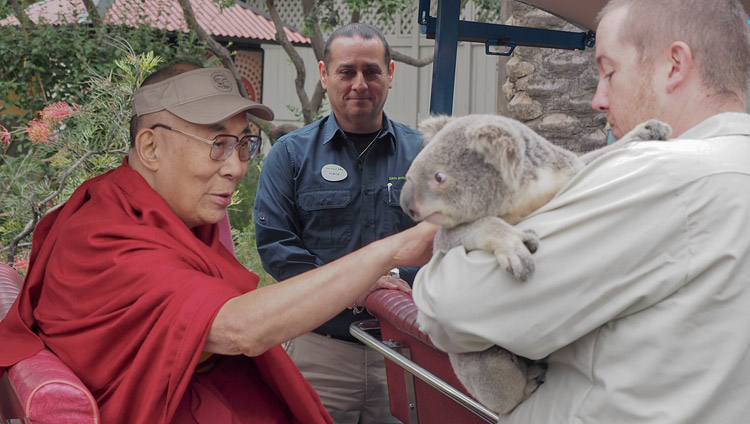
His Holiness the Dalai Lama petting an Australian koala bear during his visit to the San Diego Zoo in San Diego, CA, USA on June 18, 2017. Photo by Jeremy Russell/OHHDL

His Holiness rode in an electric buggy round the park from which he viewed various birds and animals. He was shown a Malayan tiger, a leopard, a lion and a cheetah among the big cats. He saw elephants being washed down and heard that San Diego is the destination of all the elephants in the USA when they retire. The Zoo looks after some very elderly elephants. Amongst the birds he saw condors, a peacock and hornbill, as well as a flock of flamingos. At one stop an Australian koala and a baby python were brought to him. Elsewhere he saw giraffes and rhinoceroses.

Back at reception His Holiness drank tea and talked about the Zoo’s work with the Mayor, the President, his staff and members of the board and returned to his hotel before the Zoo opened to the public.

Meeting with about 200 members of the San Diego Indian community after lunch, His Holiness was welcomed and introduced by Dr Suresh Subramani. There followed a brief musical interlude as Prof Karthik Seshadri gave a short sitar recital.

“Dear brothers and sisters,” His Holiness began, “you Indians were historically our gurus, so I’m very happy to meet with a group of you here. Among the ancient civilizations of China, Egypt and the Indus Valley, Indian civilization seems to have produced the greatest number of creative thinkers.

“I have great admiration for the spirit of ahimsa, non-violence, and secular pluralism that typify India. Because of these traditions, compared to her neighbours, India is remarkably stable and harmonious. It’s the only country I can think of where all our major religious traditions live amicably side by side. Advani told me that India’s secular respect extends even to those who have no faith, pointing out that although the Charvakas took a nihilist view, their teachers were still referred to as rishis or sages. Such a broad view is relevant when, of the 7 billion human beings alive today, 1 billion profess no faith.

“With regard to non-violence, it is worth remembering that the demarcation is not necessarily in the kind of the action so much as the motivation. Harsh words out of concern for another’s well-being are non-violent, but a smile and soft words with an intention to cheat and deceive can be seen as violent.”
His Holiness outlined his three commitments—promoting basic human values as a source of happiness, encouraging inter-religious understanding and, although he has retired and devolved his political responsibilities for Tibet to an elected leadership, preserving Tibet’s religion and culture, as well as its natural environment.

He explained that efforts to preserve Tibetan culture had begun in 1959, when he first came into exile. However, particularly after 1973, when he made his first visit to Europe, he began what have become extensive exchanges with modern scientists. He then started to appreciate that the ancient Indian knowledge of the workings of the mind and emotions could make a contribution to the well-being of humanity.  

“After 58 years, I am the Government of India’s longest standing guest. My mind is filled with Indian knowledge and my body has been nourished by Indian rice, dal and chapatis. This is why I sometimes call myself a Son of India. I consider it my duty to repay the kindness I have received by sharing the knowledge of the Nalanda tradition we Tibetans have kept alive.”

A member of the audience acknowledged that most religious traditions have resorted to violence at sometime in their history, but he’d been surprised to learn about what have been referred to as Buddhist terrorists in Burma. His Holiness agreed and told him he had recommended that when Buddhists in Burma felt antagonistic towards others they should pause and recall the face of the Buddha.

He added that although it was reported that monks had been involved in violence and persecution, if they had really behaved in such a way they could no longer be properly regarded as monks. He stressed that a terrorist is just a terrorist and that it is wrong to add a religious label, referring to Buddhist terrorists or Muslim terrorists, seeking to spoil the reputation of an entire religion.

He explained to another questioner that the ancient Indian knowledge he had been referring to is contained in the more than 300 volumes of the Kangyur and Tengyur.

Finally, an Indian woman thanked His Holiness for giving of himself all over the world. She asked if it would be acceptable if she requested her companions in the audience to join her in dedicating three recitations of the Gayatri mantra to his well-being.

Next, addressing more than 600 Tibetans, most of whom live locally, His Holiness told them:

“During this short visit to this area, I’m happy to be able to meet with some of you who have a special karmic connection with me, not just in this life but over many lifetimes. Tibetans in Tibet and in exile have shown remarkable loyalty and dedication—I’d like to thank you.

“We’ve been in exile for 58 years, which in the life of one individual is a long time. In Tibet temples and monasteries have been destroyed and many people have lost their lives. In terms of education, study of Tibetan language and culture are restricted in Tibet. Nevertheless, our Tibetan spirit remains strong and we are united—for which again I’d like to thank you.

“It’s important that we keep our language alive, not out of attachment, but because it is the best means for accurately conveying Buddhist philosophy, science and psychology. Over the last 30 years or more we’ve held discussions with scholars and scientists most of whom are not religious as such. They are intrigued that the Nalanda tradition is based not on blind faith, but on reason and logic.

“Whether you count yourself as a Buddhist or not, the study of logic is useful. In the past this was the province only of the monks, but these days the general public should be involved too. Haribadra wrote in his ‘Clear Meaning’ that those of dull faculties depend on faith, but those whose faculties are sharp depend on reason. If we follow the path of those with sharp faculties the prospects for the survival of our Buddhist tradition are bright. Remember that the Buddha advised his followers to accept what he’d taught not out of respect for him, but only after investigating and examining it as a goldsmith tests gold. Indian masters like Nagarjuna and Chandrakirti took this advice to heart and distinguished those scriptures that should be regarded as interpretable and those that could be regarded as definitive.

“Buddhism has survived for more than 2500 years. If we can pass it on to the next generation it will be good and a source of benefit.

“A few days ago I visited the Mayo Clinic for a check-up and the doctors gave me the all clear. They judge the prostate treatment I received last year to have been a success.

“Remain calm, stick together and stay united. Keep in mind that our Buddhist traditions can contribute to the wider world.”

original link and photos https://www.dalailama.com/news/2017/visit-to-san-diego-zoo-and-meetings-with-indians-and-tibetans

Monday, September 28, 2015

Dalai Lama: Interfaith Meeting & Action for Happiness Event

London, England, 21 September 2015 - Before he left for the day’s other engagements this morning, His Holiness the Dalai Lama gave an interview to Christiane Amanpour of CNN. She began by asking: “What are you trying to do here?” and he replied:

“What’s important is that all human beings, wherever they are, whether they are rich or poor, educated or uneducated, have a right to live a happy life. Many think that happiness is to be found outside ourselves in material things, but actually happiness is something that comes from within. So I try to present the importance of inner values not on the basis of religious quotations, but by taking a secular approach based on scientific findings and common sense.

Ms Amanpour remarked that China is changing because of its rapidly developing economy and yet the authorities still refer to His Holiness as a ‘splittist’. He told her that Tibetans had not been seeking independence since 1974 and everybody knows that. She mentioned concern about who will succeed him. He replied that as far as Tibetan Buddhism is concerned the 10,000 monks and nuns who are studying and practising today will be able to preserve it. He made the point that the Buddha’s teaching has survived for 2600 years without there being a recognised reincarnation of the Buddha. He conceded that while he might be the last Dalai Lama, he may yet appoint a successor from among qualified lamas before he goes.

Asked how he sees the persecution of Rohingyas in Burma His Holiness said: “It’s very sad. I have appealed to Burmese Buddhists to stop and think. When they feel angry or resentful of these people, remember the face of the Buddha. I believe that if the Buddha were there, he would offer the Rohingyas his protection.”

Finally, noting that President Xi Jinping will shortly be visiting the USA and the UK, Ms Amanpour wanted to know what His Holiness would say to him if he had the opportunity to do so. He answered:

“Perhaps I’d say that that although historically we were an independent country, as records of the 7th to 9th centuries show, we are not seeking independence now. We can benefit from the development we get as part of the People’s Republic of China, but we must be able to preserve our language, culture and Buddhist traditions. I’d remind him that last year in Paris and Delhi he said that Buddhism plays an important role in Chinese culture. Buddhist values can be of help at a time when the injustice and corruption he seeks to contain are widespread.”

Arriving at the House of Lords to attend an Interfaith Meeting organized by the Buddhist Society, His Holiness was welcomed by Baroness Caroline Cox and Desmond Biddulph, the Society’s President. They escorted him through the grand halls to the meeting, which was attended by Christians, Muslims, Buddhists and Hindus of various denominations and a Sikh.

Baroness Cox amused everyone when she introduced herself as a nurse and social scientist by profession and a Baroness by astonishment. Remarking that she was the first Baroness she’d ever met, she added that she realized that the role gave her a voice to use on behalf of those who have no voice. Desmond Biddulph told the gathering that His Holiness is the Patron of the Buddhist Society and that this was an opportunity to celebrate his 80th birthday and the Society’s 90th anniversary. He said that one of His Holiness’s requests had been that, as Buddhists, members of the Society should reach out to others. He invited His Holiness to address the gathering, which he did.

“It’s a great honour for me to be sitting here with spiritual brothers and sisters of various traditions. In too many places today it seems religious and nationalistic feelings are giving rise to terrible conflicts. We have to find ways to bring peace. This is something that those of us who are religious have to do. Meetings like this are an opportunity to build and nurture friendship and trust among us.

“There is an impression in many people’s minds these days that Muslims are especially militant. However, we have to remember that there are militant Christians, Hindus, Sikhs, Jews and Buddhists too. The Muslim community that lived in Tibet were a very peaceful community and meeting them in exile I am reminded of the pure Lhasa dialect they still speak.

“Muslim friends have told me that if you shed blood you are no longer a genuine Muslim and that Muslims have a commitment to respect all the creatures of Allah. They also tell me that the word ‘jihad’ is misunderstood. It doesn’t have anything to do with fighting other people, but refers to combating disturbing emotions within yourself.”

The Archbishop of York, Dr John Sentamu spoke of growing up in Uganda with two Muslim children from Zanzibar. His father took them in when their own parents died in a fire and he was unable to trace any other relatives. Although theirs was a Christian family, his father arranged for these two children to attend a mosque on Fridays. The Archbishop reported that in a similar spirit he has spoken in the House of Lords of the need to encourage the Chinese authorities to acknowledge and respect His Holiness the Dalai Lama as a spiritual leader. He said he feels it’s important to remember, “I am not my brother’s keeper, I am my brother’s brother.”

Archbishop Kevin McDonald conveyed greetings to His Holiness and members of the gathering from Cardinal Vincent Nichols, leader of the Roman Catholic Church in the United Kingdom. He also recalled serving in the Vatican when Pope John Paul II convened the ground-breaking interfaith gathering in Assisi in 1986 that His Holiness and Archbishop Robert Runcie had attended.

Baroness Berridge, Chair of the All Party Group on International Religious Freedom, who had just returned from the USA, mentioned her concern for persecuted Muslims and Christians in Burma and elsewhere. She said that those in public life have a responsibility to work for rights for all.

Chime Rinpoche took the opportunity simply to say thank you to His Holiness for all he has done.

The Bishop of Coventry, Christopher Cocksworth, remarked that violence is never of any help and that religious leaders need to make this clear their various governments. He pointed out that while there is public horror at the violence in Syria and Iraq, last week saw a great arms show in the UK. He said it seems there is still too great a sense that the use of military force is the way to solve problems, but in fact in the long run words are more effective than bullets. The meeting as a whole expressed dismay at the way violence continues and a determination to work for dialogue.

In his closing remarks, His Holiness repeated what he often says, that love and compassion are what bring people together, while anger and suspicion push them apart. He noted that religious people have their own different paths, each of which is worthy of respect. He said the common purpose of different kinds of food is to fill our stomachs, but it would be foolish to say, “I like to eat this food, therefore you should eat it too!”

He drew attention to three aspects of religious tradition. The religious aspect concerns the common practice of love and compassion, tolerance and self-discipline. While philosophical views may be quite different, they are all dedicated to the same goal of reinforcing the practice of love. However, he said, there may also be cultural aspects of religious tradition, like caste discrimination, that are no longer relevant and should be changed. He said he encourages religious leaders to speak out about these things whenever they can. The meeting adjourned for lunch in the Strangers’ Dining Room of the House of Commons.

In the afternoon, an enthusiastic and friendly audience of more than 2000 awaited His Holiness’s arrival at the Lyceum theatre. He was met at the stage door by his old friend Lord Richard Layard, who with Director of Action for Happiness, Mark Williamson, escorted him to the stage. They were received with resounding cheers and applause. Dr Williams explained that a new course of training was being launched today on World Peace Day, called Exploring What Matters. He said that it is ever more important to bring people together to think about their lives and to help them make their lives happier.

He invited Jasmine Hodge-Lake to the stage to tell her story. She explained that following an accident that left her injured and in pain, she had become depressed. Attending an Action for Happiness talk helped her understand she could relate differently to her pain. She then took the pilot Action for Happiness course that helped her realize how she could bring hope back into her life and help others. She said:

“I learned how helping others you can help yourself. I’m a different person now to the one I was before the Action for Happiness course. I realized I could be the change I wanted to see.”

Adrian Bethune, a teacher at John Stainer Community Primary School told of becoming disillusioned with teaching until he also took the course. It helped him understand how he could do his work more positively and introduce changes in the classroom. He began to discuss with his students how the mind and brain work based on insights from neuroscience. He rebranded an anti-bullying programme as ‘it’s cool to be kind.’ On Fridays he asked the students to think back and choose three good things they’d done that week. He said teacher and students have become much happier about coming to school.

Prof Layard then opened a conversation with His Holiness, who is Action for Happiness’s Patron. He asked him how we can have more happiness, more peace in our hearts and His Holiness replied:

“Peace means no disturbance, no danger. It relates to our mental attitude. If we have a calm mind, obstacles will be less disruptive. The important thing is to realize that ultimately peace of mind is within us, it takes a warm heart and using our intelligence. People sometimes think warm heartedness, compassion and love are religious topics; they are actually factors for our survival. If we don’t take steps to reinforce these qualities now, the 21st century will also end up being an era of violence like the 20th century. We can’t expect change if we don’t take action. Prayer is not sufficient; we have to take responsibility ourselves. Problems created by human beings have to be solved by human beings.”

When Prof Layard asked how we can improve our relations with each other, His Holiness told him that as social animals people have to overcome their old habit of seeing others in terms of ‘us’ and ‘them’, which just solidifies division. He said we have to see that we are all just human beings and that in our globalized world we have to deal with a global economy and problems like climate change whose effects ignore national boundaries. We have instead to cultivate a sense of global responsibility that sees everyone as ‘us’.

His Holiness explained how discussions with scientists over 30 years had contributed to an understanding of a curriculum of secular ethics in education from kindergarten to university. Part of this involves working with a map of emotions to ensure that the physical hygiene we need to be healthy is accompanied by emotional hygiene.

He answered several questions from the audience, observing that the natural seed of compassion we all possess can, if we use our intelligence, be extended to encompass even our enemies. He acknowledged the need to look after our own interests, but explained that the foolish way to do this is to focus on ourselves alone. A wiser sense of self-interest takes others’ interests into account as well. Asked what one thing people could do to make the world a happier place he answered: “Cultivate affection.”

As the discussions came to a close and His Holiness waved goodbye to the audience they responded with affectionate cheers.

Once the curtain had dropped on the stage, the BBC’s Mark Easton asked His Holiness about the launch of Exploring What Matters and Action for Happiness. He suggested that some were cynical that such moves could be effective. His Holiness retorted that such resistance is just old-fashioned thinking. Warm-heartedness can make individuals, families, communities and even countries happier. He said:

“Even the creation of the EU was essentially an act of compassion. And look, I'm convinced more positive reporting by the BBC and the media, just as you are doing now, can really help make people happier.”

original link + ;photos: http://dalailama.com/news/post/1320-interfaith-meeting-and-action-for-happiness-event

Monday, July 13, 2015

His Holiness the Dalai Lama is Given a Warm Welcome in Wiesbaden, Germany

Wiesbaden, Hessen, Germany, 12 July 2015 - Arriving early this morning in Frankfurt at the end of a long flight from New York, His Holiness the Dalai Lama was welcomed at the airport by representatives of the Indian Consulate and Frank Auth on behalf of Friends for a Friend. The drive through the fertile countryside to Wiesbaden was fast. In fields on either side of the expressway stood an array of golden wheat.

After some rest during the morning, His Holiness joined old friends, including former Prime Minister Roland Koch and his wife, for lunch. During a short meeting with sponsors of the afternoon's public talk he paid tribute to his long friendship with the German people, reaching back to his first visit to Europe in 1973, and the people of Hessen in particular.

At a meeting with the Press immediately afterwards he outlined his commitments to sharing with others the idea that cultivating humane inner values is the real source of human happiness. He also mentioned his commitments to promoting inter-religious harmony and preserving the culture and language, as well as the fragile natural environment, of Tibet.

He was asked to begin with what he felt about the pro-Shugden demonstrators and their noisy protest in the street outside. He replied simply:

"I'm happy to see they enjoy freedom of expression. The practice and the spirit they are referring to has been controversial for nearly 400 years. Over the last 80 years or so it was the source of severe and divisive sectarianism. This is something that needs to be carefully investigated."

Asked about the celebrations of his 80th birthday His Holiness said that it was more important to do something meaningful with your life, to dedicate your actions of body, speech and mind to the well-being of others. This, he said, is how he'd lived. About the conflict between Buddhists and Muslims in Burma, he said it is really sad. He mentioned that he had appealed to these Burmese Buddhists, when their feelings of anger are aroused, to remember the face of the Buddha, who he is convinced would offer the Muslims his protection if he were there.

It was a short drive to the Wiesbaden Kurpark where a small pavilion and stage had been erected and 12,000 people had assembled to welcome His Holiness and hear what he had to say. Frank Auth of Friends for a Friend warmly welcomed the public, the Mayor of Wiesbaden, Roland Koch, Claudia Roth and that longstanding friend of the people of Hessen, His Holiness the Dalai Lama.

Before any further speeches were made, Auth invited Tibetan singer, Dechen and her band to perform. To the band's mellow accompaniment she sang a song focused on the mantra of compassion Om mani padme hum, which paid respect to the Bodhisattva Avalokiteshvara or Chenrezig.

The Mayor of Wiesbaden remarked that the people of the city were proud to have His Holiness among them once again and noted the long friendship that has existed between them. Claudia Roth, a Green Party politician who is one of the leaders of the German Parliament, the Bundestag said:

"We are happy to have this exemplary man here. Thank you for all the work you've done for freedom in the face of difficulty. We thank you too for your efforts to achieve a world without war. You bring a light to our hearts; we support you and hope you live long and in good health."

Roland Koch told His Holiness that the gift they could offer him on his 80th birthday was continued solidarity.

"We keep up with what's happening in Tibet and we stand with you. The Dalai Lama is always welcome here. While most of us want to be friends with China, we also want to see human rights upheld in Tibet."

He recalled attending celebrations of His Holiness's 60th birthday in Delhi and looking forward to marking his 70th birthday in Lhasa. In retrospect he realises it wasn't realistic and he acknowledged that one of the things he's learned from His Holiness is to think more of the long term. He too ended with wishes for His Holiness's good health and long life.

His Holiness began his address in his customary way:

"Dear brothers and sisters, once more we are gathered together here. This place, the city of Wiesbaden and the state of Hessen is close to my heart because of the generous, warm feeling the people here have consistently shown me. I'd like to thank all the organizers and volunteers who have made this meeting possible.

"I've known Claudia Roth and Roland Koch a long time. We have a steady friendship that will last as long as I live. I don't know which of us will go first, but I think this is the kind of friendship that will continue into our future lives as well.

"Whenever I meet people, I always think that we are first of all human beings and that all of us are mentally, physically and emotionally the same. We all want to live a happy life, and we all have a right to do so. I believe that to live a happy life we depend on the rest of the community. This is one of the reasons I admire the European Union because it is based on putting the common interest ahead of narrow national interests. I look forward to when we might have a similar African Union, an Arab Union and even an Asian Union."

He explained again that whenever he speaks in public he thinks of himself as just another human being the same as everyone else. He said that if he thinks of himself as a Buddhist, as someone from Asia or as His Holiness the 14th Dalai Lama it only serves to create a distance between him and the people he's talking to. He stressed that it is on the basis of what they have in common that every individual has a responsibility to think of the well-being of all 7 billion human beings alive today. It's in this context, he said, that he regrets that the existing education system is oriented towards materialism with little place for inner values.

"If we want to create a more peaceful world, we need to find a new approach to introducing human values into education from KG up to university."

He mentioned his commitment to promoting inter-religious understanding, something he'd learned from encounters with wonderful practitioners of the world's other great religions; people like the Catholic monk Thomas Merton. He ended his talk with the suggestion that the best birthday gift he could hope for would be if other people responded more warm-heartedly to each other.

Answering questions from the audience he told them he had no regrets in life, that whatever he'd done had been done with a sincere motivation. When a young boy asked if there was one god or many, he replied it was difficult to know but that he was young enough to have the time to investigate this for himself.

He stressed the need to use our human intelligence, based on our common experience, common sense and scientific findings. We may learn that thinking of others happens to be good for us both. He mentioned the need to know more about how the mind works:

"Compared to what we can learn from ancient Indian traditions, modern psychology is quite rudimentary. We can all study these things, the mind and our emotions. At the age of 80, I'm still studying and I recommend you to do so too."

When a man from China told His Holiness in English that he and his wife had come to see him, wanting to learn from him, wanting to hear how to be a good person, and wanting to know when he would come to China, His Holiness replied:

"You should ask the Chinese government. If they give a positive signal, I'm ready to come."

As the afternoon came to an end, His Holiness waved to the audience saying:

"Last night I was flying here from New York. Now I'm looking forward to a good, sound sleep. I hope you all sleep well too."

Tuesday, August 21, 2012

Why the Dalai Lama is Hopeful

“I told President Obama the leaders of the Chinese Communist Party are missing a part of the brain, the part that contains common sense,” the Dalai Lama said to me during our conversation in London Wednesday.

But it can be put back in. I am hopeful about the new Chinese leadership beginning late this year. The Communist leaders now lack self-confidence, but I have heard from my Chinese friends that after a year or two the new ones will take some initiatives, so more freedom, more democracy.

The Dalai Lama, with whom I have been talking periodically since 1981, was in an ebullient mood even for him. He was here referring to his meeting with Obama in 2011. I had asked the Dalai Lama about those national leaders throughout the world, from South Africa to Britain, who refuse to hold formal meetings with him because they fear Beijing’s anger. President Obama declined to meet him in 2009, the first rebuff from an American president since the Tibetan leader began visiting Washington in 1991.

The meeting that finally took place in 2011 was in the White House Map Room rather than the Oval Office, after Beijing had warned against such an encounter: “We firmly oppose any foreign official to meet with the Dalai Lama in any form.” In Britain, Prime Ministers Gordon Brown and David Cameron found other venues for their meetings, far from 10 Downing Street. Two weeks ago Cameron and Deputy Prime Minister Nick Clegg held a brief unpublicized meeting with the Dalai Lama who was about to address several thousand admirers in St Paul’s cathedral. All such meetings, including the one at the cathedral, are routinely condemned by Beijing as “hurting the feelings of the Chinese people.”

“If these national leaders don’t see me that’s up to them,” the Dalai Lama said. “But slowly Chinese people realize they have been exploited, censored. The Communists tell them they don’t need Western-style democracy and human rights.’”

In recent months, there have been reports of self-immolations by Tibetans in China, and there are concerns that the human rights situation is worsening. Yet, as in previous meetings, the Dalai Lama reflected without rancor on Chinese Communist rule over Tibet. “What has kept Tibetans going for 2500 years? The Dharma.” This is the traditional Buddhist view of the universe and its principles of human behavior and wisdom. “How old is the Communist Party? Less than 200 years [it was founded in 1921]. Admiration for Tibetans throughout the world is always rising. Attitudes toward the Chinese Communist party, inside and outside China, couldn’t be worse.”

He noted that the Party sees how Aung San Suu Kyi, the Burmese opposition leader and a fellow Nobel Peace laureate, was admired throughout the world for more than twenty years when she was a captive in Rangoon and now, free at last, is welcome everywhere. She was in London this week, and Beijing cannot have been happy to see her meeting with the Dalai Lama on Wednesday. The Dalai Lama told Suu Kyi that he admired her courage.

The Dalai Lama said that the reason Chinese Nobel Peace Prize winner Liu Xiaobo is serving an eleven year prison sentence for subversion is “because he is not just one individual. There are thousands of intelligent thinking people in China who agree with him that change is necessary.” This means more transparency, he insisted, an end to violence, and a real legal system. “And there are also 1.3 billion other Chinese who because of their great culture have the brains to distinguish right from wrong. More and more they are aware of their rights.” The Party fears them, he added, and Liu is supposed to be a warning, an example, he agreed, of the Chinese saying “Strike the rooster to frighten the monkey.”

Particularly interesting was what the Dalai Lama had to say about the eleventh Panchen Lama, the second most eminent religious figure in Tibetan Buddhism, who has been chosen by the Chinese leadership in Beijing, in an apparent effort to impose further control on Tibet. The authentic eleventh Panchen, Gedhun Choekyi Nyima, was chosen by the Dalai Lama in 1995 while the Tibetan leader was in exile in India. In accordance with tradition, he made the choice five years after the tenth incarnation died.

Beijing immediately denounced the choice as illegitimate, kidnapped the child and his family—who have never been seen again—and imprisoned for subversion the abbot of the Tashilunpo monastery, the Panchen’s traditional seat, who had first identified little Choekyi Nyima as a possible eleventh Panchen. Employing “authentic” rituals, the Communist Party then chose its own boy, Gyaincain Norbu. It was only too plain that this rigamarole, as the Dalai Lama has remarked to me over the years, was a dress rehearsal for Beijing to select his own successor, the Fifteenth Dalai Lama, who it hopes will be accepted by Tibetans, as their choice of Panchen has failed to be.

I was surprised, therefore, by the Dalai Lama’s comments about the spurious Panchen. He mentioned 2008, when an uprising swept throughout Tibet proper and regions of China populated by many Tibetans. Chinese properties were destroyed, some Han were killed, and a number of Tibetans are estimated to have been killed at the hands of the Chinese police and army.

“Of course Beijing wanted the boy to denounce the uprising,” the Dalai Lama observed. “But some of his friends have told me that he remains a Tibetan deep inside and preferred to remain silent. Beijing couldn’t use him.”

By Jonathan Mirsky, The New York Review of Books, 6/21/12