Showing posts with label his holiness the dalai lama. Show all posts

Tuesday, October 10, 2017

Dalai Lama Congratulates ICAN For Winning The Nobel Peace Prize

His Holiness the Dalai Lama Congratulates ICAN For Winning The Nobel Peace Prize


Dharamsala, HP, India - In his letter to Ms. Beatrice Fihn, the Executive Director of ICAN, His Holiness congratulated the International Campaign to Abolish Nuclear Weapons (ICAN), which has been awarded this year's Nobel Peace Prize for its sustained efforts to eliminate nuclear weapons throughout the world.

His Holiness mentioned "In these times of great uncertainty and upheaval in many corners of the world, the work of ICAN is of the utmost urgency. It is therefore most fitting that the Nobel Peace Committee has recognised the endeavours of ICAN."

He further added, "I pray that there will be concerted and vigorous efforts to achieve a world without nuclear weapons."

original link: https://www.dalailama.com/news/2017/his-holiness-the-dalai-lama-congratulates-ican-for-winning-the-nobel-peace-prize

Tuesday, August 15, 2017

World Peace and Harmony through Interfaith Dialogue

Mumbai, Maharashtra, India - The drive across Mumbai today for His Holiness the Dalai Lama to attend a seminar on ‘World Peace and Harmony through Interfaith Dialogue’ at the National Sports Club of India Dome included traversing the spectacular Bandra-Worli Sealink. He was welcomed on arrival by his host Acharya Dr. Lokesh Muni to a thunderous barrage of drums and horns.

As participants in the interfaith dialogue, led by Acharya Dr. Lokesh Muni and accompanied by His Holiness and Swami Ramdev stepped out onto the stage they were met by enthusiastic applause. Together they lit a lamp to inaugurate the proceedings. Each of the guests was felicitated with a traditional shawl and a memento of the occasion.

Union Power Minister Piyush Goyal was first to speak in order that he could leave to attend the launch of the first phase of the National Cancer Institute in Nagpur later in the morning. He saluted His Holiness as a “world-renowned spiritual leader we all look up to”. He added that it is a matter of pride that Dr. Lokesh Muni-ji, who has dedicated his life to peace and harmony, was leading the gathering, observing that he has made a real commitment to bringing people together from across the country.

Goyal noted that climate change and terrorism are among the world’s greatest challenges at present. He remarked that India is taking steps to counter atmospheric pollution, but also needs to be aware of the damage intolerant thinking does to society. He ended with an aspiration for India to achieve the five ‘Ps’—power, prosperity, prestige, pleasure and position. Vivek Oberoi, present in his role as a peace ambassador, also left to attend the NCI function with the Minister.
     
First of the spiritual leaders to speak about peace and harmony among faiths, Maulana Dr. Kalbe Sadiq referred to the case of the Babri Masjid currently being heard by the Supreme Court. He said that if the judgement favours the Hindu community, his community should accept it, and if it favours the Muslim community they should offer land to the other party because making a gift is a way to resolve disputes. Giani Gurbachan Singh, Chief Jathedar of the Akal Takht stated that despite differences of appearance, there is a unity among all religions because they convey a common message.

Archbishop Felix Anthony Machado talked about the need for peace in our hearts if we seek to create peace in the world. What is required, he said, is unity and truth. Union Minister for Agriculture and Panchayat Raj saluted the spiritual leaders. Union Minister for Science & Technology;  Environment, Forest and Climate Change; as well as Earth Sciences, Dr. Harsh Vardhan told the audience of more than 4000 that the government is determined to do what it can to take India forward, but needs the people’s support and participation.

Acharya Dr. Lokesh Muni paid tribute to Swami Ramdev for sparking a widespread interest in yoga. Observing the need to include instruction on peace and non-violence, as recommended by His Holiness, in the school curriculum, he also suggested taking His Holiness’s message about resisting the urge to resort to violence to places of conflict.

Swami Ramdev began with a characteristic declamation—“Bharat Mata ki Jai”. In the course of an extensive oration he suggested that China should be aware that all major religions are about peace and non-violence. Consequently, India, which is a religious country, is ready to engage in dialogue, but if her opponent wants war, she’s ready for that too. Jainacharya Namra Muni said he didn’t want to delay His Holiness since it was nearly time for lunch.

His Holiness was helped to his feet and took his place at the lectern. He opened his address in his customary way:

“Respected spiritual brothers and ... oh, no sisters?

“I am very happy to participate in this wonderful meeting, among spiritual leaders who not only carry out their own practice sincerely, but also take action to solve problems they encounter in a non-violent way. Usually I tell people that I don’t consider myself as anything other than another of the 7 billion human beings alive today. Mentally, emotionally and physically we are the same. Some of my friends here have a lot of hair on their faces, which I don’t, but basically we are the same.

“The entire 7 billion human beings want happiness and joy, but instead are faced by a multitude of problems—many of which are man-made. So, there’s a contradiction; no one wants problems and yet we seem to bring them on ourselves. How does this come about? As a result of our emotions, especially our destructive emotions.

“Anger and jealousy are related to our sense of self-centredness and our disregard for others. Self-centredness easily gives rise to fear, which fosters irritation, which, when it blazes into anger, can provoke violence. The time has come to accept that if we’re talking about peace in the world, we have to consider peace within ourselves.

“In this country, ahimsa has, for thousands of years, characterized the path of action, but it is related to being motivated by karuna or compassion. On the one hand, if we have a self-centred attitude, an artificial smile and seek to deceive others with sweet words—that’s a kind of violence. On the other, when a parent or teacher, like my tutor, uses harsh words entirely out of concern for a child’s welfare, that’s non-violent.

“So, the demarcation between violence and non-violence isn’t just about the nature of the action, it’s about motivation. That’s why we need to pay more attention to karuna or compassion, which scientists say is our basic human nature. They also say that constant fear, anger and suspicion undermine our immune system, whereas compassion has the effect of strengthening our health.”

His Holiness talked about our common human experience of being born and nurtured by our mothers. He remarked that some scientists have suggested that a mother’s physical touch is crucial to the proper development of our brains. We all grow up appreciating love and affection. We learn that jealousy doesn’t make us happy, whereas if we deal with each other honestly, truthfully and transparently, we’ll be content.

He went on to observe that common sense tells us that the family next door may be rich, but if they don’t trust each other, they won’t be happy. Meanwhile, the poor family down the road have very little, but because they have trust and affection for each other, they are full of joy. He suggested that the education system, oriented as it is to material goals rather inner values, contributes to our unease.

“If education paid more attention to the ancient Indian knowledge of the workings of the mind and emotions, we’d learn how to achieve peace of mind. We’ve been working with education experts and scientists to draw up a curriculum to implement this from kindergarten to university. We propose to do this on a secular basis—secular meaning not only respect for all religious traditions without bias, but even respect for the views of those who have no belief. If India can combine modern education with ancient Indian knowledge, she can make a significant contribution to the well-being of all 7 billion human beings.”

His Holiness mentioned that he is committed to raising awareness of how to bring about a happier, more peaceful world through education and common sense. Having spent 58 years in this country he has observed with admiration how religious traditions that originated here live side by side with those that came from outside. In this India is an example to the world. He said it’s unthinkable that religious faith should be a source of conflict. However, there are places now where conflict takes place within the same faith—between Sunni and Shia traditions for example—something not seen in India.

“Wherever I go, I tell people that with regard to religious harmony, India is a living example that religious traditions can live together in peace and respect.

“As a Tibetan I am also concerned to preserve the knowledge that was first brought to Tibet in the 8th century by the master Shantarakshita. It reflects the traditions of Nalanda University that we have preserved and which Buddhists in the People’s Republic of China are increasingly coming to appreciate. India is our guru, and we have proved ourselves reliable chelas, because we have kept these traditions of philosophy, logic and understanding of the mind alive. Now, I’ve made a commitment to trying to revive this ancient knowledge in India, which I consider is the only country that could combine it with a modern approach to education.”

His Holiness and the several spiritual leaders ate lunch together in a cordial display of friendship before departing and going their own ways.

original link & photos: https://www.dalailama.com/news/2017/world-peace-and-harmony-through-interfaith-dialogue

Tuesday, June 20, 2017

Dalai Lama Visits the San Diego Zoo

...and Meetings with Indians and Tibetans

San Diego was barely stirring when His Holiness the Dalai Lama set out this morning to visit the San Diego Zoo. He was welcomed at the gate by Mayor Kevin Faulconer, his wife and President of the Zoo Douglas Meyers.

To begin with he was shown a short video outlining the important role the Zoo plays in conservation, both of species of animals and in some cases the plants on which they depend.


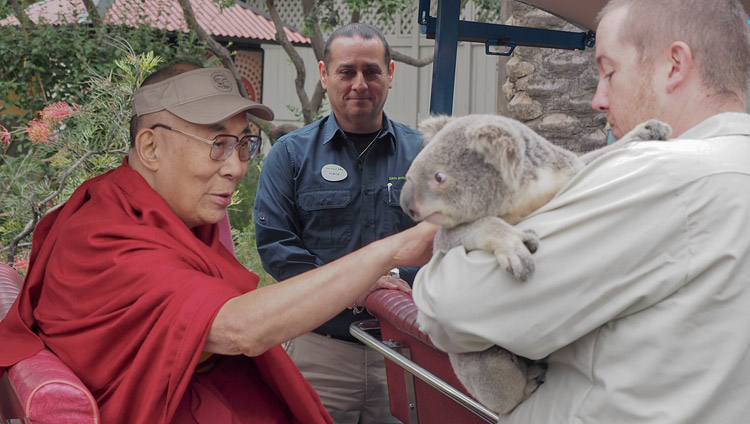
His Holiness the Dalai Lama petting an Australian koala bear during his visit to the San Diego Zoo in San Diego, CA, USA on June 18, 2017. Photo by Jeremy Russell/OHHDL

His Holiness rode in an electric buggy round the park from which he viewed various birds and animals. He was shown a Malayan tiger, a leopard, a lion and a cheetah among the big cats. He saw elephants being washed down and heard that San Diego is the destination of all the elephants in the USA when they retire. The Zoo looks after some very elderly elephants. Amongst the birds he saw condors, a peacock and hornbill, as well as a flock of flamingos. At one stop an Australian koala and a baby python were brought to him. Elsewhere he saw giraffes and rhinoceroses.

Back at reception His Holiness drank tea and talked about the Zoo’s work with the Mayor, the President, his staff and members of the board and returned to his hotel before the Zoo opened to the public.

Meeting with about 200 members of the San Diego Indian community after lunch, His Holiness was welcomed and introduced by Dr Suresh Subramani. There followed a brief musical interlude as Prof Karthik Seshadri gave a short sitar recital.

“Dear brothers and sisters,” His Holiness began, “you Indians were historically our gurus, so I’m very happy to meet with a group of you here. Among the ancient civilizations of China, Egypt and the Indus Valley, Indian civilization seems to have produced the greatest number of creative thinkers.

“I have great admiration for the spirit of ahimsa, non-violence, and secular pluralism that typify India. Because of these traditions, compared to her neighbours, India is remarkably stable and harmonious. It’s the only country I can think of where all our major religious traditions live amicably side by side. Advani told me that India’s secular respect extends even to those who have no faith, pointing out that although the Charvakas took a nihilist view, their teachers were still referred to as rishis or sages. Such a broad view is relevant when, of the 7 billion human beings alive today, 1 billion profess no faith.

“With regard to non-violence, it is worth remembering that the demarcation is not necessarily in the kind of the action so much as the motivation. Harsh words out of concern for another’s well-being are non-violent, but a smile and soft words with an intention to cheat and deceive can be seen as violent.”
His Holiness outlined his three commitments—promoting basic human values as a source of happiness, encouraging inter-religious understanding and, although he has retired and devolved his political responsibilities for Tibet to an elected leadership, preserving Tibet’s religion and culture, as well as its natural environment.

He explained that efforts to preserve Tibetan culture had begun in 1959, when he first came into exile. However, particularly after 1973, when he made his first visit to Europe, he began what have become extensive exchanges with modern scientists. He then started to appreciate that the ancient Indian knowledge of the workings of the mind and emotions could make a contribution to the well-being of humanity.  

“After 58 years, I am the Government of India’s longest standing guest. My mind is filled with Indian knowledge and my body has been nourished by Indian rice, dal and chapatis. This is why I sometimes call myself a Son of India. I consider it my duty to repay the kindness I have received by sharing the knowledge of the Nalanda tradition we Tibetans have kept alive.”

A member of the audience acknowledged that most religious traditions have resorted to violence at sometime in their history, but he’d been surprised to learn about what have been referred to as Buddhist terrorists in Burma. His Holiness agreed and told him he had recommended that when Buddhists in Burma felt antagonistic towards others they should pause and recall the face of the Buddha.

He added that although it was reported that monks had been involved in violence and persecution, if they had really behaved in such a way they could no longer be properly regarded as monks. He stressed that a terrorist is just a terrorist and that it is wrong to add a religious label, referring to Buddhist terrorists or Muslim terrorists, seeking to spoil the reputation of an entire religion.

He explained to another questioner that the ancient Indian knowledge he had been referring to is contained in the more than 300 volumes of the Kangyur and Tengyur.

Finally, an Indian woman thanked His Holiness for giving of himself all over the world. She asked if it would be acceptable if she requested her companions in the audience to join her in dedicating three recitations of the Gayatri mantra to his well-being.

Next, addressing more than 600 Tibetans, most of whom live locally, His Holiness told them:

“During this short visit to this area, I’m happy to be able to meet with some of you who have a special karmic connection with me, not just in this life but over many lifetimes. Tibetans in Tibet and in exile have shown remarkable loyalty and dedication—I’d like to thank you.

“We’ve been in exile for 58 years, which in the life of one individual is a long time. In Tibet temples and monasteries have been destroyed and many people have lost their lives. In terms of education, study of Tibetan language and culture are restricted in Tibet. Nevertheless, our Tibetan spirit remains strong and we are united—for which again I’d like to thank you.

“It’s important that we keep our language alive, not out of attachment, but because it is the best means for accurately conveying Buddhist philosophy, science and psychology. Over the last 30 years or more we’ve held discussions with scholars and scientists most of whom are not religious as such. They are intrigued that the Nalanda tradition is based not on blind faith, but on reason and logic.

“Whether you count yourself as a Buddhist or not, the study of logic is useful. In the past this was the province only of the monks, but these days the general public should be involved too. Haribadra wrote in his ‘Clear Meaning’ that those of dull faculties depend on faith, but those whose faculties are sharp depend on reason. If we follow the path of those with sharp faculties the prospects for the survival of our Buddhist tradition are bright. Remember that the Buddha advised his followers to accept what he’d taught not out of respect for him, but only after investigating and examining it as a goldsmith tests gold. Indian masters like Nagarjuna and Chandrakirti took this advice to heart and distinguished those scriptures that should be regarded as interpretable and those that could be regarded as definitive.

“Buddhism has survived for more than 2500 years. If we can pass it on to the next generation it will be good and a source of benefit.

“A few days ago I visited the Mayo Clinic for a check-up and the doctors gave me the all clear. They judge the prostate treatment I received last year to have been a success.

“Remain calm, stick together and stay united. Keep in mind that our Buddhist traditions can contribute to the wider world.”

original link and photos https://www.dalailama.com/news/2017/visit-to-san-diego-zoo-and-meetings-with-indians-and-tibetans

Monday, August 3, 2015

Dalai Lama Speaks Of Hope

Cambridge, MA, USA, 30 April 2009 (By Michael Paulson, The Boston Globe) - The Dalai Lama, kicking off a four-day visit to the Boston area, today acknowledged China's extraordinary economic and political might, but said the world's largest nation's quest to be considered a superpower will be stymied as long as China continues to dodge human rights concerns.

The 73-year-old spiritual and political leader of Tibetan Buddhism, who has led a government in exile in India for 50 years, beamed and laughed as he fielded questions from the Boston news media at the Charles Hotel, sitting in a conference room decorated with images of doodles and notes by former President John F. Kennedy. As he began the session, he was noticeably fatigued, but he became increasingly animated, and as he rose to leave, a reporter's shouted question about whether he ever expected to set foot in Tibet again prompted a lengthy finger-pointing response about the meanings of home and of hope, and he then plunged into the media scrum to bow, shake hands, and pose for pictures.

Perhaps the most pointed moment of the news conference came when the Dalai Lama appeared to compare the U.S. to China, criticizing the wars in Afghanistan and Iraq alongside his criticism of China's repression of Tibetan demonstrators last year.

Despite the fact that some have criticized the Obama administration, and particularly Secretary of State Hillary Clinton, for allegedly soft-pedalling human rights concerns when talking with China, the Dalai Lama said he saw no change in American policy toward Tibet with the arrival of the new administration, and he praised Obama as "straightforward" and for trying to improve some of America's testier foreign relationships.

But the Dalai Lama also acknowledged that he is not meeting with Obama during his current trip the US, and said that he hopes, but is not certain, that he will meet the president during another trip to the U.S. in October. And the Dalai Lama said, referring to former President George W. Bush, "I love President Bush,'' acknowledging serious policy disagreements, but citing Bush's warm personality.

The Dalai Lama offered warm remarks about Harvard University, which he first visited in 1979, and will visit again tomorrow with a speech at The Memorial Church and a tree-planting ceremony in Harvard Yard. The Dalai Lama has cultivated a relationship with Harvard because of a perception that many the nation's future leaders study there.

During this visit to Boston -- the Dalai Lama's sixth trip to the region -- he will also dedicate a new ethics center, named after him, at MIT; will discuss the relationship between meditation and psychotherapy at a Harvard Medical School sponsored panel discussion, and will host two large public events, including an introductory course in Buddhism, that are expected to be attended by as many as 13,000 people on Saturday at Gillette Stadium in Foxboro.

While in Cambridge, the Dalai Lama was scheduled to meet privately with a handful of elderly and disabled Tibetan-Americans, but most of the area's tiny Tibetan community -- estimated at about 600 people -- is expected to arrive en masse in Foxboro on Saturday.

"I doubt there is a single Tibetan in Boston who won't be there -- this is a huge deal for Tibetans to see His Holiness,'' said Dhondup Phunkhang, a spokesman for the Tibetan Association of Boston. "Tibetans in Tibet risk their lives to see him, so of course we who live in a free country should go. It's a huge honor to be able to see him and to associate with His Holiness.''

The Dalai Lama, asked whether, after 50 years with no success in his quest to win greater autonomy for Tibet, there is any reason for hope for the Tibetan cause, acknowledged that rationally there is little cause for optimism. However, he offered a brief history of post-revolutionary China, suggesting that the nation has repeatedly changed course in serious ways, and so it is possible it will change again. He said China has essentially abandoned socialism -- he called it a "capitalist autocratic communist'' nation. And he said the Chinese people have been more sympathetic to the Tibetan cause than has the Chinese government -- he cited as evidence what he said were articles sympathetic to Tibet that have been written by Chinese authors over the last year.

original link with photos: http://dalailama.com/news/post/330-dalai-lama-in-cambridge-speaks-of-hope

Monday, June 30, 2014

The Dalai Lama Speaks on Compassionate Ethics in Livorno, Italy

Livorno, Tuscany, Italy, 15 June 2014 - His Holiness the Dalai Lama began the last day of his Italian visit by arriving early at the Modigliani Forum to do preparatory prayers for the Avalokiteshvara Empowerment. After completing the preparations His Holiness welcomed Bishop Simone Giusti of Livorno on the stage.

"It is a great honor to have a spiritual brother from a major religious tradition present here ahead of my teachings of the Buddha. I always mention that all religions teach the same message, the practise of love. Philosophically there are major differences between our two religions but the aim is the same - to make everyone a better person with moral ethics." His Holiness said.

His Holiness expressed his desire to participate in a Christian prayer service during his next Italian visit, as he said it would not be possible this trip, since he was leaving the next morning. He once again conveyed his warm welcome and deep appreciation to Bishop Simone Giusti on behalf of the Buddhist community in Italy.

Bishop Simone Giusti thanked His Holiness for his words and welcome saying that he was extremely happy and equally honored to be in the presence of His Holiness. He said there are many people in this world who have lost their way and for whom His Holiness' message of love and compassion brings new hope. He once again thanked His Holiness. His Holiness held on to the hands of Bishop Simone throughout their conversation and also walked with him as he left the stage.

His Holiness then conferred the Avalokitesvara Empowerment. In the afternoon His Holiness returned to the Modigliani Forum to give a public talk on Compassionate Ethics attended by more than 6000 people.

He began by talking about the Tibetan national flag, having signed one on his way to the stage. He recalled his conversation with Chairman Mao in Peking, China during his China visit in 1954-55, during which Chairman Mao told His Holiness that he should display Tibet's national flag if they had one. His Holiness said that the Chinese leaders at that time were dedicated people and that he admired them. He went on to add that as far as a social economic theory was concerned he considered himself a Marxist.

His Holiness said that he enjoyed his Italian visit. Whenever he met members of the public they showed genuine human feeling towards him and he thanked everyone for the love that they had shown. He had just one complaint, and that was the hot weather, which is beyond everyone's control, he said.

Speaking on ethics, His Holiness said that he considered all actions carried out for the welfare and benefit of other's wellbeing as ethical. He advised people to develop a sense of concern for wellbeing of others. Ultimately, this will benefit oneself. This he said was being wise-selfish. Sincerely caring for others wellbeing leaves no room to bully, cheat or harm others. This benefits us because our mind will be much happier leading to a happy life, he said.

At the time of birth a child does not know any word, any language, but is totally dependent on its mother's love and affection. Scientists have found through study that for a new born child a mother's touch is very crucial for the proper development of the brain in the initial few weeks after birth. His Holiness said that the affection of mother at an early age in life is very important.

He concluded his talk saying that the first person who benefits from showing compassion to others is oneself. "So please practise love and compassion," he said.

The question and answer session started with questions from young children aged around 7 years and one from a young man in his teens who told His Holiness that like him there are many teens in Europe who are worried about their future and asked for advice.

His Holiness said that he places high hopes on the new generations of young people belonging to the 21st century and asked them to take the lead in being the change that they want to see. He called for them to pay more attention to inner values and moral ethics, over and above the current education system. He said by his talks and other appearances he is sending out a message to youth everywhere that he was with them in their efforts to make the 21st century a more peaceful and compassionate century.

There was one question on the subject of the demonstrations held for the past two days by Shugden supporters. One man asked His Holiness how does one differentiate between the actor and action in this case and what should the attitude of Buddhists like him be towards these protestors.

His Holiness replied that the Shugden problem is nearly 400 years old and that the Great 5th Dalai Lama and the 13th Dalai Lama considered this spirit harmful and advocated against its worship. He said that he considers Shugden worship as just a spirit worship and not a religion. His Holiness further said that this practise was very sectarian, while he always advocated non-sectarianism. He said that even he had worshipped this spirit from 1951-70 out of ignorance. But after thorough investigation and experimentation he found the practise very sectarian in that it restricted him from taking teachings from other Buddhist sects. After stopping this practise he became free to receive teachings from the Tibetan traditions of Nyingma, Kagyu, and Sakya, thereby actually gaining freedom of religion, he said, refuting the baseless charges of the Shugden followers that His Holiness restricts their freedom of religion.

Responding to a question about leadership, His Holiness said that studies have found that biologically females are more sensitive towards the welfare and well-being of others. He advocated that females take a more active role in leadership. This was received by a huge applause. He also spoke about Buddha having given equal rights to monks and nuns alike. His Holiness mentioned how he has advocated for a similar kind of education for both monks and nuns in Buddhist monasteries in Tibetan settlements in India and that he was glad his words are being implemented these days in the Tibetan monasteries and nunneries in India.

After more than an hour of questions Lama Zopa Rinpoche concluded the program with thanks to His Holiness for blessing Lama Tzong Lhapa Institute with his presence and he also thanked all concerned for making His Holiness's visit a success. The Director of Lama Zong Khapa Institute Mr. Fillipo thanked His Holiness for the teachings, the Avalokitesvara Empowerment and his public talk on compassionate ethics. His Holiness then offered scarves to Lama Zopa Rinpoche, Mr Fillipo and all the interpreters.

Before leaving the venue, His Holiness gave his farewell remarks.

"I had a very memorable visit here in Italy. It is now time to say goodbye, not just to Italy, but to this heat. We are separating for the time being but in spirit we are together. We will remain friends until our death. Everyone please realize that the ultimate source of our happiness is within oneself, and does not depend on outside sources. So please pay more attention to inner moral values. Please keep this in mind."

As he left the venue, the crowd of more than 6000 gave him a thundering applause and bidding him an emotional farewell. Tomorrow His Holiness will depart for India.

original link with photos http://dalailama.com/news/post/1142-his-holiness-the-dalai-lama-speaks-on-compassionate-ethics-in-livorno

Tuesday, November 13, 2012

His Holiness the Dalai Lama Reflects on Working Toward Peace


Today's world requires us to accept the oneness of humanity. In the past, isolated communities could afford to think of one another as fundamentally separate. Some could even exist in total isolation. But nowadays, whatever happens in one region eventually affects many other areas. Within the context of our new interdependence, self-interest clearly lies in considering the interest of others.

Many of the world's problems and conflicts arise because we have lost sight of the basic humanity that binds us all together as a human family. We tend to forget that despite the diversity of race, religion, ideology, and so forth, people are equal in their basic wish for peace and happiness.

Nearly all of us receive our first lessons in peaceful living from our mothers, because the need for love lies at the very foundation of human existence. From the earliest stages of our growth, we are completely dependent upon our mother's care and it is very important for us that she express her love. If children do not receive proper affection, in later life they will often find it hard to love others. Peaceful living is about trusting those on whom we depend and caring for those who depend on us. Most of us receive our first experience of both these qualities as children.

I believe that the very purpose of life is to be happy. From the very core of our being, we desire contentment. In my own limited experience I have found that the more we care for the happiness of others, the greater is our own sense of well-being. Cultivating a close, warmhearted feeling for others automatically puts the mind at ease. It helps remove whatever fears or insecurities we may have and gives us the strength to cope with any obstacles we encounter. It is the principal source of success in life. Since we are not solely material creatures, it is a mistake to place all our hopes for happiness on external development alone. The key is to develop inner peace.

Actions and events depend heavily on motivation. From my Buddhist viewpoint all things originate in the mind. If we develop a good heart, then whether the field of our occupation is science, agriculture, or politics, since the motivation is so very important, the result will be more beneficial. With proper motivation these activities can help humanity; without it they go the other way. This is why the compassionate mind is so very important for humankind. Although it is difficult to bring about the inner change that gives rise to it, it is absolutely worthwhile to try.

When you recognize that all beings are equal and like yourself in both their desire for happiness and their right to obtain it, you automatically feel empathy and closeness for them. You develop a feeling of responsibility for others: the wish to help them actively overcome their problems. True compassion is not just an emotional response but a firm commitment founded on reason. Therefore, a truly compassionate attitude towards others does not change even if they behave negatively.

I believe that we must consciously develop a greater sense of universal responsibility. We must learn to work not just for our own individual self, family, or nation, but for the benefit of all humankind. Universal responsibility is the best foundation both for our personal happiness and for world peace, the equitable use of our natural resources, and, through a concern for future generations, the proper care for the environment. . . .

A new way of thinking has become the necessary condition for responsible living and acting. If we maintain obsolete values and beliefs, a fragmented consciousness, and a self-centered spirit, we will continue to hold to outdated goals and behaviors. Such an attitude by a large number of people would block the entire transition to an interdependent yet peaceful and cooperative global society.

If we look back at the development in the twentieth century, the most devastating cause of human suffering, of deprivation of human dignity, freedom, and peace has been the culture of violence in resolving differences and conflicts. In some ways the twentieth century can be called the century of war and bloodshed. The challenge before us, therefore, is to make our new century a century of dialogue and of peaceful coexistence.

In human societies there will always be differences of views and interests. But the reality today is that we are all interdependent and have to coexist on this small planet. Therefore, the only sensible and intelligent way of resolving differences and clashes of interests, whether between individuals or nations, is through dialogue. The promotion of a culture of dialogue and nonviolence for the future of humankind is thus an important task of the international community. It is not enough for governments to endorse the principle of nonviolence or hold it high without any appropriate action to promote it.

It is also natural that we should face obstacles in pursuit of our goals. But if we remain passive, making no effort to solve the problems we meet, conflicts will arise and hindrances will grow. Transforming these obstacles into opportunities for positive growth is a challenge to our human ingenuity. To achieve this requires patience, compassion, and the use of our intelligence.

Resources for Teachers & Students © 2008 Markkula Center for Applied Ethics; Essays, Santa Clara, CA

Original article link: http://www.scu.edu/ethics/architects-of-peace/Dalai-Lama/essay.html