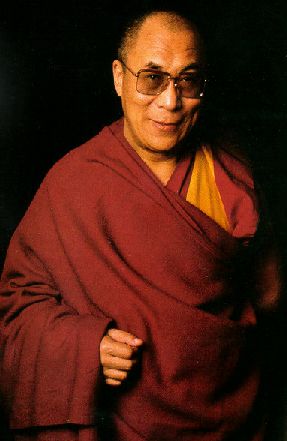
American, Indian and Tibetan Students and Teachers Meet His Holiness the Dalai Lama
Thekchen Chöling, Dharamsala, HP, India - Eighty people from three different groups met His Holiness the Dalai Lama today. They included students and faculty members from Emory University, Atlanta, Georgia, USA, as well as participants in the Emory-Tibet Partnership from the Library of Tibetan Works and Archives in Dharamsala, and students involved with the Kurukul Program of the Foundation for Universal Responsibility, New Delhi.
His Holiness welcomed them to Dharamsala, which he described as his second home for the last 59 years.
He outlined his four main commitments, explaining that the first is to promoting an understanding of the oneness that unites all 7 billion human beings alive today. He mentioned not only the interdependence of the global economy, but also how we are all affected by common concerns like climate change.
“We are emotionally, mentally and physically the same and we can help each other by sharing our experience of achieving peace of mind.”
Noting that the fundamental message of all major religious traditions includes the importance of cultivating friendship, love, tolerance and self discipline, His Holiness is committed to promoting inter-religious harmony. Consequently, he expressed regret at the level of religious conflict that can be seen today.
“Look at India,” he said, “where religious harmony has been thriving for thousands of years. In addition to indigenous traditions, there others from elsewhere. Followers of Zoroastrianism, for example, originally came from Persia and their community now numbers fewer than 100,000, mostly in Mumbai. But they live there completely without fear. That’s the Indian tradition.
“Then, as a Tibetan, someone in whom 6 million Tibetans have placed their trust, I have a moral responsibility to help them as best I can. I semi-retired from my political role in 2001 and completely retired and devolved those responsibilities to an elected leadership in 2011. Now I’m committed to working to encourage the protection of Tibet's fragile environment. This involves more than the well-being of six million Tibetans because, as a Chinese ecologist has observed, Tibet’s influence on global climate is equivalent to that of the North and South Poles. That’s why he referred to the Tibetan Plateau as the Third Pole. Almost a billion people across Asia depend on water from rivers such as the Indus, Ganges, Brahmaputra, Salween and Mekong, all of which rise in Tibet. If the snow on the mountains of Tibet disappears, millions of Indians will suffer the consequences."
His Holiness also expressed his dedication to keeping Tibet’s language and its rich cultural and religious heritage alive. He explained how the Buddhist traditions of Tibet were drawn from those upheld at the Nalanda University in India. They included a strong reliance on reasoning and investigation, which corresponds to a scientific approach.
“The world is facing a crisis of emotions. Elements of the Nalanda Tradition derived from the longstanding Indian practices for developing a calmly abiding mind and deep insight (shamatha and vipashyana) have much to tell us about tackling our negative emotions and cultivating lasting peace of mind. This is why this knowledge remains relevant today, which is why I am also committed to trying to revive an appreciation of it. I believe that here in India it is possible to integrate ancient knowledge with a modern education.”
His Holiness answered several questions from the audience related to creating a more compassion society, dealing with adversity, making positive use of technology and coming to terms with death. He also advised the Buddhists in the room to take a 21st century approach to their faith by developing a reasoned understanding of who the Buddha was and what he taught.
The meeting ended with members of the various groups gathering around His Holiness to have their photographs taken with him, after which everyone dispersed for lunch.
original link & photos: https://www.dalailama.com/news/2018/american-indian-and-tibetan-students-and-teachers-meet-his-holiness-the-dalai-lama
Showing posts with label universal responsibility. Show all posts
Monday, June 4, 2018
Dalai Lama on Religious Harmony
Labels:
14 dalai lama,
buddhists,
emory university,
friendship,
interdependence,
love,
nalanda tradition,
tibetans,
universal responsibility,
zoroastrianism
Tuesday, November 21, 2017
Dalai Lama Talks About Universal Responsibility & Compassion at Smile Foundation
Talk about Universal Responsibility and Compassion at Smile Foundation
New Delhi, India - After days of hazy mornings, today was clearer and brighter as His Holiness the Dalai Lama drove to the NCUI Auditorium in the Siri Fort area of South Delhi. He was met on arrival by his host, founder and Chairman of the Smile Foundation, Santanu Mishra. The Smile Foundation is an NGO whose aim is to empower underprivileged children, youth and women through relevant education, innovative healthcare and market-focussed livelihood programmes. It is directly benefiting 400,000 underprivileged children and families every year through 200 projects affecting 950 remote villages and slums across 25 states of India.
Once in the lobby, His Holiness was welcomed by a small group of shyly smiling eight and nine year old children. From there he was escorted onto the stage where well-known news anchor Rini Khanna introduced him to an audience of 620. She described him as a charismatic person who embodies a spirit of kindness and compassion that has a transformative effect on those he meets. She noted that he refers to himself as a simple Buddhist monk, who is most often seen smiling and laughing, and who tells us that the purpose of life is to be happy.
In a short introduction to Smile Foundation, Santanu Mishra thanked His Holiness and everyone in the audience for their presence. He expressed the hope that His Holiness’s words would be a life-long inspiration to the children listening to him. He explained that the Smile Foundation’s goal is the uplift and empowerment of underprivileged children, youth and women.
His Holiness greeted the members of the audience, young and old, as brothers and sisters, telling them how happy and honoured he was to have been invited to speak by an organization that is giving real help in the field of education, especially to the underprivileged.
“I want to share a couple of stories with you,” he told them. “Not long ago a family from Bombay came to see me seeking my blessings. I told them, I have nothing by way of blessings to give you, but it seems that you are quite well-off, so the real source of blessings is already with you. If you were to use some of your wealth to help children from the Bombay slums, by providing them with opportunities and facilities for education, that would attract real blessings to you.
“On another occasion, some students attending a prestigious institution asked what they could do to help. Again I suggested they seek out the poorer children where they live and contribute directly to their education. I encouraged them to try to help those especially who had no other help.
“Since Independence, education has expanded and improved in this country, and yet there remains a huge gap between rich and poor. And the poor get left behind. It is essential that they are able to build self-confidence.
“Once in South Africa I visited a family in Soweto. I congratulated them on South Africa’s new-found democracy and urged them to look forward to the day when black and white Africans would be equal. One of them shook his head and told me it wouldn’t happen because black brains are inferior to white ones. I was shocked and remonstrated with him that no brain expert would agree that there was any such difference between the brains of black and white people or their potential. Eventually, after much persuasion, he conceded with a sigh.
“In Tibet too, there have been Chinese hard-liners who assert that Tibetans are similarly inferior to Chinese. The reality is, however, that given the opportunity, Tibetans are quite as capable of excelling in their studies as their Chinese counterparts.”
His Holiness reiterated his view that to address the gap between rich and poor, it’s important for those with wealth to provide education facilities. But it is also important that the poor work hard and exert themselves to bolster their self-confidence. He stressed that here in India this particularly applies to those who belong to the so-called ‘lower castes’. He reminded his listeners that the 7 billion human beings alive today are physically, mentally and emotionally the same—they are equal in being human.
“The Smile Foundation is already making effective progress in providing education facilities for the underprivileged. I really appreciate your work. So I have decided to contribute to supporting it over the next five years. When I see reports of children neglected and starving in different parts of the world I feel like crying because there seems so little I can do to help. Supporting your foundation as you help children is something I can do.
“Also, I feel it’s important to do something here in India because India is important to me. Not only has it been my physical home for the last nearly 59 years, but my mind is filled with Nalanda thought. I am proud to be a student of the Nalanda Tradition that is distinguished by its reliance on reason and logic. This tradition was introduced to Tibet in the 8th century by the erudite Nalanda scholar, Shantarakshita and we have kept it alive through extensive and rigorous study.
“From this tradition I have learned a correct view of reality and how to train my mind by tackling my disturbing emotions. And in our monasteries we have trained scholars who I have urged to learn English and Hindi to be able to teach and participate in education programs.”
His Holiness remarked that generally modern education is focussed on material goals without looking within. However, he is of the opinion that India is the one place where it may be possible to augment this approach to education by combining it with ancient Indian understanding of the workings of the mind and emotions to achieve peace of mind.
“I have a vision,” he said, “but I only have one pair of hands with which to implement it. I consider organizations like yours, already working to enhance education, as like further pairs of hands to fulfil the goal. Time moves on. The past is past and we can’t change it. We can only learn from it. Nevertheless, we can change the future and I believe that if steps are taken now it will be possible eventually to make this a more compassionate, peaceful, happier century than the one that went before.”
In answering students’ questions His Holiness touched on the role of anger and attachment in our lives and how extreme emotions can become harmful. Asked if we can envisage a time when we are all equal, he answered that we will never be 100% the same because we have different DNA and different dispositions. But common sense tells us that we share common experience. We have all been born from a mother and basked in her care and affection, which plants a common seed of love and affection within us.
Invited to name his role model or someone from whom he takes inspiration His Holiness mentioned the Buddha Shakyamuni and the Indian master Nagarjuna who stressed the need to overcome the gap between appearance and reality, which becomes the ground for addressing our disturbing emotions.
“When you have peace of mind, it’s easier to cope with problems,” was His Holiness’s concluding advice. “Real change will come about not as a result of prayer, but of using intelligence and taking action.”
After the formal words of thanks, His Holiness posed for photographs with teachers and staff of the Smile Foundation and then with groups of children from seven Delhi schools in the audience.
original link with photos https://www.dalailama.com/news/2017/talk-about-universal-responsibility-and-compassion-at-smile-foundation
New Delhi, India - After days of hazy mornings, today was clearer and brighter as His Holiness the Dalai Lama drove to the NCUI Auditorium in the Siri Fort area of South Delhi. He was met on arrival by his host, founder and Chairman of the Smile Foundation, Santanu Mishra. The Smile Foundation is an NGO whose aim is to empower underprivileged children, youth and women through relevant education, innovative healthcare and market-focussed livelihood programmes. It is directly benefiting 400,000 underprivileged children and families every year through 200 projects affecting 950 remote villages and slums across 25 states of India.
Once in the lobby, His Holiness was welcomed by a small group of shyly smiling eight and nine year old children. From there he was escorted onto the stage where well-known news anchor Rini Khanna introduced him to an audience of 620. She described him as a charismatic person who embodies a spirit of kindness and compassion that has a transformative effect on those he meets. She noted that he refers to himself as a simple Buddhist monk, who is most often seen smiling and laughing, and who tells us that the purpose of life is to be happy.
In a short introduction to Smile Foundation, Santanu Mishra thanked His Holiness and everyone in the audience for their presence. He expressed the hope that His Holiness’s words would be a life-long inspiration to the children listening to him. He explained that the Smile Foundation’s goal is the uplift and empowerment of underprivileged children, youth and women.
His Holiness greeted the members of the audience, young and old, as brothers and sisters, telling them how happy and honoured he was to have been invited to speak by an organization that is giving real help in the field of education, especially to the underprivileged.
“I want to share a couple of stories with you,” he told them. “Not long ago a family from Bombay came to see me seeking my blessings. I told them, I have nothing by way of blessings to give you, but it seems that you are quite well-off, so the real source of blessings is already with you. If you were to use some of your wealth to help children from the Bombay slums, by providing them with opportunities and facilities for education, that would attract real blessings to you.
“On another occasion, some students attending a prestigious institution asked what they could do to help. Again I suggested they seek out the poorer children where they live and contribute directly to their education. I encouraged them to try to help those especially who had no other help.
“Since Independence, education has expanded and improved in this country, and yet there remains a huge gap between rich and poor. And the poor get left behind. It is essential that they are able to build self-confidence.
“Once in South Africa I visited a family in Soweto. I congratulated them on South Africa’s new-found democracy and urged them to look forward to the day when black and white Africans would be equal. One of them shook his head and told me it wouldn’t happen because black brains are inferior to white ones. I was shocked and remonstrated with him that no brain expert would agree that there was any such difference between the brains of black and white people or their potential. Eventually, after much persuasion, he conceded with a sigh.
“In Tibet too, there have been Chinese hard-liners who assert that Tibetans are similarly inferior to Chinese. The reality is, however, that given the opportunity, Tibetans are quite as capable of excelling in their studies as their Chinese counterparts.”
His Holiness reiterated his view that to address the gap between rich and poor, it’s important for those with wealth to provide education facilities. But it is also important that the poor work hard and exert themselves to bolster their self-confidence. He stressed that here in India this particularly applies to those who belong to the so-called ‘lower castes’. He reminded his listeners that the 7 billion human beings alive today are physically, mentally and emotionally the same—they are equal in being human.
“The Smile Foundation is already making effective progress in providing education facilities for the underprivileged. I really appreciate your work. So I have decided to contribute to supporting it over the next five years. When I see reports of children neglected and starving in different parts of the world I feel like crying because there seems so little I can do to help. Supporting your foundation as you help children is something I can do.
“Also, I feel it’s important to do something here in India because India is important to me. Not only has it been my physical home for the last nearly 59 years, but my mind is filled with Nalanda thought. I am proud to be a student of the Nalanda Tradition that is distinguished by its reliance on reason and logic. This tradition was introduced to Tibet in the 8th century by the erudite Nalanda scholar, Shantarakshita and we have kept it alive through extensive and rigorous study.
“From this tradition I have learned a correct view of reality and how to train my mind by tackling my disturbing emotions. And in our monasteries we have trained scholars who I have urged to learn English and Hindi to be able to teach and participate in education programs.”
His Holiness remarked that generally modern education is focussed on material goals without looking within. However, he is of the opinion that India is the one place where it may be possible to augment this approach to education by combining it with ancient Indian understanding of the workings of the mind and emotions to achieve peace of mind.
“I have a vision,” he said, “but I only have one pair of hands with which to implement it. I consider organizations like yours, already working to enhance education, as like further pairs of hands to fulfil the goal. Time moves on. The past is past and we can’t change it. We can only learn from it. Nevertheless, we can change the future and I believe that if steps are taken now it will be possible eventually to make this a more compassionate, peaceful, happier century than the one that went before.”
In answering students’ questions His Holiness touched on the role of anger and attachment in our lives and how extreme emotions can become harmful. Asked if we can envisage a time when we are all equal, he answered that we will never be 100% the same because we have different DNA and different dispositions. But common sense tells us that we share common experience. We have all been born from a mother and basked in her care and affection, which plants a common seed of love and affection within us.
Invited to name his role model or someone from whom he takes inspiration His Holiness mentioned the Buddha Shakyamuni and the Indian master Nagarjuna who stressed the need to overcome the gap between appearance and reality, which becomes the ground for addressing our disturbing emotions.
“When you have peace of mind, it’s easier to cope with problems,” was His Holiness’s concluding advice. “Real change will come about not as a result of prayer, but of using intelligence and taking action.”
After the formal words of thanks, His Holiness posed for photographs with teachers and staff of the Smile Foundation and then with groups of children from seven Delhi schools in the audience.
original link with photos https://www.dalailama.com/news/2017/talk-about-universal-responsibility-and-compassion-at-smile-foundation
Labels:
14 dalai lama,
blessings,
budhist monk,
china,
compassion,
nagarjuna,
nalanda,
ngo,
poverty,
smile foundation,
south africa,
soweto,
Tibet,
universal responsibility
Monday, October 2, 2017
Dalai Lama on Universal Responsibility in the Modern World
Universal Responsibility in the Modern World
(Transcript of His Holiness's Public Talk at Royal Albert Hall, London, United Kingdom, May 22, 2008)
Riki Hyde-Chambers (Chairman of Tibet Society): Ladies and gentlemen, it is my very great privilege to introduce you to His Holiness Tenzin Gyatso, the 14th Dalai Lama of Tibet.
Someone in audience: We love you.
His Holiness the Dalai Lama: Thank you.
Firstly, let me sit more comfortably. Don’t worry, I am not going to meditate in silence. Thank you very much. I am very very happy to be meeting with the public in this hall once more. I think it is the third time, or maybe the second. I don’t remember.
Dear brothers and sisters, I am extremely happy to sit here with you and interact. I will begin by speaking for about 30 or 40 minutes. When I talk, it is not for a precise time; it depends on my mood. If my mood is good I will speak for longer; if my mood is not that good the talk will be shorter. Whenever I give a talk I do not do any preparation or have any notes. I just express what I feel in a completely informal way. Then there will be some questions. That will be helpful to me, because sometimes there are unexpected questions, or points that I had never considered. That helps me to think about the point more seriously; so there is mutual benefit.
To begin, I want to thank the organisers, mainly I think the Tibet Society. I think that it is the oldest such society, formed when we became refugees, to support the Tibet cause. I remember the late Lord Ennals, and other very active members, who made a great contribution to the Tibetan cause. He is no longer with us, but, Riki was here on my first visit in 1973, and since then in his face there has not been much change. He is physically not very big, but he is full of energy and warm feeling. These people carry the original spirit, and make it even stronger. I want to thank the Tibet Society, and our other friends and supporters. Thank you very much. Among the parliamentarians, there are a number of people who show genuine concern. Thank you. I always believe that our supporters are not pro-Tibetan but rather pro-justice. I very much appreciate that.
I also want to thank the Tibetan musicians and dancers. I very much appreciated them. For nearly half a century they have been homeless; the generations change, but our people keep the Tibetan spirit alive. Here in England there are very few Tibetans, but they keep our spirit very much alive. Not only that, but those young children who were born here have received a transfer of the Tibetan spirit from their parents. A transfer from the older generation to the younger generation. That was our original aim. As soon as we became refugees, our main concern was to preserve the rich Tibetan Buddhist culture. In other words, a culture of peace, of compassion. Today, that is something very relevant to this world. Therefore, right from the beginning, our main effort has been to preserve the Tibetan culture. Nowadays our main discussions with the Chinese authorities are about how to protect Tibetan cultural heritage. That is our main concern. This small group here made an effort to preserve our spirit, our cultural heritage. Thank you very much.
Turning to my talk here, I think that most of you know that I have two main concerns. No. 1—now because of this light this is necessary [dons peaked cap]. This is not the red hat sect, the yellow hat sect or the blue hat sect. It is something very practical. My main interest, my main commitment on a voluntary basis, is to two things: No. 1, the promotion of human value and No. 2 the promotion of religious harmony. I am committed to those two things until my death. The third commitment is regarding Tibetan problem/struggle. It is not necessarily a voluntary commitment, because of historical facts. The most important thing is that the Tibetan people both inside and outside of Tibet trust me very much and pin a lot of hope on me, and so I have the moral responsibility to serve them as well as I can. Of course, my ability, knowledge and experience in various fields are very limited, but it is my moral responsibility to serve them in whatever way I can. But there will be a time limit. I am already in something like a semi-retired position, as we have had an elected political leadership since 2001. So, my position is something like that of senior adviser. In most cases, the political leadership listens to my view, but sometimes it doesn’t. That is good. Also, on my part, I have some reservations about some of his policy, but I always remain quiet. So, we are sincerely practising democracy.
In response to an invitation to visit, I generally talk about two things: the promotion of human value and the promotion of religious harmony. But my recent visits to America, Germany and now here, have become much more politicised because of the recent events in Tibet. Okay. So the theme of my talk here is universal responsibility in the modern world. Since my first visit to Europe in 1973, I carry this message of universal responsibility, of a sense of global responsibility. Since I went to India in 1959, I have had the opportunity to meet a variety of people—and my broken English is quite helpful for listening to the BBC World Service—and it seems to me that we are facing many, essentially man-made, problems. Of course, natural disasters are something different, but a major portion of our problems are essentially of our own creation. At the same time, nobody wants problems. There are a few thousand people in this hall, and I think that when you get up in the early, or late, morning, none of you hopes that you have more problems, more trouble that day. Nobody feels that. From early morning, as soon as I wake up, I think, hope or wish that it will be a pleasant day. A joyful day with no problems. That is human nature. Essentially, most troublemakers are not intentionally so, but their approach has become unrealistic and that causes unexpected problems. An unrealistic approach does not happen intentionally either, but comes about because of a lack of a holistic, comprehensive perspective, and in many cases short-sightedness. So, ultimately, that is a lack of a sense of global responsibility, which divides us into “us” and “them” and makes us feel that our interests are independent from others’. We consider our own interests as the most important ones and disregard others’ interests. So that creates a problem. In reality our interests and others’ interests are very much interconnected; we are part of the six billion human beings. Therefore, if six billion human beings are happy, one individual is bound to be happy. If six billion get trouble, you cannot escape. That is the reality. According to that reality, our centuries-old concept that “us” and “them” are independent is, I think, outdated. Now, particularly in these modern times, with the economic conditions, the environmental issues and the sheer size of the population, everything is interdependent. So, in those circumstances, a Buddhist concept is that you should consider all sentient beings as the mother sentient being, to whom you should develop the same sense of closeness as to your own mother. So, according to theological religion, all creation is created by God. So, we human beings, other sentient beings and the whole world were created by God. A Muslim friend told me that a true Muslim should love the whole of creation as much as they love God. So different words, a different approach, but the same meaning. Therefore, there is the idea that there is a sense of global responsibility, that we should develop a sense of concern for the whole of humanity, the whole world. That eventually develops. For more than 30 years that has been my concept, and it is still relevant. More and more people seem to agree with it.
So, how do you develop a sense of global responsibility? It is very much related to commitment to the promotion of religious harmony and human value. Firstly, I will touch on the promotion of human value.
What is human value? Money? Oh, yes. That is very important. In Tibetan we say Kunga Dhondup. That is a nickname for money, which literally means, “That which makes everybody happy and can accomplish everything”. That is true, without money you cannot do things. Money is important. Sometimes I make a joke to Buddhist audiences, particularly Tibetan: we usually recite a special sort of Tibetan mantra, “Om Mani Padme Hum”. Some of you know that, I think. We recite that, sometimes hurriedly, so it becomes: “Om Mani Padme Hum, Om Mani Padma Hum, Om Mani Padma Hum”, then it become “OmMani, OmMani, Mani, Mani, Mani” [spoken more and more quickly]. It sounds very much like, “money money money money”. Maybe, “dollar money dollar money”, or “pound money pound money”. So, money has value, and all these external facilities are valuable. Good. But they all provide physical not mental comfort. If you have plenty of money, you have some sort of satisfaction in your mental life: “Ah, I have a lot of money.” That is an illusion, because we notice that a billionaire has plenty of money but is a very unhappy person. We notice that. They have a lot of worry, anxiety, suspicion and jealousy. Money fails to bring them inner peace. More money brings more suspicion, discomfort and worry. To truly believe that if you have money everything can be sorted out, that you will get 100 per cent satisfaction, is an illusion. But, of course, you must be the judge of that, because I never say that the points that I make are 100 per cent correct. Please investigate for yourselves. I myself am trained in such a way that I am always investigating.
The Tibetan Buddhist tradition is actually the Nalanda tradition. Nalanda is, I think we can say, the oldest university, because it is more than 2,000 years old. It is not just a monastery, but a learning centre. The Tibetan Buddhist tradition was established by a great Indian philosopher, a logician, from that university. His name was Shantarakshita. In the 8th century he was invited to Tibet by the Tibetan emperor. He was aged 900, according to the Tibetan age system; according to an Indian friend he was around 75 years old. That friend teases that Tibetans add an extra zero, so that 90 became 900. Shantarakshita—his name sounds good, in Tibetan Shiwa Tso—was the person who established Buddhism in Tibet, with the help of the Tibetan emperor. Since he was a great scholar and logician, he was never satisfied. He said, “always investigate, always argue, always reason.” So that was his style. He introduced the Buddhist tradition in that way. Up to now, the major Tibetan Buddhist institution has always carried study in such a manner: investigation, investigation. I myself am also trained in investigation and experiment, and so I want to share with you, even regarding my own talks: “Please carry on investigating.” Do not just accept my word.
Real inner peace and inner satisfaction ultimately depends on our mental attitude. What kind of mental attitude? Firstly, we are social animals, so there must be an emotional factor that brings us together as a social group. There is also a biological factor. We are born from our mother’s womb, and at that moment are just like animals, tiny infants. Our survival totally depends on someone else’s care, usually our mother’s. If your mother abandons you for just one, two or three days, I think that you will die. Our survival totally depends on others’ care. Furthermore, the physical body survives with the nutrition of the mother’s milk. The survival of the youngsters of not only human beings, but of cats, dogs and even birds, entirely depends on others’ care. That is a fact. So, there must be an emotional factor that has developed that kind of determination on the part of the mother: the mother’s affection. That affection brings with it the determination of a mother to sacrifice her own comfort, or even her life, in order to protect and care.
Recently I was on an overnight flight, from I think Japan to America or from America to Europe. In the front seat there was a couple with two children. One was perhaps six or seven years old, and the other one year old. The younger one did not sleep the whole night; he was walking here and there and shouting. On one occasion, I offered him a sweet from my pocket. He took it and then carried on walking. At the beginning, the father was taking so much care of him, but after around midnight he suddenly lay down on the chair. Then the mother took care of the child through the whole night. The mother’s eyes became red due, I think, to lack of sleep. So that reaffirmed for me, that the mother is so, so kind. That kind of attitude does not come from religious teaching, but from nature. It is mainly a biological factor. That affection is ultimately the basis of our life.
There has been some scientific research. On one occasion, a scientist made a presentation about young monkeys, some of whom were with their mothers and some of whom were separated from their mothers. The monkeys who were with their mothers were always playful and very rarely fought. The monkeys who were separated from their mothers were always in a bad mood and often quarreled. We are the same. Therefore, a happy, peaceful life is ultimately very much related to affection. On another occasion, a medical scientist at a conference talked about how guinea pigs, or mice, licking each other had a very positive effect on the healing of wounds. That also indicates that affection has an effect on our physical selves and on our mental comfort. Therefore, we can say that human affection is the basic human value. From the time of birth until death, affection, or human compassion, plays a very important role.
Now immense crises have developed, compassion really makes a difference. My own case is the recent developments, since 10 March. On the afternoon of 10 March I received news from Lhasa that some Tibetans were now demonstrating. As soon as I heard that, I had the same experience as on 10 March 1959: a lot of anxiety and also fear. At the intelligence level, there was a lot of anxiety, fear, doubt and uncertainty. But underneath, on a more emotional level, it seemed quite okay. Usually I sleep for at least eight or nine hours. What do you think, is that too much? Fortunately, in spite of a lot of disturbances at the intelligence level, my sleep is never disturbed. So, underneath, there seems to be some calmness. The main factor is my training, and daily meditation. One particular sort of meditation is “take and give”, give and take”—the Tibetan word is Tonglen. I usually meditate on that, on altruism. Of course, my day starts at 3.30am every morning, when I do at least four hours’ meditation, mainly analytical meditation. One part of my meditation is to visualise those individuals who take decisions, and develop altruism. It is very important to make a distinction between the action and the person. As far as action is concerned, we have to oppose, to make a response. But the person who carried out the wrongdoing really deserves our compassion, our concern. It was their wrongdoing, so from the Buddhist viewpoint, from the non-theistic religious viewpoint according to the law of causality, they have to face the consequences. So there is more reason to feel concern about that troublemaker than about their victims. Visualise those things and then take their anger, hatred and suspicion and give them compassion, a spirit of forgiveness and patience. That kind of meditation practice looks silly because it is just imagination. Yes, it has no actual effect. But the practitioner’s emotional level gets immense benefit from it. That is my experience, but it is nothing special.
In the past I have also told the story of a Tibetan monk I knew well before 1959, who spent 18 years in a Chinese gulag. In the early 80s, the Chinese Government adopted a new policy allowing Tibetans to go to India, and allowing Tibetans outside of Tibet to go “home”, to their villages. So this monk then joined Dharamsala. So since we knew each other very well, one day we chatted. He told me that during 18 years in the Chinese gulag he had faced danger on a few occasions. I thought that maybe he meant that his life had been in danger. I asked him, “What kind of danger?” His answer was, “Danger of losing compassion towards the Chinese.” That is the kind of attitude I am talking about. A practitioner has a certain kind of inner peace through that practice, and this is an example.
In order to keep inner peace, compassion really makes a difference. That is very important. When I talk about compassion, I think it is worthwhile to be more precise. One kind of compassion is essentially low level and has a biological factor, it is low-level compassion mixed with attachment. That limited compassion, as a seed, can be strengthened with the help of reasoning and become a higher level of unlimited, unbiased compassion. We need that. To give an example, as I mentioned before, for my own happy and successful future as a social animal, as one of the six billion human beings, I have to take care of the other human beings, because my future depends on them, doesn’t it? If I create more enemies I will suffer. If I create more friends I will benefit. How do we create friends? Only through money? No. Money can bring friends, but they are essentially friends of money, not of you yourself. When your fortune grows and you become richer, richer, richer, you will find more friends. When your fortune goes, those friends will also disappear. Even if you phone them they may not answer. Those friends are not genuinely your friends, but friends of your money. Therefore, real friends come only out of a sense of concern or respect. Respect them. Develop a genuine sense of concern, of compassion, as even animals do. My main point is that a seed of happiness, of inner calmness, of inner strength, creates more inner strength, more self-confidence and less fear. That automatically causes some kind of close feeling towards other human beings to develop. A compassionate attitude opens our inner door, and as a result it is much easier to communicate with others. If there is too much self-centred attitude, then fear, doubt and suspicion come and as a result our inner door closes. Then it is very difficult to communicate with others.
There was a doctor at a conference in America who presented the data from an experiment he had done. He said that individuals who often use the words, “me’, “my” and “I”, are at a greater risk of a heart attack. Why was that? He didn’t explain. But I thought, “Ah, that could be true”, because a self-centred person is someone who cherishes him or herself, and only him or herself, and that feeling is reflected in their use of the word, “I”. There is nothing wrong with that word, but the attitude behind it is thinking of just oneself. If you think only of yourself, even a tiny problem appears unbearable. If you think more about others’ wellbeing—“others” is infinite—your mind opens wider and your own problem appears insignificant. The same problem, the same tragedy can appear very different. From one angle, you can see something as very bad; from another angle you can see it and say, “Oh, that’s okay.” That often happens, and therefore a compassionate attitude really widens your mind. One small problem is not very serious. That makes a difference to our inner peace. That is the way to promote human value, which is the basis of our inner peace. That is a very important factor for a happy life, including a healthy body.
A scientist told me that anger, hatred and fear are actually eating our immune system. Compassion strengthens our immune system. Therefore, from the point of view of physical health, and mental health—because of peace of mind—warm-heartedness is a key factor. That, as I mentioned earlier, does not necessarily come from religious faith, but from nature. Therefore I usually call it “secular ethics”. That is very very important for peace. Genuine, lasting world peace must be through inner peace. I sometimes call that “inner disarmament”. Through anger and hatred, genuine peace is very difficult. Even at the family level, if you are full of hatred and suspicion, how can you develop genuine peace in that family? Compassion brings real peace.
At the global level, we need external disarmament for genuine world peace. If there is first inner disarmament, there is a real possibility to achieve external disarmament, step by step. I usually talk about “my century”—the older generation, of more or less my age, 60 or 70, belongs to the 20th century. Our century, whether we like it or not, has become the century of bloodshed, war and violence. Our generation will now let the younger generation solve the problems that it started. Our younger generation, which belongs to this century, the 21st century, will hopefully have a peaceful century. Peace does not mean no more conflict among humanity. Conflict is bound to happen, so in order to keep peace in spite of conflict, the only realistic method is the spirit of dialogue, respecting the other side and understanding their viewpoint. We need to try to solve problems in a spirit of brotherhood and sisterhood, in a spirit of reconciliation and compromise. I often share this with people: let us now try to make this century a century of dialogue. Then there will be a real possibility of peace.
So, that was about the promotion of human value. Now I will talk about the promotion of religious harmony. If you have a sense of global responsibility, all human beings, including non-believers and even those who criticise religion, who are anti-religion, are your brothers and sisters. Once we develop that, there is no problem with people having different religious faith. That is their right. If you look closely, all major religious traditions, as I mentioned briefly before, carry the same message of love, compassion and forgiveness. A different approach is necessary because of different locations, different times and different climates. People’s mentality is a little different. Therefore a different approach is necessary to promote these human values. All major religious traditions carry the message of love, and a sense of brotherhood and sisterhood. So, it is a matter of a different approach. Some say that there is God, that God made all these things and that we are therefore brothers and sisters in a true sense. Some say it is the law of causality. Again, good experience comes from love and respect for others. Bad experience comes from harming others. That brings negative consequences. It is the same end but with a different approach. Therefore, if you understanding these things, you will see that there is no obstacle to bringing genuine harmony among religious traditions. It may be useful here to make a distinction between faith and respect. Faith is towards one’s own religion, respect is to all religions. That is one thing. Another thing is the concept of one religion, one truth and the concept of several truths, several religions. Those two things appear contradictory, but that is due to the different context. On an individual basis, the concept of one truth, one religion is very relevant in developing a single-pointed faith, but in terms of a group of people, the concept of several truths, several religions is relevant. That is a fact. That is reality. Therefore there is no contradiction between the concept of one truth, one religion and the concept of several truths, several religions. That is my way of promoting religious harmony. Full stop. Now the Questions and Answers.
Norman Baker MP: Your Holiness, thank you very much for a wonderfully warm and compassionate speech. You had the audience rapt, listening to every word here at the Royal Albert Hall. We are all delighted that you are in London, and to hear your address this afternoon. You are a beacon of hope and inspiration, not just to Tibetans but to many millions around the world. Thank you.
Ladies and gentlemen, I am Norman Baker MP, president of the Tibet Society. It is my tremendous privilege to conduct this question and answer session, which I am afraid necessarily will be a little truncated, because His Holiness has a very important engagement shortly after this engagement here. So straight on to the questions, if I may.
The first question is: “What are your opinions on the earthquake crisis in China?”
His Holiness the Dalai Lama: I was very sad and very shocked, particularly when I saw the picture of the young student who perished under the rubble of the collapsed school. I immediately felt, “Oh, due to the one-child policy, many of the parents of these students have only one child.” One mother, one child. How much pain do those mothers, those parents feel? Their only child. That is very sad. But one really encouraging thing was the worldwide response, similar to when the tsunami happened. With the Burmese case also, although the military junta’s handling of the situation is very poor, I think that the response has been wonderful. The Chinese case is also very encouraging, including the response from those Tibetans who have recently suffered very much. For example, the monks in the Drepung monastery near Lhasa have suffered a lot recently. A lot of monks were arrested or missing, but, after the earthquake, monks from that monastery also raised funds for the victims. Another encouraging sign is the transparent way the Chinese Government has handled that problem. That is very, very encouraging. So, hopefully now there will be more transparency over a wider field.
Norman Baker: Thank you. The second question is rather different: “What makes you laugh?”
His Holiness the Dalai Lama: In one word, Love; in another, I immediately laugh at others’ little mistakes. Once in London, we visited a place, I can’t remember where, where a young Tibetan was performing a dance or something like that. The child was wearing very big shoes, and as soon as I saw those big shoes I laughed and laughed. Sometimes people are too serious. Once in Mexico City at an interfaith service, there were a few representatives of different traditions, including a representative of Japanese Buddhism. As usual, he was quite stern—or very dignified—and as usual he did the rosary like this. Then somehow the string broke, and the beads scattered all over. But he still remained like that. I laughed a lot at that.
Norman Baker: The third question is: “What can we in the United Kingdom do to help in the struggle to keep Tibet and its wonderful traditions alive?”
His Holiness the Dalai Lama: Thank you for your concern. Our main aim, as everybody knows, is not to seek separation, because our interests remain within the Peoples’ Republic of China. We get much benefit from that, as far as material development is concerned, provided that we have meaningful autonomy, with the safeguard of preserving our culture. There is no time to explain in detail now, but recently the Chinese Government seems to be paying more attention to the Tibetan problem. Also, I think that the clear worldwide signal of concern definitely impacts on the leaders of the Chinese Government. So, please continue to express your solidarity and concern. It is really helpful. I particularly appreciate the sincere concern of the parliamentarians and their desire to help. That is really very helpful. Please continue. And then, wherever you find an opportunity to talk with Chinese brothers and sisters, then talk. Educate them, because some of the Chinese do not have the full information about the reality. Sometimes there is a feeling that there we Tibetans are anti-Chinese, but they are absolutely not. So it is important to educate them.
Norman Baker: Sadly, I have been told that I am only allowed one more question. I am very sorry about that. “Would you like to be reborn in London?”
His Holiness the Dalai Lama: What do you mean by “reborn”?
Norman Baker: Reincarnated.
His Holiness the Dalai Lama: Yes, that’s possible. Since my childhood, we have described Englishmen as “big noses”. So my next reincarnation could be as a big nose! That is theoretically speaking. It is important that there is some usefulness. As I always pray, as long as sentient beings’ pain and suffering remains, I will remain in order to serve them. That is my favourite sort of prayer. I try to develop that kind of determination. So naturally, my next life will be wherever it would have some usefulness. That is for sure. So, if there is more usefulness here, then naturally I will be reborn here.
Norman Baker: We would love to have you here if you do that. Ladies and gentlemen, I was asked by the BBC this week, “Why Tibet?” It is not simply the wonderful culture and history of the country, nor the terrible human rights abuses that have occurred, nor the inspirational leadership of His Holiness. It is also because the Tibetan cause is our cause, a struggle for every person’s right to be free, to say what they want to say, without being subject to arrest, imprisonment or torture. It is a right to be able to demonstrate peacefully for causes in which they believe. It is the ability to follow one’s religion and culture, without being intimidated by the state or by others. Those are not simply Tibetan causes; they belong to us all. In your programme, you will have seen some of the action points that some of us are pursuing in parliament, and which the Tibet Society is pursuing as well. Please take a moment to look at those, and see if you can help in some way. If you are not a member of the Tibet Society, please do join us and help us in our campaign for justice so that we can await the day, not too far away I hope, when Tibet will once again be free, and we can meet in Lhasa.
Lastly, I want to tell you of an initiative, which I hope, Your Holiness, you will agree with. It is called is “Give Peace a Hand”. In a moment you will, I very much hope, shake my hand, and there are two Tibetan children outside who I will pass that handshake on to. There are also 2,000 people between here and the Chinese Embassy, and that handshake of peace will go from here to the Chinese Embassy. I hope very much that that will be a message of peace and reconciliation, and a constructive end to this very useful and wonderful occasion this afternoon. Thank you very much for coming.
original link: https://www.dalailama.com/messages/transcripts-and-interviews/universal-responsibility-modern-world
(Transcript of His Holiness's Public Talk at Royal Albert Hall, London, United Kingdom, May 22, 2008)
Riki Hyde-Chambers (Chairman of Tibet Society): Ladies and gentlemen, it is my very great privilege to introduce you to His Holiness Tenzin Gyatso, the 14th Dalai Lama of Tibet.
Someone in audience: We love you.
His Holiness the Dalai Lama: Thank you.
Firstly, let me sit more comfortably. Don’t worry, I am not going to meditate in silence. Thank you very much. I am very very happy to be meeting with the public in this hall once more. I think it is the third time, or maybe the second. I don’t remember.
Dear brothers and sisters, I am extremely happy to sit here with you and interact. I will begin by speaking for about 30 or 40 minutes. When I talk, it is not for a precise time; it depends on my mood. If my mood is good I will speak for longer; if my mood is not that good the talk will be shorter. Whenever I give a talk I do not do any preparation or have any notes. I just express what I feel in a completely informal way. Then there will be some questions. That will be helpful to me, because sometimes there are unexpected questions, or points that I had never considered. That helps me to think about the point more seriously; so there is mutual benefit.
To begin, I want to thank the organisers, mainly I think the Tibet Society. I think that it is the oldest such society, formed when we became refugees, to support the Tibet cause. I remember the late Lord Ennals, and other very active members, who made a great contribution to the Tibetan cause. He is no longer with us, but, Riki was here on my first visit in 1973, and since then in his face there has not been much change. He is physically not very big, but he is full of energy and warm feeling. These people carry the original spirit, and make it even stronger. I want to thank the Tibet Society, and our other friends and supporters. Thank you very much. Among the parliamentarians, there are a number of people who show genuine concern. Thank you. I always believe that our supporters are not pro-Tibetan but rather pro-justice. I very much appreciate that.
I also want to thank the Tibetan musicians and dancers. I very much appreciated them. For nearly half a century they have been homeless; the generations change, but our people keep the Tibetan spirit alive. Here in England there are very few Tibetans, but they keep our spirit very much alive. Not only that, but those young children who were born here have received a transfer of the Tibetan spirit from their parents. A transfer from the older generation to the younger generation. That was our original aim. As soon as we became refugees, our main concern was to preserve the rich Tibetan Buddhist culture. In other words, a culture of peace, of compassion. Today, that is something very relevant to this world. Therefore, right from the beginning, our main effort has been to preserve the Tibetan culture. Nowadays our main discussions with the Chinese authorities are about how to protect Tibetan cultural heritage. That is our main concern. This small group here made an effort to preserve our spirit, our cultural heritage. Thank you very much.
Turning to my talk here, I think that most of you know that I have two main concerns. No. 1—now because of this light this is necessary [dons peaked cap]. This is not the red hat sect, the yellow hat sect or the blue hat sect. It is something very practical. My main interest, my main commitment on a voluntary basis, is to two things: No. 1, the promotion of human value and No. 2 the promotion of religious harmony. I am committed to those two things until my death. The third commitment is regarding Tibetan problem/struggle. It is not necessarily a voluntary commitment, because of historical facts. The most important thing is that the Tibetan people both inside and outside of Tibet trust me very much and pin a lot of hope on me, and so I have the moral responsibility to serve them as well as I can. Of course, my ability, knowledge and experience in various fields are very limited, but it is my moral responsibility to serve them in whatever way I can. But there will be a time limit. I am already in something like a semi-retired position, as we have had an elected political leadership since 2001. So, my position is something like that of senior adviser. In most cases, the political leadership listens to my view, but sometimes it doesn’t. That is good. Also, on my part, I have some reservations about some of his policy, but I always remain quiet. So, we are sincerely practising democracy.
In response to an invitation to visit, I generally talk about two things: the promotion of human value and the promotion of religious harmony. But my recent visits to America, Germany and now here, have become much more politicised because of the recent events in Tibet. Okay. So the theme of my talk here is universal responsibility in the modern world. Since my first visit to Europe in 1973, I carry this message of universal responsibility, of a sense of global responsibility. Since I went to India in 1959, I have had the opportunity to meet a variety of people—and my broken English is quite helpful for listening to the BBC World Service—and it seems to me that we are facing many, essentially man-made, problems. Of course, natural disasters are something different, but a major portion of our problems are essentially of our own creation. At the same time, nobody wants problems. There are a few thousand people in this hall, and I think that when you get up in the early, or late, morning, none of you hopes that you have more problems, more trouble that day. Nobody feels that. From early morning, as soon as I wake up, I think, hope or wish that it will be a pleasant day. A joyful day with no problems. That is human nature. Essentially, most troublemakers are not intentionally so, but their approach has become unrealistic and that causes unexpected problems. An unrealistic approach does not happen intentionally either, but comes about because of a lack of a holistic, comprehensive perspective, and in many cases short-sightedness. So, ultimately, that is a lack of a sense of global responsibility, which divides us into “us” and “them” and makes us feel that our interests are independent from others’. We consider our own interests as the most important ones and disregard others’ interests. So that creates a problem. In reality our interests and others’ interests are very much interconnected; we are part of the six billion human beings. Therefore, if six billion human beings are happy, one individual is bound to be happy. If six billion get trouble, you cannot escape. That is the reality. According to that reality, our centuries-old concept that “us” and “them” are independent is, I think, outdated. Now, particularly in these modern times, with the economic conditions, the environmental issues and the sheer size of the population, everything is interdependent. So, in those circumstances, a Buddhist concept is that you should consider all sentient beings as the mother sentient being, to whom you should develop the same sense of closeness as to your own mother. So, according to theological religion, all creation is created by God. So, we human beings, other sentient beings and the whole world were created by God. A Muslim friend told me that a true Muslim should love the whole of creation as much as they love God. So different words, a different approach, but the same meaning. Therefore, there is the idea that there is a sense of global responsibility, that we should develop a sense of concern for the whole of humanity, the whole world. That eventually develops. For more than 30 years that has been my concept, and it is still relevant. More and more people seem to agree with it.
So, how do you develop a sense of global responsibility? It is very much related to commitment to the promotion of religious harmony and human value. Firstly, I will touch on the promotion of human value.
What is human value? Money? Oh, yes. That is very important. In Tibetan we say Kunga Dhondup. That is a nickname for money, which literally means, “That which makes everybody happy and can accomplish everything”. That is true, without money you cannot do things. Money is important. Sometimes I make a joke to Buddhist audiences, particularly Tibetan: we usually recite a special sort of Tibetan mantra, “Om Mani Padme Hum”. Some of you know that, I think. We recite that, sometimes hurriedly, so it becomes: “Om Mani Padme Hum, Om Mani Padma Hum, Om Mani Padma Hum”, then it become “OmMani, OmMani, Mani, Mani, Mani” [spoken more and more quickly]. It sounds very much like, “money money money money”. Maybe, “dollar money dollar money”, or “pound money pound money”. So, money has value, and all these external facilities are valuable. Good. But they all provide physical not mental comfort. If you have plenty of money, you have some sort of satisfaction in your mental life: “Ah, I have a lot of money.” That is an illusion, because we notice that a billionaire has plenty of money but is a very unhappy person. We notice that. They have a lot of worry, anxiety, suspicion and jealousy. Money fails to bring them inner peace. More money brings more suspicion, discomfort and worry. To truly believe that if you have money everything can be sorted out, that you will get 100 per cent satisfaction, is an illusion. But, of course, you must be the judge of that, because I never say that the points that I make are 100 per cent correct. Please investigate for yourselves. I myself am trained in such a way that I am always investigating.
The Tibetan Buddhist tradition is actually the Nalanda tradition. Nalanda is, I think we can say, the oldest university, because it is more than 2,000 years old. It is not just a monastery, but a learning centre. The Tibetan Buddhist tradition was established by a great Indian philosopher, a logician, from that university. His name was Shantarakshita. In the 8th century he was invited to Tibet by the Tibetan emperor. He was aged 900, according to the Tibetan age system; according to an Indian friend he was around 75 years old. That friend teases that Tibetans add an extra zero, so that 90 became 900. Shantarakshita—his name sounds good, in Tibetan Shiwa Tso—was the person who established Buddhism in Tibet, with the help of the Tibetan emperor. Since he was a great scholar and logician, he was never satisfied. He said, “always investigate, always argue, always reason.” So that was his style. He introduced the Buddhist tradition in that way. Up to now, the major Tibetan Buddhist institution has always carried study in such a manner: investigation, investigation. I myself am also trained in investigation and experiment, and so I want to share with you, even regarding my own talks: “Please carry on investigating.” Do not just accept my word.
Real inner peace and inner satisfaction ultimately depends on our mental attitude. What kind of mental attitude? Firstly, we are social animals, so there must be an emotional factor that brings us together as a social group. There is also a biological factor. We are born from our mother’s womb, and at that moment are just like animals, tiny infants. Our survival totally depends on someone else’s care, usually our mother’s. If your mother abandons you for just one, two or three days, I think that you will die. Our survival totally depends on others’ care. Furthermore, the physical body survives with the nutrition of the mother’s milk. The survival of the youngsters of not only human beings, but of cats, dogs and even birds, entirely depends on others’ care. That is a fact. So, there must be an emotional factor that has developed that kind of determination on the part of the mother: the mother’s affection. That affection brings with it the determination of a mother to sacrifice her own comfort, or even her life, in order to protect and care.
Recently I was on an overnight flight, from I think Japan to America or from America to Europe. In the front seat there was a couple with two children. One was perhaps six or seven years old, and the other one year old. The younger one did not sleep the whole night; he was walking here and there and shouting. On one occasion, I offered him a sweet from my pocket. He took it and then carried on walking. At the beginning, the father was taking so much care of him, but after around midnight he suddenly lay down on the chair. Then the mother took care of the child through the whole night. The mother’s eyes became red due, I think, to lack of sleep. So that reaffirmed for me, that the mother is so, so kind. That kind of attitude does not come from religious teaching, but from nature. It is mainly a biological factor. That affection is ultimately the basis of our life.
There has been some scientific research. On one occasion, a scientist made a presentation about young monkeys, some of whom were with their mothers and some of whom were separated from their mothers. The monkeys who were with their mothers were always playful and very rarely fought. The monkeys who were separated from their mothers were always in a bad mood and often quarreled. We are the same. Therefore, a happy, peaceful life is ultimately very much related to affection. On another occasion, a medical scientist at a conference talked about how guinea pigs, or mice, licking each other had a very positive effect on the healing of wounds. That also indicates that affection has an effect on our physical selves and on our mental comfort. Therefore, we can say that human affection is the basic human value. From the time of birth until death, affection, or human compassion, plays a very important role.
Now immense crises have developed, compassion really makes a difference. My own case is the recent developments, since 10 March. On the afternoon of 10 March I received news from Lhasa that some Tibetans were now demonstrating. As soon as I heard that, I had the same experience as on 10 March 1959: a lot of anxiety and also fear. At the intelligence level, there was a lot of anxiety, fear, doubt and uncertainty. But underneath, on a more emotional level, it seemed quite okay. Usually I sleep for at least eight or nine hours. What do you think, is that too much? Fortunately, in spite of a lot of disturbances at the intelligence level, my sleep is never disturbed. So, underneath, there seems to be some calmness. The main factor is my training, and daily meditation. One particular sort of meditation is “take and give”, give and take”—the Tibetan word is Tonglen. I usually meditate on that, on altruism. Of course, my day starts at 3.30am every morning, when I do at least four hours’ meditation, mainly analytical meditation. One part of my meditation is to visualise those individuals who take decisions, and develop altruism. It is very important to make a distinction between the action and the person. As far as action is concerned, we have to oppose, to make a response. But the person who carried out the wrongdoing really deserves our compassion, our concern. It was their wrongdoing, so from the Buddhist viewpoint, from the non-theistic religious viewpoint according to the law of causality, they have to face the consequences. So there is more reason to feel concern about that troublemaker than about their victims. Visualise those things and then take their anger, hatred and suspicion and give them compassion, a spirit of forgiveness and patience. That kind of meditation practice looks silly because it is just imagination. Yes, it has no actual effect. But the practitioner’s emotional level gets immense benefit from it. That is my experience, but it is nothing special.
In the past I have also told the story of a Tibetan monk I knew well before 1959, who spent 18 years in a Chinese gulag. In the early 80s, the Chinese Government adopted a new policy allowing Tibetans to go to India, and allowing Tibetans outside of Tibet to go “home”, to their villages. So this monk then joined Dharamsala. So since we knew each other very well, one day we chatted. He told me that during 18 years in the Chinese gulag he had faced danger on a few occasions. I thought that maybe he meant that his life had been in danger. I asked him, “What kind of danger?” His answer was, “Danger of losing compassion towards the Chinese.” That is the kind of attitude I am talking about. A practitioner has a certain kind of inner peace through that practice, and this is an example.
In order to keep inner peace, compassion really makes a difference. That is very important. When I talk about compassion, I think it is worthwhile to be more precise. One kind of compassion is essentially low level and has a biological factor, it is low-level compassion mixed with attachment. That limited compassion, as a seed, can be strengthened with the help of reasoning and become a higher level of unlimited, unbiased compassion. We need that. To give an example, as I mentioned before, for my own happy and successful future as a social animal, as one of the six billion human beings, I have to take care of the other human beings, because my future depends on them, doesn’t it? If I create more enemies I will suffer. If I create more friends I will benefit. How do we create friends? Only through money? No. Money can bring friends, but they are essentially friends of money, not of you yourself. When your fortune grows and you become richer, richer, richer, you will find more friends. When your fortune goes, those friends will also disappear. Even if you phone them they may not answer. Those friends are not genuinely your friends, but friends of your money. Therefore, real friends come only out of a sense of concern or respect. Respect them. Develop a genuine sense of concern, of compassion, as even animals do. My main point is that a seed of happiness, of inner calmness, of inner strength, creates more inner strength, more self-confidence and less fear. That automatically causes some kind of close feeling towards other human beings to develop. A compassionate attitude opens our inner door, and as a result it is much easier to communicate with others. If there is too much self-centred attitude, then fear, doubt and suspicion come and as a result our inner door closes. Then it is very difficult to communicate with others.
There was a doctor at a conference in America who presented the data from an experiment he had done. He said that individuals who often use the words, “me’, “my” and “I”, are at a greater risk of a heart attack. Why was that? He didn’t explain. But I thought, “Ah, that could be true”, because a self-centred person is someone who cherishes him or herself, and only him or herself, and that feeling is reflected in their use of the word, “I”. There is nothing wrong with that word, but the attitude behind it is thinking of just oneself. If you think only of yourself, even a tiny problem appears unbearable. If you think more about others’ wellbeing—“others” is infinite—your mind opens wider and your own problem appears insignificant. The same problem, the same tragedy can appear very different. From one angle, you can see something as very bad; from another angle you can see it and say, “Oh, that’s okay.” That often happens, and therefore a compassionate attitude really widens your mind. One small problem is not very serious. That makes a difference to our inner peace. That is the way to promote human value, which is the basis of our inner peace. That is a very important factor for a happy life, including a healthy body.
A scientist told me that anger, hatred and fear are actually eating our immune system. Compassion strengthens our immune system. Therefore, from the point of view of physical health, and mental health—because of peace of mind—warm-heartedness is a key factor. That, as I mentioned earlier, does not necessarily come from religious faith, but from nature. Therefore I usually call it “secular ethics”. That is very very important for peace. Genuine, lasting world peace must be through inner peace. I sometimes call that “inner disarmament”. Through anger and hatred, genuine peace is very difficult. Even at the family level, if you are full of hatred and suspicion, how can you develop genuine peace in that family? Compassion brings real peace.
At the global level, we need external disarmament for genuine world peace. If there is first inner disarmament, there is a real possibility to achieve external disarmament, step by step. I usually talk about “my century”—the older generation, of more or less my age, 60 or 70, belongs to the 20th century. Our century, whether we like it or not, has become the century of bloodshed, war and violence. Our generation will now let the younger generation solve the problems that it started. Our younger generation, which belongs to this century, the 21st century, will hopefully have a peaceful century. Peace does not mean no more conflict among humanity. Conflict is bound to happen, so in order to keep peace in spite of conflict, the only realistic method is the spirit of dialogue, respecting the other side and understanding their viewpoint. We need to try to solve problems in a spirit of brotherhood and sisterhood, in a spirit of reconciliation and compromise. I often share this with people: let us now try to make this century a century of dialogue. Then there will be a real possibility of peace.
So, that was about the promotion of human value. Now I will talk about the promotion of religious harmony. If you have a sense of global responsibility, all human beings, including non-believers and even those who criticise religion, who are anti-religion, are your brothers and sisters. Once we develop that, there is no problem with people having different religious faith. That is their right. If you look closely, all major religious traditions, as I mentioned briefly before, carry the same message of love, compassion and forgiveness. A different approach is necessary because of different locations, different times and different climates. People’s mentality is a little different. Therefore a different approach is necessary to promote these human values. All major religious traditions carry the message of love, and a sense of brotherhood and sisterhood. So, it is a matter of a different approach. Some say that there is God, that God made all these things and that we are therefore brothers and sisters in a true sense. Some say it is the law of causality. Again, good experience comes from love and respect for others. Bad experience comes from harming others. That brings negative consequences. It is the same end but with a different approach. Therefore, if you understanding these things, you will see that there is no obstacle to bringing genuine harmony among religious traditions. It may be useful here to make a distinction between faith and respect. Faith is towards one’s own religion, respect is to all religions. That is one thing. Another thing is the concept of one religion, one truth and the concept of several truths, several religions. Those two things appear contradictory, but that is due to the different context. On an individual basis, the concept of one truth, one religion is very relevant in developing a single-pointed faith, but in terms of a group of people, the concept of several truths, several religions is relevant. That is a fact. That is reality. Therefore there is no contradiction between the concept of one truth, one religion and the concept of several truths, several religions. That is my way of promoting religious harmony. Full stop. Now the Questions and Answers.
Norman Baker MP: Your Holiness, thank you very much for a wonderfully warm and compassionate speech. You had the audience rapt, listening to every word here at the Royal Albert Hall. We are all delighted that you are in London, and to hear your address this afternoon. You are a beacon of hope and inspiration, not just to Tibetans but to many millions around the world. Thank you.
Ladies and gentlemen, I am Norman Baker MP, president of the Tibet Society. It is my tremendous privilege to conduct this question and answer session, which I am afraid necessarily will be a little truncated, because His Holiness has a very important engagement shortly after this engagement here. So straight on to the questions, if I may.
The first question is: “What are your opinions on the earthquake crisis in China?”
His Holiness the Dalai Lama: I was very sad and very shocked, particularly when I saw the picture of the young student who perished under the rubble of the collapsed school. I immediately felt, “Oh, due to the one-child policy, many of the parents of these students have only one child.” One mother, one child. How much pain do those mothers, those parents feel? Their only child. That is very sad. But one really encouraging thing was the worldwide response, similar to when the tsunami happened. With the Burmese case also, although the military junta’s handling of the situation is very poor, I think that the response has been wonderful. The Chinese case is also very encouraging, including the response from those Tibetans who have recently suffered very much. For example, the monks in the Drepung monastery near Lhasa have suffered a lot recently. A lot of monks were arrested or missing, but, after the earthquake, monks from that monastery also raised funds for the victims. Another encouraging sign is the transparent way the Chinese Government has handled that problem. That is very, very encouraging. So, hopefully now there will be more transparency over a wider field.
Norman Baker: Thank you. The second question is rather different: “What makes you laugh?”
His Holiness the Dalai Lama: In one word, Love; in another, I immediately laugh at others’ little mistakes. Once in London, we visited a place, I can’t remember where, where a young Tibetan was performing a dance or something like that. The child was wearing very big shoes, and as soon as I saw those big shoes I laughed and laughed. Sometimes people are too serious. Once in Mexico City at an interfaith service, there were a few representatives of different traditions, including a representative of Japanese Buddhism. As usual, he was quite stern—or very dignified—and as usual he did the rosary like this. Then somehow the string broke, and the beads scattered all over. But he still remained like that. I laughed a lot at that.
Norman Baker: The third question is: “What can we in the United Kingdom do to help in the struggle to keep Tibet and its wonderful traditions alive?”
His Holiness the Dalai Lama: Thank you for your concern. Our main aim, as everybody knows, is not to seek separation, because our interests remain within the Peoples’ Republic of China. We get much benefit from that, as far as material development is concerned, provided that we have meaningful autonomy, with the safeguard of preserving our culture. There is no time to explain in detail now, but recently the Chinese Government seems to be paying more attention to the Tibetan problem. Also, I think that the clear worldwide signal of concern definitely impacts on the leaders of the Chinese Government. So, please continue to express your solidarity and concern. It is really helpful. I particularly appreciate the sincere concern of the parliamentarians and their desire to help. That is really very helpful. Please continue. And then, wherever you find an opportunity to talk with Chinese brothers and sisters, then talk. Educate them, because some of the Chinese do not have the full information about the reality. Sometimes there is a feeling that there we Tibetans are anti-Chinese, but they are absolutely not. So it is important to educate them.
Norman Baker: Sadly, I have been told that I am only allowed one more question. I am very sorry about that. “Would you like to be reborn in London?”
His Holiness the Dalai Lama: What do you mean by “reborn”?
Norman Baker: Reincarnated.
His Holiness the Dalai Lama: Yes, that’s possible. Since my childhood, we have described Englishmen as “big noses”. So my next reincarnation could be as a big nose! That is theoretically speaking. It is important that there is some usefulness. As I always pray, as long as sentient beings’ pain and suffering remains, I will remain in order to serve them. That is my favourite sort of prayer. I try to develop that kind of determination. So naturally, my next life will be wherever it would have some usefulness. That is for sure. So, if there is more usefulness here, then naturally I will be reborn here.
Norman Baker: We would love to have you here if you do that. Ladies and gentlemen, I was asked by the BBC this week, “Why Tibet?” It is not simply the wonderful culture and history of the country, nor the terrible human rights abuses that have occurred, nor the inspirational leadership of His Holiness. It is also because the Tibetan cause is our cause, a struggle for every person’s right to be free, to say what they want to say, without being subject to arrest, imprisonment or torture. It is a right to be able to demonstrate peacefully for causes in which they believe. It is the ability to follow one’s religion and culture, without being intimidated by the state or by others. Those are not simply Tibetan causes; they belong to us all. In your programme, you will have seen some of the action points that some of us are pursuing in parliament, and which the Tibet Society is pursuing as well. Please take a moment to look at those, and see if you can help in some way. If you are not a member of the Tibet Society, please do join us and help us in our campaign for justice so that we can await the day, not too far away I hope, when Tibet will once again be free, and we can meet in Lhasa.
Lastly, I want to tell you of an initiative, which I hope, Your Holiness, you will agree with. It is called is “Give Peace a Hand”. In a moment you will, I very much hope, shake my hand, and there are two Tibetan children outside who I will pass that handshake on to. There are also 2,000 people between here and the Chinese Embassy, and that handshake of peace will go from here to the Chinese Embassy. I hope very much that that will be a message of peace and reconciliation, and a constructive end to this very useful and wonderful occasion this afternoon. Thank you very much for coming.
original link: https://www.dalailama.com/messages/transcripts-and-interviews/universal-responsibility-modern-world
Labels:
14 dalai lama,
Buddhist,
compassion,
lhasa tibet,
love,
peace,
Tibet,
tibet society,
tibetan monk,
universal responsibility,
world peace
Wednesday, July 2, 2014
A Clean Environment is a Human Right
By The Dalai Lama
Tibet should not be used for the production of nuclear weapons and the dumping of nuclear waste. Tibetans have a great respect for all forms of life. This inherent feeling is enhanced by our Buddhist faith, which prohibits the harming of all sentient beings, whether human or animal. Prior to the Chinese invasion, Tibet was a fresh, beautiful, unspoiled wilderness sanctuary in a unique natural environment.
Sadly, during the past few decades, the wildlife of Tibet has been _most totally destroyed and, in many places, irreparable damage has been done to its forests. The overall effect on Tibet's delicate environment has been devastating - particularly since the country's altitude and aridity mean that the process of restoring vegetation will take much longer than in lower, wetter regions. For this reason, what little is left must be protected and efforts made to reverse the effects of China's iniquitous and wanton destruction of the Tibetan environment.
In doing so, the first priority will be to halt the production of nuclear weaponry and, even more importantly, to prevent the dumping of nuclear waste. Apparently, China plans not only to dispose of its own but also to import other countries' waste, in exchange for hard currency. The danger this represents is obvious. Not only living generations, but also future generations are threatened. Furthermore, the inevitable problems this would cause locally could so easily turn into a catastrophe of global proportions. Giving waste to China, which might have access to large areas of lightly populated land but has only crude technology, will likely prove only a short-term solution to the problem.
If I were actually to vote in an election, it would be for one of the environmental parties. One of the most positive developments in the world recently has been the growing awareness of the importance of nature. There is nothing sacred or holy about this. Taking care of our planet is like taking care of our houses. Since we human beings come from Nature, there is no point in our going against Nature, which is why I say the environment is not a matter of religion or ethics or morality. These are luxuries, since we can survive without them. But we will not survive if we continue to go against Nature.
We have to accept this. If we unbalance Nature, humankind will suffer. Furthermore, as people alive today, we must consider future generations: a clean environment is a human right like any other. It is therefore part of our responsibility towards others to ensure that the world we pass on is as healthy, if not healthier, than when we found .it. This is not quite such a difficult proposition as it might sound. For although there is a limit to what we as individuals can do, there is no limit to what a universal response might achieve. It is up to us as individuals to do what we can, however little that may be. Just because switching off the light when leaving the room seems inconsequential, it does not mean that we should not do it.
This is where, as a Buddhist monk, I feel that belief in the concept of karma is very useful in the conduct of daily life. Once you believe in the connection between motivation and its effect, you will become more alert to the effects, which your own actions have upon yourself and others.
Thus, despite the continuing tragedy of Tibet, I find much good in the world. I am especially encouraged that the belief in consumerism as an end in itself seems to be giving way to an appreciation that we humans must conserve the earth's resources. This is very necessary. Human beings are in a sense children of the earth. And, whereas up until now our common Mother tolerated her children's behavior, she is presently showing us that she has reached the limit of her tolerance.
It is my prayer that one day I shall be able to carry this message of concern fonhe environment and for others to the people of China. Since Buddhism is by no means alien to the Chinese, I believe that I may be able to serve them in a practical way. The last Panchen Lama's predecessor once conducted a Kalachakra initiation ceremony in Peking. If I were to do the same, it would not be without precedent. For as a Buddhist monk, my concern extends to all members of the human family and, indeed, to all suffering sentient beings.
I believe that this suffering is caused by ignorance, and that people inflict pain on others in pursuit of their own happiness or satisfaction. Yet true happiness comes from a sense of inner peace and contentment, which in turn must be achieved through cultivation of altruism, of love, of compassion, and through the elimination of anger, selfishness and greed.
To some people this may sound naive, but I would remind them that, 'no matter what part of the world we come from, fundamentally we are all the same human beings. We all seek happiness and try to avoid suffering. We have the same basic needs and concerns. Furthermore, all of us human beings want freedom and the right to determine our own destiny as individuals. That is human nature. The great changes taking place everywhere in the world, from Eastern Europe to Africa, is a clear indication of this.
At the same time, the problems we face today - violent conflicts, destruction of Nature, poverty, hunger, and so on - are mainly problems created by humans. They can be resolved - but only through human effort, understanding and the development of a sense of brotherhood and sisterhood. To do this, we need to cultivate a universal Responsibility for one another and for the planet we share, based on a good heart and awareness.
Now, although I have found my own Buddhist religion helpful in generating love and compassion, I am convinced that these qualities can be developed by anyone, with or without religion. I further believe that all religions pursue the same goals: those of cultivating goodness and bringing happiness to all human beings. Though the means might appear different, the ends are the same.
With the ever- growing impact of science on our lives, religion and spirituality have a greater role to play in reminding us of our humanity. There is no contradiction between the two. Each gives us valuable insights into the other. Both science and the teachings of the Buddha tell us of the fundamental unity of all things.
Finally, I would like to share with my readers a short prayer, which gives me great inspiration and determination:
Adapted from the chapter Universal Responsibility and the Good Heart in Freedom in Exile: The autobiography of His Holiness the Dalai Lama of Tibet, Hodder and Stoughton. UK 1990. (p 280-299).
Tibet should not be used for the production of nuclear weapons and the dumping of nuclear waste. Tibetans have a great respect for all forms of life. This inherent feeling is enhanced by our Buddhist faith, which prohibits the harming of all sentient beings, whether human or animal. Prior to the Chinese invasion, Tibet was a fresh, beautiful, unspoiled wilderness sanctuary in a unique natural environment.
Sadly, during the past few decades, the wildlife of Tibet has been _most totally destroyed and, in many places, irreparable damage has been done to its forests. The overall effect on Tibet's delicate environment has been devastating - particularly since the country's altitude and aridity mean that the process of restoring vegetation will take much longer than in lower, wetter regions. For this reason, what little is left must be protected and efforts made to reverse the effects of China's iniquitous and wanton destruction of the Tibetan environment.
In doing so, the first priority will be to halt the production of nuclear weaponry and, even more importantly, to prevent the dumping of nuclear waste. Apparently, China plans not only to dispose of its own but also to import other countries' waste, in exchange for hard currency. The danger this represents is obvious. Not only living generations, but also future generations are threatened. Furthermore, the inevitable problems this would cause locally could so easily turn into a catastrophe of global proportions. Giving waste to China, which might have access to large areas of lightly populated land but has only crude technology, will likely prove only a short-term solution to the problem.
If I were actually to vote in an election, it would be for one of the environmental parties. One of the most positive developments in the world recently has been the growing awareness of the importance of nature. There is nothing sacred or holy about this. Taking care of our planet is like taking care of our houses. Since we human beings come from Nature, there is no point in our going against Nature, which is why I say the environment is not a matter of religion or ethics or morality. These are luxuries, since we can survive without them. But we will not survive if we continue to go against Nature.
We have to accept this. If we unbalance Nature, humankind will suffer. Furthermore, as people alive today, we must consider future generations: a clean environment is a human right like any other. It is therefore part of our responsibility towards others to ensure that the world we pass on is as healthy, if not healthier, than when we found .it. This is not quite such a difficult proposition as it might sound. For although there is a limit to what we as individuals can do, there is no limit to what a universal response might achieve. It is up to us as individuals to do what we can, however little that may be. Just because switching off the light when leaving the room seems inconsequential, it does not mean that we should not do it.
This is where, as a Buddhist monk, I feel that belief in the concept of karma is very useful in the conduct of daily life. Once you believe in the connection between motivation and its effect, you will become more alert to the effects, which your own actions have upon yourself and others.
Thus, despite the continuing tragedy of Tibet, I find much good in the world. I am especially encouraged that the belief in consumerism as an end in itself seems to be giving way to an appreciation that we humans must conserve the earth's resources. This is very necessary. Human beings are in a sense children of the earth. And, whereas up until now our common Mother tolerated her children's behavior, she is presently showing us that she has reached the limit of her tolerance.
It is my prayer that one day I shall be able to carry this message of concern fonhe environment and for others to the people of China. Since Buddhism is by no means alien to the Chinese, I believe that I may be able to serve them in a practical way. The last Panchen Lama's predecessor once conducted a Kalachakra initiation ceremony in Peking. If I were to do the same, it would not be without precedent. For as a Buddhist monk, my concern extends to all members of the human family and, indeed, to all suffering sentient beings.
I believe that this suffering is caused by ignorance, and that people inflict pain on others in pursuit of their own happiness or satisfaction. Yet true happiness comes from a sense of inner peace and contentment, which in turn must be achieved through cultivation of altruism, of love, of compassion, and through the elimination of anger, selfishness and greed.
To some people this may sound naive, but I would remind them that, 'no matter what part of the world we come from, fundamentally we are all the same human beings. We all seek happiness and try to avoid suffering. We have the same basic needs and concerns. Furthermore, all of us human beings want freedom and the right to determine our own destiny as individuals. That is human nature. The great changes taking place everywhere in the world, from Eastern Europe to Africa, is a clear indication of this.
At the same time, the problems we face today - violent conflicts, destruction of Nature, poverty, hunger, and so on - are mainly problems created by humans. They can be resolved - but only through human effort, understanding and the development of a sense of brotherhood and sisterhood. To do this, we need to cultivate a universal Responsibility for one another and for the planet we share, based on a good heart and awareness.
Now, although I have found my own Buddhist religion helpful in generating love and compassion, I am convinced that these qualities can be developed by anyone, with or without religion. I further believe that all religions pursue the same goals: those of cultivating goodness and bringing happiness to all human beings. Though the means might appear different, the ends are the same.
With the ever- growing impact of science on our lives, religion and spirituality have a greater role to play in reminding us of our humanity. There is no contradiction between the two. Each gives us valuable insights into the other. Both science and the teachings of the Buddha tell us of the fundamental unity of all things.
Finally, I would like to share with my readers a short prayer, which gives me great inspiration and determination:
For as long as space endures,
And for as long as living beings remain,
Until then may I, too, abide
To dispel the misery of the world.
Adapted from the chapter Universal Responsibility and the Good Heart in Freedom in Exile: The autobiography of His Holiness the Dalai Lama of Tibet, Hodder and Stoughton. UK 1990. (p 280-299).
Labels:
: buddhism,
china,
clean environment,
Dalai Lama,
dalai lama autobiography,
freedom in exile,
karma,
Panchen Lama,
Santideva,
Tibet,
universal responsibility
Tuesday, March 25, 2014
Dalai Lama Discusses Love & Compassion
New Delhi, India, 21 March 2014 - On behalf of the Foundation for Universal Responsibility, Rajiv Mehrotra welcomed His Holiness the Dalai Lama to a gathering of about 320 people in New Delhi today. He said they were blessed and honoured that he was with them again and dedicated any merit or insight that might arise as a result to the benefit of all sentient beings. In his response, His Holiness greeted everybody, saying it was good to see so many old friends. Asking how many were there for the first time, the raised hands indicated about two-thirds. He began:
“I usually describe myself as just a Buddhist monk and as a human being, one of the 7 billion alive today. There are no differences between us; emotionally, physically and mentally we are all the same. We all want to lead a happy life. In order to do that we need to develop peace of mind, this in turn requires knowledge of the mind and emotions. This is what we are here today to discuss.”
He spoke of his commitment to promoting inner peace by integrating secular ethics into our lives without necessarily depending on faith. He added, however, that faith, be it in God or like Jains and Buddhists in the law of causality, can be useful in developing peace of mind. He clarified that within Buddhism, the Pali tradition represents the foundation, on which the Sanskrit tradition with its emphasis on infinite altruism and deeper understanding of reality is based.
Before inviting everyone to join in reciting the ‘Praise to the 17 Masters of Nalanda’, he explained that he had composed it to honour not only the original eight Indian masters included among the Six Ornaments and the Two Supreme Ones - Nagarjuna, Aryadeva, Asanga, Vasubandhu, Dignaga, Dharmakirti, Gunaprabha, and Shakyaprabha, but also Buddhapalita, Bhavaviveka, Chandrakirti, Shantideva, Shantarakshita, Kamalashila, Vimuktisena, Haribadra and Atisha. He said he regards these masters as professors of Nalanda University, whose works have had great influence on the Tibetan Buddhist tradition. Their rigorous approach is exemplified by Nagarjuna and Chandrakirti who examined the Buddha’s words and noted that where they contradicted reason they should not be taken literally. He feels this is a scientific approach.
Dialogue with modern scientists over the last thirty years has taught Tibetan Buddhists a great deal about the material world, which has been of immense benefit. However, it has also revealed that modern psychology still has only a very basic understanding of the mind. He noted:
“As human beings we need to make an effort to promote awareness that the ultimate source of a happy life is within ourselves. Meanwhile, scientists have observed that a happy mind is essential if we are to enjoy physical health. The affection we receive as infants from our mothers equips us to develop the warm-heartedness that is the basis of this.”
Pointing out that the climate change, environmental problems and the global economy all indicate our need to work together, His Holiness stressed the importance of focussing on the whole of humanity. This is why our education systems must include a sense of ethics. In order to retain a universal appeal, such ethics need to have a secular basis. He cited the example of India’s secular constitution, which far from dismissing religion expresses respect for all religions and the right of those who choose to have none. This secular approach reflects the religious harmony that has flourished in India for thousands of years.
“All religious traditions foster a sense of love and compassion and because greed and desire can obstruct it, they also advise contentment. The idea of being created by God means that individuals possess a spark of God within them. This is a powerful concept that resembles the Buddhist explanation of Buddha nature. If you ask the purpose of such different philosophical ideas, it is to foster a sense of love and compassion.”
His Holiness repeated that if we choose to engage in religious practice, it is important to do so sincerely.
Following a short break for tea, he announced his intention to explain a verse that is sometimes referred to as the ‘essence of dependent origination.’ It comes from the Vinaya, is found in both the Pali and Sanskrit traditions and is often written on the walls of temples:
Ye dharma hetuprabhava hetum tesham tathagata hyavadat tesham cha yo nirodha evam vadi mahashramana
Of those things that arise from causes,
The Tathagata has taught those causes,
And also what their cessation is:
This is the doctrine of the Great Recluse.
The cessation of causes here refers to the cessation of the causes of suffering.
“What we seek is happiness and yet what we encounter is suffering because we are under the sway of ignorance. Consequently, what we need is insight into the true nature of things. The Buddha revealed the possibility of attaining a state free from suffering. This is consistent with the teaching of the Four Noble Truths and the basic Buddhist concept of the law of causality or cause and effect. Whether our actions are positive or negative depends entirely on our motivation. Suffering results from our being motivated by disturbing emotions such as anger, hatred and attachment that are very much related to ignorance.”
His Holiness talked of his meeting with the experienced American psychologist Aaron Beck who told him that when we are angry, the object of our anger seems entirely negative and yet that negativity is 90% mental projection. This accords with what Nagarjuna taught long ago.
His Holiness remarked that disturbing emotions are so called because they disturb our peace of mind and lead to harmful action. The Tibetan term has the sense of something that makes us unhappy, that brings trouble to ourselves and others. The ultimate cause of suffering is ignorance that is a misconception of reality. However, any misconception can be countered by knowledge no matter how strong it may seem, because knowledge is based on reality, while ignorance has no basis at all. As we become more familiar with reality, ignorance becomes thinner until it is eliminated altogether. The mind is clear and neutral so when combined with compassion it becomes positive, but when combined with anger or attachment it becomes negative.
When it comes to training the mind, His Holiness explained, once you reach a certain level there is no need for renewed effort, because of its continuity. The possibility of the cessation of suffering accords with the Third Noble Truth, the path to which involves wisdom derived from a threefold awareness involving hearing, reflection and meditation. To deepen understanding we need single-pointed concentration, for which mindfulness is important, and that in turn depends on morality. So, morality, concentration and wisdom are the three important factors here.
According to the Sanskrit tradition, the Second Turning of the Wheel of Dharma concerns the teaching of the Perfection of Wisdom. This consists of 20 volumes including the Perfection of Wisdom in 100,000 lines, 25,000 lines, 18,000 lines, 8,000 lines, 2,500 lines, 700 lines, 500 lines, 300 lines and 25 lines. The last two, the texts in 300 and 25 lines, the ‘Diamond Cutter Sutra’ and the ‘Heart Sutra’ are the most widely known. The ‘Heart Sutra’ contains a dharani, ‘Gate, Gate, Paragate, Parasamgate, Bodhi svaha’ or ‘Go, Go, Go beyond, Go completely beyond, lay the foundation of enlightenment.’
His Holiness explained how this represents the path of spiritual development. The first two words ‘Go, Go - Gate, Gate’ refer to the paths of accumulation and preparation respectively. ‘Go beyond - paragate’ refers to the path of seeing on which emptiness is seen directly without duality. ‘Go completely beyond - parasamgate’ refers to the path of meditation, while ‘lay the foundation of enlightenment - bodhi svaha’ refers to the path of no more learning. Enlightenment here could refer to the attainment of the paths of Hearers or Solitary Realizers or, motivated by altruism, to the enlightenment of a Buddha.
Common to the basic and greater vehicles are the 37 factors of enlightenment which include the Four Foundations of Mindfulness, the Four Right Efforts and the Four Bases of Power that relate to the path of accumulation; the Five Faculties and Five Strengths that relate to the path of preparation; the Seven Factors of Enlightenment that relate to the path of seeing; and the Eightfold Noble Path that relates to the path of meditation. Again, His Holiness explained that within the Eightfold Noble Path, right livelihood, right action and right speech concern morality; right mindfulness and right concentration concern concentration, while right view and right thought concern wisdom. He said that to attain the path of a noble being, you prepare from the beginning to integrate these practices in order to reach the path of seeing. This involves practising with honesty and contentment.
He reiterated that enlightenment can mean mere liberation from disturbing emotions or the great enlightenment of Buddhahood in which disturbing emotions are eliminated along with their imprints.
The basis of the Four Noble Truths is dependent origination. This can be interpreted as causality in common with all Buddhist paths or as referring to existence as mere designation, which is found only in the Madhyamaka explanation. Existence in dependence on other factors and the implied lack of independent existence resembles the account of Quantum Physics today, but was first described 2000 years ago by Nagarjuna.
His Holiness concluded the day’s talk, saying:
“Now it’s time for tea, a shower and sleep, then up again at 3am for analytical meditation, reflecting on the nature of the mind. Although everything appears to have independent existence, remembering that nothing exists that way produces an experience of things being like an illusion, which shakes up the basis of the disturbing emotions.”
Original link: http://www.dalailama.com/news/post/1096-his-holiness-the-dalai-lama-gives-teachings-in-the-indian-capital
“I usually describe myself as just a Buddhist monk and as a human being, one of the 7 billion alive today. There are no differences between us; emotionally, physically and mentally we are all the same. We all want to lead a happy life. In order to do that we need to develop peace of mind, this in turn requires knowledge of the mind and emotions. This is what we are here today to discuss.”
He spoke of his commitment to promoting inner peace by integrating secular ethics into our lives without necessarily depending on faith. He added, however, that faith, be it in God or like Jains and Buddhists in the law of causality, can be useful in developing peace of mind. He clarified that within Buddhism, the Pali tradition represents the foundation, on which the Sanskrit tradition with its emphasis on infinite altruism and deeper understanding of reality is based.
Before inviting everyone to join in reciting the ‘Praise to the 17 Masters of Nalanda’, he explained that he had composed it to honour not only the original eight Indian masters included among the Six Ornaments and the Two Supreme Ones - Nagarjuna, Aryadeva, Asanga, Vasubandhu, Dignaga, Dharmakirti, Gunaprabha, and Shakyaprabha, but also Buddhapalita, Bhavaviveka, Chandrakirti, Shantideva, Shantarakshita, Kamalashila, Vimuktisena, Haribadra and Atisha. He said he regards these masters as professors of Nalanda University, whose works have had great influence on the Tibetan Buddhist tradition. Their rigorous approach is exemplified by Nagarjuna and Chandrakirti who examined the Buddha’s words and noted that where they contradicted reason they should not be taken literally. He feels this is a scientific approach.
Dialogue with modern scientists over the last thirty years has taught Tibetan Buddhists a great deal about the material world, which has been of immense benefit. However, it has also revealed that modern psychology still has only a very basic understanding of the mind. He noted:
“As human beings we need to make an effort to promote awareness that the ultimate source of a happy life is within ourselves. Meanwhile, scientists have observed that a happy mind is essential if we are to enjoy physical health. The affection we receive as infants from our mothers equips us to develop the warm-heartedness that is the basis of this.”
Pointing out that the climate change, environmental problems and the global economy all indicate our need to work together, His Holiness stressed the importance of focussing on the whole of humanity. This is why our education systems must include a sense of ethics. In order to retain a universal appeal, such ethics need to have a secular basis. He cited the example of India’s secular constitution, which far from dismissing religion expresses respect for all religions and the right of those who choose to have none. This secular approach reflects the religious harmony that has flourished in India for thousands of years.
“All religious traditions foster a sense of love and compassion and because greed and desire can obstruct it, they also advise contentment. The idea of being created by God means that individuals possess a spark of God within them. This is a powerful concept that resembles the Buddhist explanation of Buddha nature. If you ask the purpose of such different philosophical ideas, it is to foster a sense of love and compassion.”
His Holiness repeated that if we choose to engage in religious practice, it is important to do so sincerely.
Following a short break for tea, he announced his intention to explain a verse that is sometimes referred to as the ‘essence of dependent origination.’ It comes from the Vinaya, is found in both the Pali and Sanskrit traditions and is often written on the walls of temples:
Ye dharma hetuprabhava hetum tesham tathagata hyavadat tesham cha yo nirodha evam vadi mahashramana
Of those things that arise from causes,
The Tathagata has taught those causes,
And also what their cessation is:
This is the doctrine of the Great Recluse.
The cessation of causes here refers to the cessation of the causes of suffering.
“What we seek is happiness and yet what we encounter is suffering because we are under the sway of ignorance. Consequently, what we need is insight into the true nature of things. The Buddha revealed the possibility of attaining a state free from suffering. This is consistent with the teaching of the Four Noble Truths and the basic Buddhist concept of the law of causality or cause and effect. Whether our actions are positive or negative depends entirely on our motivation. Suffering results from our being motivated by disturbing emotions such as anger, hatred and attachment that are very much related to ignorance.”
His Holiness talked of his meeting with the experienced American psychologist Aaron Beck who told him that when we are angry, the object of our anger seems entirely negative and yet that negativity is 90% mental projection. This accords with what Nagarjuna taught long ago.
His Holiness remarked that disturbing emotions are so called because they disturb our peace of mind and lead to harmful action. The Tibetan term has the sense of something that makes us unhappy, that brings trouble to ourselves and others. The ultimate cause of suffering is ignorance that is a misconception of reality. However, any misconception can be countered by knowledge no matter how strong it may seem, because knowledge is based on reality, while ignorance has no basis at all. As we become more familiar with reality, ignorance becomes thinner until it is eliminated altogether. The mind is clear and neutral so when combined with compassion it becomes positive, but when combined with anger or attachment it becomes negative.
When it comes to training the mind, His Holiness explained, once you reach a certain level there is no need for renewed effort, because of its continuity. The possibility of the cessation of suffering accords with the Third Noble Truth, the path to which involves wisdom derived from a threefold awareness involving hearing, reflection and meditation. To deepen understanding we need single-pointed concentration, for which mindfulness is important, and that in turn depends on morality. So, morality, concentration and wisdom are the three important factors here.
According to the Sanskrit tradition, the Second Turning of the Wheel of Dharma concerns the teaching of the Perfection of Wisdom. This consists of 20 volumes including the Perfection of Wisdom in 100,000 lines, 25,000 lines, 18,000 lines, 8,000 lines, 2,500 lines, 700 lines, 500 lines, 300 lines and 25 lines. The last two, the texts in 300 and 25 lines, the ‘Diamond Cutter Sutra’ and the ‘Heart Sutra’ are the most widely known. The ‘Heart Sutra’ contains a dharani, ‘Gate, Gate, Paragate, Parasamgate, Bodhi svaha’ or ‘Go, Go, Go beyond, Go completely beyond, lay the foundation of enlightenment.’
His Holiness explained how this represents the path of spiritual development. The first two words ‘Go, Go - Gate, Gate’ refer to the paths of accumulation and preparation respectively. ‘Go beyond - paragate’ refers to the path of seeing on which emptiness is seen directly without duality. ‘Go completely beyond - parasamgate’ refers to the path of meditation, while ‘lay the foundation of enlightenment - bodhi svaha’ refers to the path of no more learning. Enlightenment here could refer to the attainment of the paths of Hearers or Solitary Realizers or, motivated by altruism, to the enlightenment of a Buddha.
Common to the basic and greater vehicles are the 37 factors of enlightenment which include the Four Foundations of Mindfulness, the Four Right Efforts and the Four Bases of Power that relate to the path of accumulation; the Five Faculties and Five Strengths that relate to the path of preparation; the Seven Factors of Enlightenment that relate to the path of seeing; and the Eightfold Noble Path that relates to the path of meditation. Again, His Holiness explained that within the Eightfold Noble Path, right livelihood, right action and right speech concern morality; right mindfulness and right concentration concern concentration, while right view and right thought concern wisdom. He said that to attain the path of a noble being, you prepare from the beginning to integrate these practices in order to reach the path of seeing. This involves practising with honesty and contentment.
He reiterated that enlightenment can mean mere liberation from disturbing emotions or the great enlightenment of Buddhahood in which disturbing emotions are eliminated along with their imprints.
The basis of the Four Noble Truths is dependent origination. This can be interpreted as causality in common with all Buddhist paths or as referring to existence as mere designation, which is found only in the Madhyamaka explanation. Existence in dependence on other factors and the implied lack of independent existence resembles the account of Quantum Physics today, but was first described 2000 years ago by Nagarjuna.
His Holiness concluded the day’s talk, saying:
“Now it’s time for tea, a shower and sleep, then up again at 3am for analytical meditation, reflecting on the nature of the mind. Although everything appears to have independent existence, remembering that nothing exists that way produces an experience of things being like an illusion, which shakes up the basis of the disturbing emotions.”
Original link: http://www.dalailama.com/news/post/1096-his-holiness-the-dalai-lama-gives-teachings-in-the-indian-capital
Labels:
buddhist monk,
Dalai Lama,
dharma,
eightfold noble path,
enlightenment,
jains,
nagarjuna,
new delhi,
perfection of wisdom,
teachings,
universal responsibility
Monday, February 17, 2014
A Clean Environment Is a Human Right
By The Dalai Lama
Tibet should not be used for the production of nuclear weapons and the dumping of nuclear waste. Tibetans have a great respect for all forms of life. This inherent feeling is enhanced by our Buddhist faith, which prohibits the harming of all sentient beings, whether human or animal. Prior to the Chinese invasion, Tibet was a fresh, beautiful, unspoiled wilderness sanctuary in a unique natural environment.
Sadly, during the past few decades, the wildlife of Tibet has been _most totally destroyed and, in many places, irreparable damage has been done to its forests. The overall effect on Tibet's delicate environment has been devastating - particularly since the country's altitude and aridity mean that the process of restoring vegetation will take much longer than in lower, wetter regions. For this reason, what little is left must be protected and efforts made to reverse the effects of China's iniquitous and wanton destruction of the Tibetan environment.
In doing so, the first priority will be to halt the production of nuclear weaponry and, even more importantly, to prevent the dumping of nuclear waste. Apparently, China plans not only to dispose of its own but also to import other countries' waste, in exchange for hard currency. The danger this represents is obvious. Not only living generations, but also future generations are threatened. Furthermore, the inevitable problems this would cause locally could so easily turn into a catastrophe of global proportions. Giving waste to China, which might have access to large areas of lightly populated land but has only crude technology, will likely prove only a short-term solution to the problem.
If I were actually to vote in an election, it would be for one of the environmental parties. One of the most positive developments in the world recently has been the growing awareness of the importance of nature. There is nothing sacred or holy about this. Taking care of our planet is like taking care of our houses. Since we human beings come from Nature, there is no point in our going against Nature, which is why I say the environment is not a matter of religion or ethics or morality. These are luxuries, since we can survive without them. But we will not survive if we continue to go against Nature.
We have to accept this. If we unbalance Nature, humankind will suffer. Furthermore, as people alive today, we must consider future generations: a clean environment is a human right like any other. It is therefore part of our responsibility towards others to ensure that the world we pass on is as healthy, if not healthier, than when we found .it. This is not quite such a difficult proposition as it might sound. For although there is a limit to what we as individuals can do, there is no limit to what a universal response might achieve. It is up to us as individuals to do what we can, however little that may be. Just because switching off the light when leaving the room seems inconsequential, it does not mean that we should not do it.
This is where, as a Buddhist monk, I feel that belief in the concept of karma is very useful in the conduct of daily life. Once you believe in the connection between motivation and its effect, you will become more alert to the effects, which your own actions have upon yourself and others.
Thus, despite the continuing tragedy of Tibet, I find much good in the world. I am especially encouraged that the belief in consumerism as an end in itself seems to be giving way to an appreciation that we humans must conserve the earth's resources. This is very necessary. Human beings are in a sense children of the earth. And, whereas up until now our common Mother tolerated her children's behavior, she is presently showing us that she has reached the limit of her tolerance.
It is my prayer that one day I shall be able to carry this message of concern fonhe environment and for others to the people of China. Since Buddhism is by no means alien to the Chinese, I believe that I may be able to serve them in a practical way. The last Panchen Lama's predecessor once conducted a Kalachakra initiation ceremony in Peking. If I were to do the same, it would not be without precedent. For as a Buddhist monk, my concern extends to all members of the human family and, indeed, to all suffering sentient beings.
I believe that this suffering is caused by ignorance, and that people inflict pain on others in pursuit of their own happiness or satisfaction. Yet true happiness comes from a sense of inner peace and contentment, which in turn must be achieved through cultivation of altruism, of love, of compassion, and through the elimination of anger, selfishness and greed.
To some people this may sound naive, but I would remind them that, 'no matter what part of the world we come from, fundamentally we are all the same human beings. We all seek happiness and try to avoid suffering. We have the same basic needs and concerns. Furthermore, all of us human beings want freedom and the right to determine our own destiny as individuals. That is human nature. The great changes taking place everywhere in the world, from Eastern Europe to Africa, is a clear indication of this.
At the same time, the problems we face today - violent conflicts, destruction of Nature, poverty, hunger, and so on - are mainly problems created by humans. They can be resolved - but only through human effort, understanding and the development of a sense of brotherhood and sisterhood. To do this, we need to cultivate a universal Responsibility for one another and for the planet we share, based on a good heart and awareness.
Now, although I have found my own Buddhist religion helpful in generating love and compassion, I am convinced that these qualities can be developed by anyone, with or without religion. I further believe that all religions pursue the same goals: those of cultivating goodness and bringing happiness to all human beings. Though the means might appear different, the ends are the same.
With the ever- growing impact of science on our lives, religion and spirituality have a greater role to play in reminding us of our humanity. There is no contradiction between the two. Each gives us valuable insights into the other. Both science and the teachings of the Buddha tell us of the fundamental unity of all things.
Finally, I would like to share with my readers a short prayer, which gives me great inspiration and determination:
Adapted from the chapter Universal Responsibility and the Good Heart in Freedom in Exile: The autobiography of His Holiness the Dalai Lama of Tibet, Hodder and Stoughton. UK 1990. (p 280-299).
Tibet should not be used for the production of nuclear weapons and the dumping of nuclear waste. Tibetans have a great respect for all forms of life. This inherent feeling is enhanced by our Buddhist faith, which prohibits the harming of all sentient beings, whether human or animal. Prior to the Chinese invasion, Tibet was a fresh, beautiful, unspoiled wilderness sanctuary in a unique natural environment.
Sadly, during the past few decades, the wildlife of Tibet has been _most totally destroyed and, in many places, irreparable damage has been done to its forests. The overall effect on Tibet's delicate environment has been devastating - particularly since the country's altitude and aridity mean that the process of restoring vegetation will take much longer than in lower, wetter regions. For this reason, what little is left must be protected and efforts made to reverse the effects of China's iniquitous and wanton destruction of the Tibetan environment.
In doing so, the first priority will be to halt the production of nuclear weaponry and, even more importantly, to prevent the dumping of nuclear waste. Apparently, China plans not only to dispose of its own but also to import other countries' waste, in exchange for hard currency. The danger this represents is obvious. Not only living generations, but also future generations are threatened. Furthermore, the inevitable problems this would cause locally could so easily turn into a catastrophe of global proportions. Giving waste to China, which might have access to large areas of lightly populated land but has only crude technology, will likely prove only a short-term solution to the problem.
If I were actually to vote in an election, it would be for one of the environmental parties. One of the most positive developments in the world recently has been the growing awareness of the importance of nature. There is nothing sacred or holy about this. Taking care of our planet is like taking care of our houses. Since we human beings come from Nature, there is no point in our going against Nature, which is why I say the environment is not a matter of religion or ethics or morality. These are luxuries, since we can survive without them. But we will not survive if we continue to go against Nature.
We have to accept this. If we unbalance Nature, humankind will suffer. Furthermore, as people alive today, we must consider future generations: a clean environment is a human right like any other. It is therefore part of our responsibility towards others to ensure that the world we pass on is as healthy, if not healthier, than when we found .it. This is not quite such a difficult proposition as it might sound. For although there is a limit to what we as individuals can do, there is no limit to what a universal response might achieve. It is up to us as individuals to do what we can, however little that may be. Just because switching off the light when leaving the room seems inconsequential, it does not mean that we should not do it.
This is where, as a Buddhist monk, I feel that belief in the concept of karma is very useful in the conduct of daily life. Once you believe in the connection between motivation and its effect, you will become more alert to the effects, which your own actions have upon yourself and others.
Thus, despite the continuing tragedy of Tibet, I find much good in the world. I am especially encouraged that the belief in consumerism as an end in itself seems to be giving way to an appreciation that we humans must conserve the earth's resources. This is very necessary. Human beings are in a sense children of the earth. And, whereas up until now our common Mother tolerated her children's behavior, she is presently showing us that she has reached the limit of her tolerance.
It is my prayer that one day I shall be able to carry this message of concern fonhe environment and for others to the people of China. Since Buddhism is by no means alien to the Chinese, I believe that I may be able to serve them in a practical way. The last Panchen Lama's predecessor once conducted a Kalachakra initiation ceremony in Peking. If I were to do the same, it would not be without precedent. For as a Buddhist monk, my concern extends to all members of the human family and, indeed, to all suffering sentient beings.
I believe that this suffering is caused by ignorance, and that people inflict pain on others in pursuit of their own happiness or satisfaction. Yet true happiness comes from a sense of inner peace and contentment, which in turn must be achieved through cultivation of altruism, of love, of compassion, and through the elimination of anger, selfishness and greed.
To some people this may sound naive, but I would remind them that, 'no matter what part of the world we come from, fundamentally we are all the same human beings. We all seek happiness and try to avoid suffering. We have the same basic needs and concerns. Furthermore, all of us human beings want freedom and the right to determine our own destiny as individuals. That is human nature. The great changes taking place everywhere in the world, from Eastern Europe to Africa, is a clear indication of this.
At the same time, the problems we face today - violent conflicts, destruction of Nature, poverty, hunger, and so on - are mainly problems created by humans. They can be resolved - but only through human effort, understanding and the development of a sense of brotherhood and sisterhood. To do this, we need to cultivate a universal Responsibility for one another and for the planet we share, based on a good heart and awareness.
Now, although I have found my own Buddhist religion helpful in generating love and compassion, I am convinced that these qualities can be developed by anyone, with or without religion. I further believe that all religions pursue the same goals: those of cultivating goodness and bringing happiness to all human beings. Though the means might appear different, the ends are the same.
With the ever- growing impact of science on our lives, religion and spirituality have a greater role to play in reminding us of our humanity. There is no contradiction between the two. Each gives us valuable insights into the other. Both science and the teachings of the Buddha tell us of the fundamental unity of all things.
Finally, I would like to share with my readers a short prayer, which gives me great inspiration and determination:
For as long as space endures,
And for as long as living beings remain,
Until then may I, too, abide
To dispel the misery of the world.
Adapted from the chapter Universal Responsibility and the Good Heart in Freedom in Exile: The autobiography of His Holiness the Dalai Lama of Tibet, Hodder and Stoughton. UK 1990. (p 280-299).
Labels:
buddhism,
china,
clean environment,
Dalai Lama,
dalai lama autobiography,
freedom in exile,
karma,
Panchen Lama,
Santideva,
Tibet,
universal responsibility
Tuesday, March 6, 2012
The Dalai Lama on Human Rights & Universal Responsibility
By The Dalai Lama
No matter what country or continent we come from we are all basically the same human beings. We have the same common human needs and concerns. We all seek happiness and try to avoid suffering regardless of our race, religion, sex or political status.
As free human beings we can use our unique intelligence to try to understand ourselves and our world. It is very often the most gifted, dedicated and creative members of our society who become victims of human rights abuses. Thus the political, social, cultural and economic developments of a society are obstructed by the violations of human rights. Therefore, the protection of these rights and freedoms are of immense importance both for the individuals affected and for the development of the society as a whole.
Some people think that causing pain to others may lead to their own happiness or that their own happiness is of such importance that the pain of others is of no significance. But this is clearly shortsighted. No one truly benefits from causing harm to another being. Whatever immediate advantage is gained at the expense of someone else is short-lived. In the long run causing others misery and infringing upon their peace and happiness creates anxiety, fear and suspicion for oneself.
The key to creating a better and more peaceful world is the development of love and compassion for others. This naturally means we must develop concern for our brothers and sisters who are less fortunate than we are.
We need to think in global terms because the effects of one nation's actions are felt far beyond its borders. Respect for fundamental human rights should not remain an ideal to be achieved but a requisite foundation for every human society.
All human beings, whatever their cultural or historical background, suffer when they are intimidated, imprisoned or tortured. We must insist on a global consensus not only on the need to respect human rights world wide but more importantly on the definition of these rights.
Some Asian governments have contended that the standards of human rights laid down in the Universal Declaration of Human Rights are those advocated by the West and cannot be applied to Asia and others parts of the Third World because of differences in culture and differences in social and economic development. I do not share this view and I am convinced that the majority of Asian people do not support this view either, for it is the inherent nature of all human beings to yearn for freedom, equality and dignity, and they have an equal right to achieve that. I do not see any contradiction between the need for economic development and the need for respect of human rights.
The rich diversity of cultures and religions should help to strengthen the fundamental human rights in all communities, because underlying this diversity are fundamental principles that bind us all as members of the same human family. Diversity and traditions can never justify the violations of human rights. Thus discrimination of persons from a different race, of women, and of weaker sections of society may be traditional in some regions, but if they are inconsistent with universally recognized human rights, these forms of behavior must change. The universal principles of equality of all human beings must take precedence.
It is mainly the authoritarian and totalitarian regimes who are opposed to the universality of human rights. It would be absolutely wrong to concede to this view. On the contrary, such regimes must be made to respect and conform to the universally accepted principles in the larger and long term interests of their own peoples. The dramatic changes in the past few years clearly indicate that the triumph of human rights is inevitable.
There is a growing awareness of peoples' responsibilities to each other and to the planet we share. This is encouraging even though so much suffering continues to be inflicted based on chauvinism, race, religion, ideology and history. A new hope is emerging for the downtrodden, and people everywhere are displaying a willingness to champion and defend the rights and freedoms of their fellow human beings.
Brute force, no matter how strongly applied, can never subdue the basic human desire for freedom and dignity. It is not enough, as communist systems have assumed, merely to provide people with food, shelter and clothing. The deeper human nature needs to breathe the precious air of liberty.
There still remains a major gulf at the heart of the human family. By this I am referring to the North-South divide. Today's economic disparity can no longer be ignored. It is not enough to merely state that all human beings must enjoy equal dignity. This must be translated into action. We have a responsibility to find ways to achieve a more equitable distribution of the world's resources.
We are witnessing a tremendous popular movement for the advancement of human rights and democratic freedom in the world. This movement must become an even more powerful moral force, so that even the most obstructive governments and armies are incapable of suppressing it.
Human rights, environmental protection and great social and economic equality, are all interrelated. I believe that to meet the challenges of our times, human beings will have to develop a greater sense of universal responsibility. Each of us must learn to work not just for one self, one's own family or one's nation, but for the benefit of all humankind. Universal responsibility is the best foundation for world peace.
No matter what country or continent we come from we are all basically the same human beings. We have the same common human needs and concerns. We all seek happiness and try to avoid suffering regardless of our race, religion, sex or political status.
Human beings, indeed all sentient beings,
have the right to pursue happiness and live in peace and in freedom.
As free human beings we can use our unique intelligence to try to understand ourselves and our world. It is very often the most gifted, dedicated and creative members of our society who become victims of human rights abuses. Thus the political, social, cultural and economic developments of a society are obstructed by the violations of human rights. Therefore, the protection of these rights and freedoms are of immense importance both for the individuals affected and for the development of the society as a whole.
Some people think that causing pain to others may lead to their own happiness or that their own happiness is of such importance that the pain of others is of no significance. But this is clearly shortsighted. No one truly benefits from causing harm to another being. Whatever immediate advantage is gained at the expense of someone else is short-lived. In the long run causing others misery and infringing upon their peace and happiness creates anxiety, fear and suspicion for oneself.
The key to creating a better and more peaceful world is the development of love and compassion for others. This naturally means we must develop concern for our brothers and sisters who are less fortunate than we are.
We need to think in global terms because the effects of one nation's actions are felt far beyond its borders. Respect for fundamental human rights should not remain an ideal to be achieved but a requisite foundation for every human society.
When we demand the rights and freedoms we so cherish
we should also be aware of our responsibilities.
If we accept that others have an equal right to peace and happiness as ourselves
do we not have a responsibility to help those in need?
All human beings, whatever their cultural or historical background, suffer when they are intimidated, imprisoned or tortured. We must insist on a global consensus not only on the need to respect human rights world wide but more importantly on the definition of these rights.
Some Asian governments have contended that the standards of human rights laid down in the Universal Declaration of Human Rights are those advocated by the West and cannot be applied to Asia and others parts of the Third World because of differences in culture and differences in social and economic development. I do not share this view and I am convinced that the majority of Asian people do not support this view either, for it is the inherent nature of all human beings to yearn for freedom, equality and dignity, and they have an equal right to achieve that. I do not see any contradiction between the need for economic development and the need for respect of human rights.
The rich diversity of cultures and religions should help to strengthen the fundamental human rights in all communities, because underlying this diversity are fundamental principles that bind us all as members of the same human family. Diversity and traditions can never justify the violations of human rights. Thus discrimination of persons from a different race, of women, and of weaker sections of society may be traditional in some regions, but if they are inconsistent with universally recognized human rights, these forms of behavior must change. The universal principles of equality of all human beings must take precedence.
It is mainly the authoritarian and totalitarian regimes who are opposed to the universality of human rights. It would be absolutely wrong to concede to this view. On the contrary, such regimes must be made to respect and conform to the universally accepted principles in the larger and long term interests of their own peoples. The dramatic changes in the past few years clearly indicate that the triumph of human rights is inevitable.
There is a growing awareness of peoples' responsibilities to each other and to the planet we share. This is encouraging even though so much suffering continues to be inflicted based on chauvinism, race, religion, ideology and history. A new hope is emerging for the downtrodden, and people everywhere are displaying a willingness to champion and defend the rights and freedoms of their fellow human beings.
Brute force, no matter how strongly applied, can never subdue the basic human desire for freedom and dignity. It is not enough, as communist systems have assumed, merely to provide people with food, shelter and clothing. The deeper human nature needs to breathe the precious air of liberty.
Some governments still consider the fundamental human rights of its citizens an internal matter of the state. They do not accept that the fate of a people in any country is the legitimate concern of the entire human family. Claims to sovereignty are not a license to mistreat one's citizens. It is not only our right as members of the global human family to protest when our brothers and sisters are being treated brutally, but it is also our duty to do whatever we can to help them.
There still remains a major gulf at the heart of the human family. By this I am referring to the North-South divide. Today's economic disparity can no longer be ignored. It is not enough to merely state that all human beings must enjoy equal dignity. This must be translated into action. We have a responsibility to find ways to achieve a more equitable distribution of the world's resources.
We are witnessing a tremendous popular movement for the advancement of human rights and democratic freedom in the world. This movement must become an even more powerful moral force, so that even the most obstructive governments and armies are incapable of suppressing it.
Human rights, environmental protection and great social and economic equality, are all interrelated. I believe that to meet the challenges of our times, human beings will have to develop a greater sense of universal responsibility. Each of us must learn to work not just for one self, one's own family or one's nation, but for the benefit of all humankind. Universal responsibility is the best foundation for world peace.
World Conference on Human Rights Vienna, Austria 15 June, 1993.
Excerpts from the Dalai Lama's Address
Labels:
Human Rights,
universal responsibility,
world peace
Tuesday, January 24, 2012
Human Rights and Universal Responsibility
By The Dalai Lama
“Our world is becoming smaller and ever more interdependent with the rapid growth in population and increasing contact between people and governments. In this light, it is important to reassess the rights and responsibilities of individuals, peoples and nations in relation to each other and to the planet as a whole. This World Conference of organisations and governments concerned about the rights and freedoms of people throughout the world reflects the appreciation of our interdependence. No matter what country or continent we come from we are all basically the same human beings. We have the common human needs and concerns. We all seek happiness and try to avoid suffering regardless of our race, religion, sex or political status. Human beings, indeed all sentient beings, have the right to pursue happiness and live in peace and in freedom. As free human beings we can use our unique intelligence to try to understand ourselves and our world. But if we are prevented from using our creative potential, we are deprived of one of the basic characteristics of a human being. It is very often the most gifted, dedicated and creative members of our society who become victims of human rights abuses. Thus the political, social, cultural and economic developments of a society are obstructed by the violations of human rights. Therefore, the protection of these rights and freedoms are of immense importance both for the individuals affected and for the development of the society as a whole.
“It is my belief that the lack of understanding of the true cause of happiness is the principal reason why people inflict suffering on others. Some people think that causing pain to others may lead to their own happiness or that their own happiness is of such importance that the pain of others is of no significance. But this is clearly short-sighted. No one truly benefits from causing harm to another being. Whatever immediate advantage is gained at the expense of someone else is short-lived. In the long run causing others misery and infringing upon their peace and happiness creates anxiety, fear and suspicion for oneself.
“The key to creating a better and more peaceful world is the development of love and compassion for others. This naturally means we must develop concern for our brothers and sisters who are less fortunate than we are. In this respect, the non-governmental organisations have a key role to play. You not only create awareness for the need to respect the rights of all human beings, but also give the victims of human rights violations hope for a better future. When I travelled to Europe for the first time in 1973, I talked about the increasing interdependence of the world and the need to develop a sense of universal responsibility. We need to think in global terms because the effects of one nation's actions are felt far beyond its borders. The acceptance of universally binding standards of human rights as laid down in the Universal Declaration of Human Rights and in the International Covenants of Human Rights is essential in today's shrinking world. Respect for fundamental human rights should not remain an ideal to be achieved but a requisite foundation for every human society.
“When we demand the rights and freedoms we so cherish we should also be aware of our responsibilities. If we accept that others have an equal right to peace and happiness as ourselves do we not have a responsibility to help those in need? Respect for fundamental human rights is as important to the people of Africa and Asia as it is to those in Europe or the Americas. All human beings, whatever their cultural or historical background, suffer when they are intimidated, imprisoned or tortured. The question of human rights is so fundamentally important that there should be no difference of views on this. We must therefore insist on a global consensus not only on the need to respect human rights world-wide but more importantly on the definition of these rights.
“Recently some Asian governments have contended that the standards of human rights laid down in the Universal Declaration of Human Rights are those advocated by the West and cannot be applied to Asia and others parts of the Third World because of differences in culture and differences in social and economic development. I do not share this view and I am convinced that the majority of Asian people do not support this view either, for it is the inherent nature of all human beings to yearn for freedom, equality and dignity, and they have an equal [right] to achieve that. I do not see any contradiction between the need for economic development and the need for respect of human rights. The rich diversity of cultures and religions should help to strengthen the fundamental human rights in all communities. Because underlying this diversity are fundamental principles that bind us all as members of the same human family. Diversity and traditions can never justify the violations of human rights. Thus, discrimination of persons from a different race, of women, and of weaker sections of society may be traditional in some regions, but if they are inconsistent with universally recognised human rights, these forms of behaviour must change. The universal principles of equality of all human beings must take precedence.
“It is mainly the authoritarian and totalitarian regimes who are opposed to the universality of human rights. It would be absolutely wrong to concede to this view. On the contrary, such regimes must be made to respect and conform to the universally accepted principles in the larger and long term interests of their own peoples. The dramatic changes in the past few years clearly indicate that the triumph of human rights is inevitable.
“There is a growing awareness of people's responsibilities to each other and to the planet we share. This is encouraging even though so much suffering continues to be inflicted based on chauvinism, race, religion, ideology and history. A new hope is emerging for the downtrodden, and people everywhere are displaying a willingness to champion and defend the rights and freedoms of their fellow human beings.
“Brute force, no matter how strongly applied, can never subdue the basic human desire for freedom and dignity. It is not enough, as communist systems have assumed, merely to provide people with food, shelter and clothing. The deeper human nature needs to breathe the precious air of liberty. However, some governments still consider the fundamental human rights of its citizens an internal matter of the state. They do not accept that the fate of a people in any country is the legitimate concern of the entire human family and that claims to sovereignty are not a license to mistreat one's citizens. It is not only our right as members of the global human family to protest when our brothers and sisters are being treated brutally, but it is also our duty to do whatever we can to help them.
“Artificial barriers that have divided nations and peoples have fallen in recent times. With the dismantling of the Berlin Wall the East-West division which has polarised the whole world for decades has now come to an end. We are experiencing a time filled with hope and expectations. Yet there still remains a major gulf at the heart of the human family. By this I am referring to the North-South divide. If we are serious in our commitment to the fundamental principles of equality, principles which, I believe, lie at the heart of the concept of human rights, today's economic disparity can no longer be ignored. It is not enough to merely state that all human beings must enjoy equal dignity. This must be translated into action. We have a responsibility to find ways to achieve a more equitable distribution of world's resources.
“We are witnessing a tremendous popular movement for the advancement of human rights and democratic freedom in the world. This movement must become an even more powerful moral force, so that even the most obstructive governments and armies are incapable of suppressing it. This conference is an occasion for all of us to reaffirm our commitment to this goal. It is natural and just for nations, peoples and individuals to demand respect for their rights and freedoms and to struggle to end repression, racism, economic exploitation, military occupation, and various forms of colonialism and alien domination. Governments should actively support such demands instead of only paying lip service to them. As we approach the end of the Twentieth Century, we find that the world is becoming one community. We are being drawn together by the grave problems of over-population, dwindling natural resources, and an environmental crisis that threatens the very foundation of our existence on this planet. Human rights, environmental protection and great social and economic equality, are all interrelated. I believe that to meet the challenges of our times, human beings will have to develop a greater sense of universal responsibility. Each of us must learn to work not just for oneself, one's own family or one's nation, but for the benefit of all humankind. Universal responsibility is the key to human survival. It is the best foundation for world peace.
“This need for co-operation can only strengthen humankind, because it helps us to recognise that the most secure foundation for a new world order is not simply broader political and economic alliances, but each individual's genuine practice of love and compassion. These qualities are the ultimate source of human happiness, and our need for them lies at the very core of our being. The practice of compassion is not idealistic, but the most effective way to pursue the best interests of others as well as our own. The more we become interdependent the more it is in our own interest to ensure the well-being of others.
“I believe that one of the principal factors that hinder us from fully appreciating our interdependence is our undue emphasis on material development. We have become so engrossed in its pursuit that, unknowingly, we have neglected the most basic qualities of compassion, caring and cooperation. When we do not know someone or do not feel connected to an individual or group, we tend to overlook their needs. Yet, the development of human society requires that people help each other.
“I, for one, strongly believe that individuals can make a difference in society. Every individual has a responsibility to help move our global family in the right direction and we must each assume that responsibility. As a Buddhist monk, I try to develop compassion within myself, not simply as a religious practice, but on a human level as well. To encourage myself in this altruistic attitude, I sometimes find it helpful to imagine myself standing as a single individual on one side, facing a huge gathering of all other human beings on the other side. Then I ask myself, 'Whose interests are more important?' To me it is quite clear that however important I may feel I am, I am just one individual while others are infinite in number and importance.
“Thank you.”
A speech given by His Holiness the Dalai Lama to the United Nations World Conference on Human Rights, Vienna, Austria, June 1993.
“Our world is becoming smaller and ever more interdependent with the rapid growth in population and increasing contact between people and governments. In this light, it is important to reassess the rights and responsibilities of individuals, peoples and nations in relation to each other and to the planet as a whole. This World Conference of organisations and governments concerned about the rights and freedoms of people throughout the world reflects the appreciation of our interdependence. No matter what country or continent we come from we are all basically the same human beings. We have the common human needs and concerns. We all seek happiness and try to avoid suffering regardless of our race, religion, sex or political status. Human beings, indeed all sentient beings, have the right to pursue happiness and live in peace and in freedom. As free human beings we can use our unique intelligence to try to understand ourselves and our world. But if we are prevented from using our creative potential, we are deprived of one of the basic characteristics of a human being. It is very often the most gifted, dedicated and creative members of our society who become victims of human rights abuses. Thus the political, social, cultural and economic developments of a society are obstructed by the violations of human rights. Therefore, the protection of these rights and freedoms are of immense importance both for the individuals affected and for the development of the society as a whole.
“It is my belief that the lack of understanding of the true cause of happiness is the principal reason why people inflict suffering on others. Some people think that causing pain to others may lead to their own happiness or that their own happiness is of such importance that the pain of others is of no significance. But this is clearly short-sighted. No one truly benefits from causing harm to another being. Whatever immediate advantage is gained at the expense of someone else is short-lived. In the long run causing others misery and infringing upon their peace and happiness creates anxiety, fear and suspicion for oneself.
“The key to creating a better and more peaceful world is the development of love and compassion for others. This naturally means we must develop concern for our brothers and sisters who are less fortunate than we are. In this respect, the non-governmental organisations have a key role to play. You not only create awareness for the need to respect the rights of all human beings, but also give the victims of human rights violations hope for a better future. When I travelled to Europe for the first time in 1973, I talked about the increasing interdependence of the world and the need to develop a sense of universal responsibility. We need to think in global terms because the effects of one nation's actions are felt far beyond its borders. The acceptance of universally binding standards of human rights as laid down in the Universal Declaration of Human Rights and in the International Covenants of Human Rights is essential in today's shrinking world. Respect for fundamental human rights should not remain an ideal to be achieved but a requisite foundation for every human society.
“When we demand the rights and freedoms we so cherish we should also be aware of our responsibilities. If we accept that others have an equal right to peace and happiness as ourselves do we not have a responsibility to help those in need? Respect for fundamental human rights is as important to the people of Africa and Asia as it is to those in Europe or the Americas. All human beings, whatever their cultural or historical background, suffer when they are intimidated, imprisoned or tortured. The question of human rights is so fundamentally important that there should be no difference of views on this. We must therefore insist on a global consensus not only on the need to respect human rights world-wide but more importantly on the definition of these rights.
“Recently some Asian governments have contended that the standards of human rights laid down in the Universal Declaration of Human Rights are those advocated by the West and cannot be applied to Asia and others parts of the Third World because of differences in culture and differences in social and economic development. I do not share this view and I am convinced that the majority of Asian people do not support this view either, for it is the inherent nature of all human beings to yearn for freedom, equality and dignity, and they have an equal [right] to achieve that. I do not see any contradiction between the need for economic development and the need for respect of human rights. The rich diversity of cultures and religions should help to strengthen the fundamental human rights in all communities. Because underlying this diversity are fundamental principles that bind us all as members of the same human family. Diversity and traditions can never justify the violations of human rights. Thus, discrimination of persons from a different race, of women, and of weaker sections of society may be traditional in some regions, but if they are inconsistent with universally recognised human rights, these forms of behaviour must change. The universal principles of equality of all human beings must take precedence.
“It is mainly the authoritarian and totalitarian regimes who are opposed to the universality of human rights. It would be absolutely wrong to concede to this view. On the contrary, such regimes must be made to respect and conform to the universally accepted principles in the larger and long term interests of their own peoples. The dramatic changes in the past few years clearly indicate that the triumph of human rights is inevitable.
“There is a growing awareness of people's responsibilities to each other and to the planet we share. This is encouraging even though so much suffering continues to be inflicted based on chauvinism, race, religion, ideology and history. A new hope is emerging for the downtrodden, and people everywhere are displaying a willingness to champion and defend the rights and freedoms of their fellow human beings.
“Brute force, no matter how strongly applied, can never subdue the basic human desire for freedom and dignity. It is not enough, as communist systems have assumed, merely to provide people with food, shelter and clothing. The deeper human nature needs to breathe the precious air of liberty. However, some governments still consider the fundamental human rights of its citizens an internal matter of the state. They do not accept that the fate of a people in any country is the legitimate concern of the entire human family and that claims to sovereignty are not a license to mistreat one's citizens. It is not only our right as members of the global human family to protest when our brothers and sisters are being treated brutally, but it is also our duty to do whatever we can to help them.
“Artificial barriers that have divided nations and peoples have fallen in recent times. With the dismantling of the Berlin Wall the East-West division which has polarised the whole world for decades has now come to an end. We are experiencing a time filled with hope and expectations. Yet there still remains a major gulf at the heart of the human family. By this I am referring to the North-South divide. If we are serious in our commitment to the fundamental principles of equality, principles which, I believe, lie at the heart of the concept of human rights, today's economic disparity can no longer be ignored. It is not enough to merely state that all human beings must enjoy equal dignity. This must be translated into action. We have a responsibility to find ways to achieve a more equitable distribution of world's resources.
“We are witnessing a tremendous popular movement for the advancement of human rights and democratic freedom in the world. This movement must become an even more powerful moral force, so that even the most obstructive governments and armies are incapable of suppressing it. This conference is an occasion for all of us to reaffirm our commitment to this goal. It is natural and just for nations, peoples and individuals to demand respect for their rights and freedoms and to struggle to end repression, racism, economic exploitation, military occupation, and various forms of colonialism and alien domination. Governments should actively support such demands instead of only paying lip service to them. As we approach the end of the Twentieth Century, we find that the world is becoming one community. We are being drawn together by the grave problems of over-population, dwindling natural resources, and an environmental crisis that threatens the very foundation of our existence on this planet. Human rights, environmental protection and great social and economic equality, are all interrelated. I believe that to meet the challenges of our times, human beings will have to develop a greater sense of universal responsibility. Each of us must learn to work not just for oneself, one's own family or one's nation, but for the benefit of all humankind. Universal responsibility is the key to human survival. It is the best foundation for world peace.
“This need for co-operation can only strengthen humankind, because it helps us to recognise that the most secure foundation for a new world order is not simply broader political and economic alliances, but each individual's genuine practice of love and compassion. These qualities are the ultimate source of human happiness, and our need for them lies at the very core of our being. The practice of compassion is not idealistic, but the most effective way to pursue the best interests of others as well as our own. The more we become interdependent the more it is in our own interest to ensure the well-being of others.
“I believe that one of the principal factors that hinder us from fully appreciating our interdependence is our undue emphasis on material development. We have become so engrossed in its pursuit that, unknowingly, we have neglected the most basic qualities of compassion, caring and cooperation. When we do not know someone or do not feel connected to an individual or group, we tend to overlook their needs. Yet, the development of human society requires that people help each other.
“I, for one, strongly believe that individuals can make a difference in society. Every individual has a responsibility to help move our global family in the right direction and we must each assume that responsibility. As a Buddhist monk, I try to develop compassion within myself, not simply as a religious practice, but on a human level as well. To encourage myself in this altruistic attitude, I sometimes find it helpful to imagine myself standing as a single individual on one side, facing a huge gathering of all other human beings on the other side. Then I ask myself, 'Whose interests are more important?' To me it is quite clear that however important I may feel I am, I am just one individual while others are infinite in number and importance.
“Thank you.”
A speech given by His Holiness the Dalai Lama to the United Nations World Conference on Human Rights, Vienna, Austria, June 1993.
Subscribe to:
Posts (Atom)