Showing posts with label tibetan culture. Show all posts

Tuesday, July 30, 2019

10 Questions to His Holiness the Dalai Lama

Time Magazine interviewed His Holiness in New York City in May of 2010 for its "10 Questions to His Holiness the Dalai Lama".

Question: Do you ever feel angry or outraged? —Kantesh Guttal, PUNE, INDIA

His Holiness: Oh, yes, of course. I'm a human being. Generally speaking, if a human being never shows anger, then I think something's wrong. He's not right in the brain. [Laughs.]

Question: How do you stay so optimistic and faithful when there is so much hate in the world? —Joana Cotar, FRANKFURT

His Holiness: I always look at any event from a wider angle. There's always some problem, some killing, some murder or terrorist act or scandal everywhere, every day. But if you think the whole world is like that, you're wrong. Out of 6 billion humans, the troublemakers are just a handful.

Question: How has the role set out for you changed since you first came to be the Dalai Lama? —Andy Thomas, CARMARTHEN, WALES

His Holiness: I became the Dalai Lama not on a volunteer basis. Whether I was willing or not, I [had to study] Buddhist philosophy like an ordinary monk student in these big monastic institutions. Eventually I realized I have a responsibility. Sometimes it is difficult, but where there is some challenge, that is also truly an opportunity to serve more.

Question: Do you see any possibility of reconciliation with the Chinese government in your lifetime? —Joseph K.H. Cheng, MELBOURNE

His Holiness: Yes, there is a possibility. But I think past experience shows it is not easy. Many of these hard-liners, their outlook is very narrow and shortsighted. They are not looking at it in a holistic way. However, within the People's Republic of China, there is wider contact with the outside world. There are more and more voices of discontentment among the people, particularly among the intellectuals. Things will change — that's bound to happen.

Question: How can we teach our children not to be angry? —Robyn Rice, GRAND JUNCTION, COLO.

His Holiness: Children always look to their parents. Parents should be more calm. You can teach children that you face a lot of problems but you must react to those problems with a calm mind and reason. I have always had this view about the modern education system: we pay attention to brain development, but the development of warmheartedness we take for granted.

Question: Have you ever thought about being a normal person instead of being the Dalai Lama? —Grego Franco, MANILA

His Holiness: Yes, at a young age. Sometimes I felt, "Oh, this is a burden. I wish I was an unknown Tibetan. Then I'd have more freedom." But then later I realized that my position was something useful to others. Nowadays I feel happy that I'm Dalai Lama. At the same time, I never feel that I'm some special person. Same — we are all the same.

Question: Do you miss Tibet? —Pamela Delgado Córdoba, AGUASCALIENTES, MEXICO

His Holiness: Yes. Tibetan culture is not only ancient but relevant to today's world. After seeing the problems of violence, we realize that Tibetan culture is one of compassion and nonviolence. There is also the climate. In India during monsoon season, it is too wet. Then, I very much miss [ Tibet].

Question: What do you say to people who use religion as a pretext to violence or killing? —Arnie Domingo, QUEZON CITY, PHILIPPINES

His Holiness: There are innocent, faithful people that are manipulated by some other people whose interest is different. Their interest is not religion but power or sometimes money. They manipulate religious faith. In such cases, we must make a distinction: these [bad things] are not caused by religion.

Question: Have you ever tried on a pair of trousers? —Ju Huang, STAMFORD, CONN.

His Holiness: When it's very, very cold. And particularly in 1959, when I escaped, I wore trousers, like laypeople dressed. So I have experience.

Question: Do you believe your time here on earth has been a success? —Les Lucas, KELOWNA, B.C.

His Holiness: Hmmm. That's relative. It's so difficult to say. All human life is some part failure and some part achievement.

original link: https://www.dalailama.com/messages/transcripts-and-interviews/10-questions-time-magazine

Tuesday, November 7, 2017

Dalai Lama on Science, Spirituality & World Peace

Dharamsala, HP, India - Invited by the Bhaktivedanta Institute, a centre for advanced studies in science and Vedanta associated with the International Society for Krishna Consciousness, His Holiness the Dalai Lama attended the inaugural session of a conference on Science, Spirituality & World Peace today. The event took place in the auditorium of the Government Degree College, Dharamsala.

His Holiness was welcomed to the stage and presented with a bouquet. All stood for the National Anthem. After a song of praise to Lord Krishna, the principal guests gathered to light the peace lamp. The Chairman for the occasion, Dr Sudipto Ghosh gave a welcome address, concluding with a quotation from His Holiness, “If you want others to be happy, practise compassion; if you want to be happy yourself, practise compassion”. In a subsequent address elaborating on the theme of the conference, Dr PB Sharma remarked that truth, the cardinal principle of religion, is also a principle of science. A message from Subhag Swami stressed the need to create a culture of peace and harmony.

When His Holiness was invited to speak, he wanted to greet his respected brothers and sisters on the stage, only to observe that there were no sisters. Turning to those in the audience, he began,

“Brothers and sisters, I’m extremely happy to participate in this meeting. Among this gathering of brothers and sisters, some of us, like me, belong to the 20th century. Others who are not more than twenty years old belong to the new generation of the 21st century.

“The 20th century has gone, but if we look back it was an era of war and violence as a result of short-sightedness, giving in to destructive emotions, a lack of moral principles, as well as a lack of concern for others’ well-being. This was compounded by a belief in the use of force to solve problems. These factors still prevail to some extent at the beginning of the 21st century. The news is filled with stories of killing. Corruption flourishes. Poor people suffer. And in many places religion is used as an excuse for violence, while scientific developments have provided more efficient ways to kill.

“We have to stop and think—if we go on like this, the 21st century will be an era of violence and suffering like the century that went before. For someone 82 years old like me there isn’t much to worry about, but those of you who belong to the younger generation today need to question whether you want to see killing, beating and cheating continue. Much of the suffering we face is of our own making. Climate change is something we human beings have brought about through negligence. We have to ask how we can reduce and counter the problems we have created.”

His Holiness reported that scientists cite evidence that basic human nature is compassionate. This is borne out by our common experience of being cared for by our mothers. Without that care we would die. Common sense also tells us that if one of our neighbours is friendly and smiling when we meet, but another frowns with anger and hostility, we feel more comfortable with the one who smiles.

If it is motivated by anger, science is likely to be destructive. His Holiness observed that we have marvellous brains—how sad it would be if we only use them to find ways to kill each other. He suggested that all 7 billion human beings alive today have the potential to develop compassion and can be guided to do so by adopting universal values that he likes to call secular ethics. He clarified that he uses the word secular in an Indian context of unbiased respect for all religions.

He noted that so far science has learned a great deal about the material world, but is now gradually beginning to explore the mind and human consciousness. He predicted that during this century science will learn much more about our inner world. His Holiness recalled nuclear scientist Raja Ramana’s telling him that quantum physics’ new observations that phenomena do not exist objectively had been anticipated long ago in Nagarjuna’s writings. He asserted that ancient Indian understanding of the workings of the mind and emotions also remains relevant today.

“We can change our minds. We don’t have to give in to anger and hatred. Since compassion and anger cannot co-exist, the more we cultivate compassion the more our anger will be reduced. Other animals seem to have a capacity for some sense of compassion, but they lack the intelligence we human beings possess to cultivate and develop it.

“Compassion brings peace of mind and if we have that we won’t be deflected when negative events occur. A Christian monk I met in Montserrat, Spain, spent five years as a hermit in the mountains living only bread and tea. I asked him what he practised and he told me he meditated on love. And as he said that I could see from the sparkle in his eyes that he experienced the real, deep and lasting happiness of peace of mind.

“Nowadays, whenever I can I tell Indians that you already have a thorough understanding of our inner world and the workings of our mind and emotions. However, in pursuit of material goals, many people neglect this ancient knowledge. One of my commitments is to encourage its revival here in India. I believe that India is a country where it is possible to combine the benefits of a modern education with the benefits of this ancient understanding of the mind. What’s more I believe that this is something India, the world’s greatest democracy, can contribute to the wider world. If we are to succeed, we have to make an effort and we have to start now. Please think seriously about this.”

In responding to several questions from the audience His Holiness expressed appreciation of the practice of vipashyana in the form of analytical meditation. He stated that the purpose of life is to find happiness and joy, observing that day to day we are sustained by hope. He repeated that cultivating a proper sense of secular ethics is a basis for developing compassion. This also has a bearing on world peace. He added that the goal should be the demilitarization of the world, asking “Is this an empty dream?”

Challenged to say how an individual can really help others he agreed that it can sometimes seem as if one person will not be very effective. However, he stressed that change in the world always begins with an individual who shares what he or she has learned and passes it on to others. He reiterated that human beings are intelligent. We are able to understand that compassion is a realistic state of mind, whereas anger is not. We can also understand and observe that anger destroys our own peace of mind as well as good family relations. Anger attracts no friends.

A student from Lower TCV asked about the role of suffering in our lives and His Holiness told him that it depends on your perspective. If you only focus on the hardship you undergo it’s tough, but if you can adopt a broader perspective it’s possible to recognise advantage and benefit even in great loss.

After seeking his host’s permission, His Holiness spoke briefly to the Tibetan students in the audience in their mother-tongue. He touched on the efforts Tibet’s kings made in the 7th and 8th centuries to develop Tibetan culture. Consequently, the Tibetan language is now the most accurate medium for expressing the essence of the Nalanda Tradition—something to be proud of.

He said that after 60 years of hardship, Tibetans have kept up their spirit and determination. Consequently, even Chinese hardliners need to question the effects of their policies.

His Holiness stated plainly that Tibetans need not be shy or modest about their culture. The logic and psychology that are part of the Nalanda Tradition have a positive contribution to make to the world. He encouraged Tibetan students to work to keep those traditions and their modern education alive. He quoted a friend who told him, “Today Tibet is physically occupied by China, but in the future Tibetan culture can occupy the Chinese mind.”

In his final words to the whole audience His Holiness noted that historically Tibetans have regarded Indians as their Gurus and themselves as the chelas or students. However, while the Gurus’ ancient knowledge has fallen into neglect, the chelas have kept it alive and so proved themselves reliable. He ended by repeating his sense of commitment to encourage Indians to revive their ancient heritage.

original link & photos https://www.dalailama.com/news/2017/science-spirituality-world-peace

Tuesday, June 20, 2017

Dalai Lama Visits the San Diego Zoo

...and Meetings with Indians and Tibetans

San Diego was barely stirring when His Holiness the Dalai Lama set out this morning to visit the San Diego Zoo. He was welcomed at the gate by Mayor Kevin Faulconer, his wife and President of the Zoo Douglas Meyers.

To begin with he was shown a short video outlining the important role the Zoo plays in conservation, both of species of animals and in some cases the plants on which they depend.


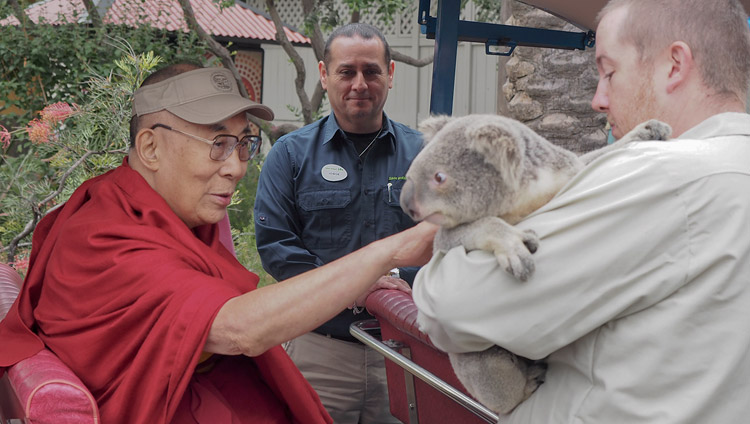
His Holiness the Dalai Lama petting an Australian koala bear during his visit to the San Diego Zoo in San Diego, CA, USA on June 18, 2017. Photo by Jeremy Russell/OHHDL

His Holiness rode in an electric buggy round the park from which he viewed various birds and animals. He was shown a Malayan tiger, a leopard, a lion and a cheetah among the big cats. He saw elephants being washed down and heard that San Diego is the destination of all the elephants in the USA when they retire. The Zoo looks after some very elderly elephants. Amongst the birds he saw condors, a peacock and hornbill, as well as a flock of flamingos. At one stop an Australian koala and a baby python were brought to him. Elsewhere he saw giraffes and rhinoceroses.

Back at reception His Holiness drank tea and talked about the Zoo’s work with the Mayor, the President, his staff and members of the board and returned to his hotel before the Zoo opened to the public.

Meeting with about 200 members of the San Diego Indian community after lunch, His Holiness was welcomed and introduced by Dr Suresh Subramani. There followed a brief musical interlude as Prof Karthik Seshadri gave a short sitar recital.

“Dear brothers and sisters,” His Holiness began, “you Indians were historically our gurus, so I’m very happy to meet with a group of you here. Among the ancient civilizations of China, Egypt and the Indus Valley, Indian civilization seems to have produced the greatest number of creative thinkers.

“I have great admiration for the spirit of ahimsa, non-violence, and secular pluralism that typify India. Because of these traditions, compared to her neighbours, India is remarkably stable and harmonious. It’s the only country I can think of where all our major religious traditions live amicably side by side. Advani told me that India’s secular respect extends even to those who have no faith, pointing out that although the Charvakas took a nihilist view, their teachers were still referred to as rishis or sages. Such a broad view is relevant when, of the 7 billion human beings alive today, 1 billion profess no faith.

“With regard to non-violence, it is worth remembering that the demarcation is not necessarily in the kind of the action so much as the motivation. Harsh words out of concern for another’s well-being are non-violent, but a smile and soft words with an intention to cheat and deceive can be seen as violent.”
His Holiness outlined his three commitments—promoting basic human values as a source of happiness, encouraging inter-religious understanding and, although he has retired and devolved his political responsibilities for Tibet to an elected leadership, preserving Tibet’s religion and culture, as well as its natural environment.

He explained that efforts to preserve Tibetan culture had begun in 1959, when he first came into exile. However, particularly after 1973, when he made his first visit to Europe, he began what have become extensive exchanges with modern scientists. He then started to appreciate that the ancient Indian knowledge of the workings of the mind and emotions could make a contribution to the well-being of humanity.  

“After 58 years, I am the Government of India’s longest standing guest. My mind is filled with Indian knowledge and my body has been nourished by Indian rice, dal and chapatis. This is why I sometimes call myself a Son of India. I consider it my duty to repay the kindness I have received by sharing the knowledge of the Nalanda tradition we Tibetans have kept alive.”

A member of the audience acknowledged that most religious traditions have resorted to violence at sometime in their history, but he’d been surprised to learn about what have been referred to as Buddhist terrorists in Burma. His Holiness agreed and told him he had recommended that when Buddhists in Burma felt antagonistic towards others they should pause and recall the face of the Buddha.

He added that although it was reported that monks had been involved in violence and persecution, if they had really behaved in such a way they could no longer be properly regarded as monks. He stressed that a terrorist is just a terrorist and that it is wrong to add a religious label, referring to Buddhist terrorists or Muslim terrorists, seeking to spoil the reputation of an entire religion.

He explained to another questioner that the ancient Indian knowledge he had been referring to is contained in the more than 300 volumes of the Kangyur and Tengyur.

Finally, an Indian woman thanked His Holiness for giving of himself all over the world. She asked if it would be acceptable if she requested her companions in the audience to join her in dedicating three recitations of the Gayatri mantra to his well-being.

Next, addressing more than 600 Tibetans, most of whom live locally, His Holiness told them:

“During this short visit to this area, I’m happy to be able to meet with some of you who have a special karmic connection with me, not just in this life but over many lifetimes. Tibetans in Tibet and in exile have shown remarkable loyalty and dedication—I’d like to thank you.

“We’ve been in exile for 58 years, which in the life of one individual is a long time. In Tibet temples and monasteries have been destroyed and many people have lost their lives. In terms of education, study of Tibetan language and culture are restricted in Tibet. Nevertheless, our Tibetan spirit remains strong and we are united—for which again I’d like to thank you.

“It’s important that we keep our language alive, not out of attachment, but because it is the best means for accurately conveying Buddhist philosophy, science and psychology. Over the last 30 years or more we’ve held discussions with scholars and scientists most of whom are not religious as such. They are intrigued that the Nalanda tradition is based not on blind faith, but on reason and logic.

“Whether you count yourself as a Buddhist or not, the study of logic is useful. In the past this was the province only of the monks, but these days the general public should be involved too. Haribadra wrote in his ‘Clear Meaning’ that those of dull faculties depend on faith, but those whose faculties are sharp depend on reason. If we follow the path of those with sharp faculties the prospects for the survival of our Buddhist tradition are bright. Remember that the Buddha advised his followers to accept what he’d taught not out of respect for him, but only after investigating and examining it as a goldsmith tests gold. Indian masters like Nagarjuna and Chandrakirti took this advice to heart and distinguished those scriptures that should be regarded as interpretable and those that could be regarded as definitive.

“Buddhism has survived for more than 2500 years. If we can pass it on to the next generation it will be good and a source of benefit.

“A few days ago I visited the Mayo Clinic for a check-up and the doctors gave me the all clear. They judge the prostate treatment I received last year to have been a success.

“Remain calm, stick together and stay united. Keep in mind that our Buddhist traditions can contribute to the wider world.”

original link and photos https://www.dalailama.com/news/2017/visit-to-san-diego-zoo-and-meetings-with-indians-and-tibetans

Tuesday, June 13, 2017

10 Questions for the Dalai Lama

Time Magazine interviewed His Holiness in New York City in May of 2010 for its "10 Questions to His Holiness the Dalai Lama".

Question: Do you ever feel angry or outraged? —Kantesh Guttal, PUNE, INDIA

His Holiness: Oh, yes, of course. I'm a human being. Generally speaking, if a human being never shows anger, then I think something's wrong. He's not right in the brain. [Laughs.]

Question: How do you stay so optimistic and faithful when there is so much hate in the world? —Joana Cotar, FRANKFURT

His Holiness: I always look at any event from a wider angle. There's always some problem, some killing, some murder or terrorist act or scandal everywhere, every day. But if you think the whole world is like that, you're wrong. Out of 6 billion humans, the troublemakers are just a handful.

Question: How has the role set out for you changed since you first came to be the Dalai Lama? —Andy Thomas, CARMARTHEN, WALES

His Holiness: I became the Dalai Lama not on a volunteer basis. Whether I was willing or not, I [had to study] Buddhist philosophy like an ordinary monk student in these big monastic institutions. Eventually I realized I have a responsibility. Sometimes it is difficult, but where there is some challenge, that is also truly an opportunity to serve more.

Question: Do you see any possibility of reconciliation with the Chinese government in your lifetime? —Joseph K.H. Cheng, MELBOURNE

His Holiness: Yes, there is a possibility. But I think past experience shows it is not easy. Many of these hard-liners, their outlook is very narrow and shortsighted. They are not looking at it in a holistic way. However, within the People's Republic of China, there is wider contact with the outside world. There are more and more voices of discontentment among the people, particularly among the intellectuals. Things will change — that's bound to happen.

Question: How can we teach our children not to be angry? —Robyn Rice, GRAND JUNCTION, COLO.

His Holiness: Children always look to their parents. Parents should be more calm. You can teach children that you face a lot of problems but you must react to those problems with a calm mind and reason. I have always had this view about the modern education system: we pay attention to brain development, but the development of warmheartedness we take for granted.

Question: Have you ever thought about being a normal person instead of being the Dalai Lama? —Grego Franco, MANILA

His Holiness: Yes, at a young age. Sometimes I felt, "Oh, this is a burden. I wish I was an unknown Tibetan. Then I'd have more freedom." But then later I realized that my position was something useful to others. Nowadays I feel happy that I'm Dalai Lama. At the same time, I never feel that I'm some special person. Same — we are all the same.

Question: Do you miss Tibet? —Pamela Delgado Córdoba, AGUASCALIENTES, MEXICO

His Holiness: Yes. Tibetan culture is not only ancient but relevant to today's world. After seeing the problems of violence, we realize that Tibetan culture is one of compassion and nonviolence. There is also the climate. In India during monsoon season, it is too wet. Then, I very much miss [ Tibet].

Question: What do you say to people who use religion as a pretext to violence or killing? —Arnie Domingo, QUEZON CITY, PHILIPPINES

His Holiness: There are innocent, faithful people that are manipulated by some other people whose interest is different. Their interest is not religion but power or sometimes money. They manipulate religious faith. In such cases, we must make a distinction: these [bad things] are not caused by religion.

Question: Have you ever tried on a pair of trousers? —Ju Huang, STAMFORD, CONN.

His Holiness: When it's very, very cold. And particularly in 1959, when I escaped, I wore trousers, like laypeople dressed. So I have experience.

Question: Do you believe your time here on earth has been a success? —Les Lucas, KELOWNA, B.C.

His Holiness: Hmmm. That's relative. It's so difficult to say. All human life is some part failure and some part achievement.

original link: https://www.dalailama.com/messages/transcripts-and-interviews/10-questions-time-magazine

Monday, November 21, 2016

Dalai Lama: The Potential of Today, The Potential of Tomorrow

Tokyo, Japan, 16 November 2016 - Long lines of junior high-school boys, immaculate in their formal, dark-blue uniforms, and visibly excited, had formed to greet His Holiness as he arrived at the Setagaya Junior High School in Tokyo on a cool, grey morning. The Tibetan flag was flying on every side, and a banner in English above the school’s entrance read, “We are Honored to Welcome H.H. Dalai Lama the 14th to Setagaya Gakuen.” Teachers watched the arrival from a third-floor walkway, under the school’s more than apt motto, “Think and Share.”

His Holiness took pains to greet almost every boy in the lines, tickling some, pulling the earlobes of others, leaning down to hold a small boy on crutches and to ask him what was wrong. Later he would say, “Your young, fresh, bright faces make me feel young again!”

After meeting some of the school’s officials—with three little boys in monks’ robes bringing him tea and cookies—His Holiness stepped into a jampacked wooden gymnasium in which—as on his previous trip to the school, some years before—every last seat in thirty long rows was occupied by silent, attentive young boys. “My English is very poor,” he began, “but I’m often suggesting that Japanese students should try to learn English. That way you can make an even greater contribution for the benefit of other people. And you can get more self-confidence. Traveling, you can realize that your own country’s conditions are really very good.”

Then he said simply, “You are the basis of our hope. Past is past; no one can change what happened. But in the future there is still hope, possibility.” Recalling the wars that had broken out throughout his life—since the rise of Nazi Germany and the Sino-Japanese Conflict in his earliest years—His Holiness explained how we can work for peace in an active, concrete way, instead of perpetuating the cycle of violence. “Many of my elder brothers and sisters here and I,” he said, “may not see a more peaceful and happier world. It’s not easily achieved. But in the next thirty or forty years, yours is the generation that can make a significant contribution to a more harmonious world.”

As his answers were translated, His Holiness peered intently into the crowd, making eye contact with some students, smiling at others, observing responses in every corner. “Violence always destroys lives,” he says. “The people who indulge in violence may get some temporary satisfaction; but deep inside they won’t be happy. Perhaps at the end of their lives, they will feel uncomfortable. Nobody wants problems, but we create many problems. Why? Because we can be short-sighted and narrow-minded.” Even trouble-makers, after all, are born to mothers and “raised with the seed of compassion.” Schools should therefore attend not just to material values but to inner values. “Not through religion, but through common sense, common experience and scientific findings.”

When His Holiness opened the session up to questions, the students were shy for a second, and then, almost instantly, lines of forty or more clamorously formed on each side of the gymnasium, reaching almost to the back of the large space. The boys’ questions cut to the heart of things: how can one cure aggression and anger? Must religion involve strictness? What is the meaning of life? His Holiness gave crisp direct answers, handling many questions from both sides of the hall. He stressed motivation—the difference between aspiring to succeed and hoping that others fail. He pointed out, in answer to a question about “destiny,” that “Karma means action. So, till yesterday, you had a certain destiny due to prior karma. Today you’re creating new karma, more forcibly, that can change your destiny.”

And in answer to a question about how a young student can hope to change the world, he said that it was more than possible. “The first thing is to develop peace of mind. And then spread it among your friends and family. And then, slowly and steadily as you grow in your profession, whatever that might be, it will help. Even in politics!”

Having spoken for more than two hours, His Holiness came down off the stage, taking care to greet many of the students in the front rows individually before taking lunch with the leaders of the school. Then he went straight to the Japanese parliament, to deal with real-life politicians. It was as if, having worked to bring meaning and wisdom to the leaders of tomorrow, he was now bringing his vision to the power-brokers of today.

As soon as he got out of his car at the gleaming, glassy, nine-story Front Office Building for the Japanese House of Representatives, in the heart of skyscraper Tokyo, His Holiness was greeted by loud applause from a large group of formally dressed politicians. Members of five different parties had gathered to welcome him, and when he stepped into a meeting hall, it was to be greeted again by spontaneous clapping, and a thronged audience of more than 200 policy-makers, part of the Japan-Tibet Parliament Group. It was the third time His Holiness had addressed Japan’s parliamentarians officially, and, according to a speech from one, each time saw more and more people in attendance.

A few Japanese politicians opened the event by speaking about how the Tibetan leader had touched their hearts, about visiting him in Dharamsala, about how Japan as a whole can and should work to help bring peace to the world and to think about religion and humanity, especially given the many age-old ties between the cultures.

Then His Holiness, speaking from a podium, spoke more about those ties and about his lifelong commitment to democracy. As a human being, he was fully committed to his 7 billion fellow humans. As a Buddhist monk, he was committed to a universal message of love, of tolerance, of forgiveness. And as a Tibetan, though he had retired from political life, he was committed to trying to preserve one of the world’s ancient cultures, a rich heritage of knowledge and the environment.

“Politically,” he stressed, “we are not looking for independence. For economic and other reasons, we want to stay within China.” But the Tibetan issue was not just political. It was about the preservation of Tibetan culture, language and the environment. In answer to a series of questions, he emphasized, as ever, “The Chinese people we really admire, we really respect. They have a 5000 year-old culture, they are a very cultured people, hard-working, realistic.” The fact of so many people attending a Japan-Tibet Parliamentary Group, His Holiness concluded, was part of an almost universal commitment not just to Tibet, but to justice and truth.

As he left the hall, one formal-looking politician after another pushed forwards to say hello, to shake his hand, to thank him for his presence in the world and in the room.

original link and photos: http://www.dalailama.com/news/post/1490-the-potential-of-today-the-potential-of-tomorrow

Monday, March 14, 2016

The Dalai Lama Emphasizes the Oneness of Humanity

When His Holiness the Dalai Lama arrived in Geneva yesterday evening a large number of Tibetans gathered in front of the hotel to welcome him.

This morning, during a meeting with journalists he explained his three commitments. He recommended that education should emphasize the inner values of warm heartedness, tolerance and forgiveness. He observed that although religion has been a source of happiness for thousands of years, sadly, today, it is becoming a source of hatred.

He made clear that when he retired from his political responsibilities in 2011, he did so completely, voluntarily and proudly, but conceded that 99 percent of the Tibetan people continued to place their hope and trust in him. Therefore, in addition to being concerned for them, he continues to work for the protection of Tibetan culture and Tibet’s natural environment. He explained that since Tibetan culture is a culture of peace, non-violence and compassion, it is in everyone's interest that it be preserved.

In the afternoon, His Holiness the Dalai Lama, fellow Nobel Laureate Tawakkol Abdel-Salam Karman and Leila Alikarami, an Iranian lawyer and human rights activist representing Nobel Laureate Shirin Ebadi, engaged in discussions on the theme ‘Nobel Laureates on Human Rights - A view from civil society’ at the Graduate Institute of Geneva. This event, hosted by the Permanent Missions of the United States and Canada to the United Nations, took place on the periphery of the UN Human Rights Council's 31st session. Mrs. Kate Gilmore, UN Deputy High Commissioner for Human Rights moderated the event.

His Holiness expressed his gratitude to the US and Canadian Permanent Missions to the UN for hosting the event. He also acknowledged the moving addresses of the two speakers who preceded him.

“We are talking about the future of humanity,” he said. “No matter how small our voice here may be, it is essential we speak up. Sometimes people say all is well with the world, but they are mistaken. We are facing many problems. During my lifetime I have witnessed continual conflict and bloodshed in the course of which millions of people have been killed. We need to ask where we went wrong, what qualities we lack and why violations of human rights take place. Answering these questions and creating peace will require wisdom and compassion.

“Although I am a Buddhist monk, I am sceptical that prayers alone will achieve world peace. We need instead to be enthusiastic and self-confident in taking action.”

He said those now causing trouble and disturbing peace in the world are also confident, but are insufficiently moved by basic human values. Therefore, if we are to create a more peaceful world in the future, we need to introduce warm-heartedness and secular ethics into our general education system.

He observed that climate change and the ups and downs of the global economy are problems that affect us all. They are not confined to national boundaries. Focussing on secondary differences between us like race, religion, nationality and gender, stokes our inclination to divide people into ‘us’ and ‘them’, which easily becomes a basis for conflict. He stressed that if we remember the oneness of humanity and think of each other as brothers and sisters we can overcome that potential for violence.

Following the panel discussion, His Holiness drove to the Palais des Nations where he addressed about 3000 Tibetans. He assured them that he was in good health and thanked them for their prayers for his well-being.

original link with photos: http://dalailama.com/news/post/1377-his-holiness-the-dalai-lama-emphasizes-the-oneness-of-humanity

Monday, January 4, 2016

Long Life Offering for the Dalai Lama

Tashi Lhunpo, Bylakuppe, Karnataka, India, 1 January 2016 - Today’s White Tara Longevity Empowerment and Offering of Requests to His Holiness the Dalai Lama to Live Long took place inside the new Tashi Lhunpo Assembly Hall. Once he had completed necessary preparations, as prayers were recited, His Holiness addressed the congregation of Abbots, former Abbots, Tulkus, monks, nuns and lay-people.

“I’ve been teaching almost continuously since arriving at Gyumey Tantric College three and a half weeks ago. Today, as a way of dedicating the merit we’ll conduct a White Tara Longevity Empowerment. I gather 700 students from local schools have joined us today, I wish you a Happy New Year. Young students like these are very important because they belong to the generation of the 21st century. I and my colleagues belong to the 20th century. Our time has passed and our lives are nearly over. The 21st century generation on the other hand are just at the beginning. They have a realistic opportunity to change the world.

“We all want happiness and to avoid suffering, and within ourselves that involves a greater sense of love and compassion. As far as the external world is concerned it will entail taking serious steps to preserve the environment and adapt to climate change. These days scientists are increasingly finding evidence that cultivating love and compassion has a positive effect on our physical health and general well-being. Humanity is made up of individuals and we will only achieve a happier more peaceful society if those individuals are happier and more peaceful within themselves.

“I am optimistic about this. I believe that human nature is fundamentally positive and again scientists are finding evidence to support this. Experiments with infants, who are too young to talk, and so have limited conceptual thinking, show that they respond favourably to illustrations of people helping each other. They show clear adverse responses to illustrations of people harming or obstructing each other. What’s more, scientists have shown that constant fear and anger has a damaging effect on our immune systems.

“We may conclude that human nature is essentially compassionate. Love and affection are essential because we all depend on others to survive. Therefore affection is part of our basic nature. If it was otherwise and it was our nature to be angry and hateful, there’d be little we could do, but because it is our nature to be affectionate and compassionate it’s possible for us to think of enhancing these natural qualities through education and training.

“By and large, modern education systems are inadequate because they are focused on material development and pay insufficient attention to inner development, to training in basic human values. However, projects are underway in the USA and Canada, in Europe and also here in India to design curriculums that will incorporate secular ethics into standard education. Steps need to be taken now to implement such changes. If we can inculcate and nurture basic human values in those who are young today, I believe that by the end of the century we will have created a happier more peaceful world.

“Students, work hard, study well and make the most of your opportunities,” His Holiness advised.

Turning his attention to Tibetan culture His Holiness remarked that Indian Buddhist literature was translated into Tibetan more than a thousand years ago. As a result, today, Tibetan remains the language best suited to accurately expressing and explaining the Nalanda tradition. He described this as something to be proud of, something which provides access to knowledge that Tibetans can contribute to the whole of humanity. Inner peace is based on compassion, cultivation of which is thoroughly explained in Buddhist science. Meanwhile, many among Tibet’s Asian neighbours, such as China where there are 100s of millions of Buddhists, are showing growing interest in the teachings of Tibetan Buddhism.

“The Buddhist tradition may be more than 2500 years old, but instructions such as how to deal with disturbing emotions not only remain relevant today, but are something everyone can benefit from, without needing to be a Buddhist. It is important to remember that all human beings are fundamentally the same. We are all brothers and sisters belonging to one human family. We are born the same way and we die the same way. And yet instead of appreciating what we have in common, we tend to stress those differences between us, such as faith, nationality, whether we are rich or poor, educated or illiterate, which are of secondary importance. We see each other in terms of ‘us’ and ‘them’, which in terms of the interdependent world in which we live is not only unrealistic, it’s out of date.

“If, we adopt a more affectionate, appreciative and concerned attitude towards each other, our lives will become more meaningful. If we can contribute to the happiness and prosperity of the whole world, it will be worth leading a long life.

“Of course, there are simple physical factors that can contribute to longer life. One is basic hygiene. Another is that while you have good hospital facilities, you don't have enough qualified medical staff working in them. This is like the schools that need more qualified and dedicated teachers.

“You need to keep up your health. Take proper advice about diet and the importance of nutritious food. Eat less white rice. Take more exercise. Do circumambulations as you say your prayers. It saddens me to see knowledgeable students and teachers in poor health. Receiving blessings and performing rituals won’t solve this; you need to adopt more practical steps. Taking urgent care of your health is the most important aspect of ensuring you live a long life. Of course, as I’ve already said, inner peace and less stress have a beneficial effect on your physical well-being too.”

Returning again to the topic of education, His Holiness discussed whether it would not be better to refer to a teacher with Buddhist training as a philosophy teacher rather than as a religious or spiritual teacher. He cited the quotation he often repeats about the Buddha’s not washing misdeeds away with water, but revealing the path to liberation. A philosophy teacher should be able to explain the Two Truths, the Four Noble Truths and what the Three Jewels are. He or she should be able to explain what the Buddha represents and what he taught.

Before beginning to give the White Tara empowerment, His Holiness set the context.

“Here we are in Tashi Lhunpo founded by Gendun Drup, the First Dalai Lama. He had a special connection to White Tara and I feel especially fortunate to be able to give this empowerment today.”

When the empowerment was complete, the Chant Master began the Offering of Requests to His Holiness to Live Long based on the Lama Chöpa (Guru Puja). Ling Rinpoche, patron of the Jangchub LamRim teachings, recited the eulogy and requests during the main mandala offering. He recalled the kindness of Dromtönpa, Gendun Drup and all the Dalai Lamas, including His Holiness, to Tibetans. Whole series of offerings were made in connection with the request to His Holiness to live very long. They included a full set of monk’s robes, an alms bowl and a monk’s staff. There were also elaborate sets of the Seven Emblems of Royalty and the Eight Auspicious Symbols.

At one point the clear voices of children could be heard singing a praise to His Holiness outside. Representatives of five Tibetan settlements in South India offered their own prayers to His Holiness to live long. Monks recited the story of the incarnations of Avalokiteshvara and the Long Life Prayer composed by His Holiness’s two tutors. The final mandala offering was made by the Tashi Lhunpo Abbot and Zopa Rinpoche.

The grand rituals over, guests and dignitaries joined His Holiness for lunch. Tomorrow morning he is due to leave Bylakuppe and drive to Bangalore.

original link and photos http://dalailama.com/news/post/1361-longevity-empowerment-long-life-offering

Monday, November 30, 2015

The Dalai Lama: Questions & Answers

Question: How do you view yourself?

Answer: I always consider myself as a simple Buddhist monk. I feel that is the real me. I feel that the Dalai Lama as a temporal ruler is a man-made institution. As long as the people accept the Dalai Lama, they will accept me. But being a monk is something which belongs to me. No one can change that. Deep down inside, I always consider myself a monk, even in my dreams. So naturally I feel myself as more of a religious person. Even in my daily life, I can say that I spend 80% of my time on spiritual activities and 20% on Tibet as a whole. The spiritual or religious life is something I know and have great interest in. I have some kind of confidence in it, and thus I want to study it more. Regarding politics, I have no modern education except for a little experience. It is a big responsibility for someone not so well equipped. This is not voluntary work but something that I feel I must pursue because of the hope and trust that the Tibetan people place on me.

Question: Will you be the last Dalai Lama?

Answer: Whether the institution of the Dalai Lama remains or not depends entirely on the wishes of the Tibetan people. It is for them to decide. I made this clear as early as in 1969. Even in 1963, after four years in exile, we made a draft constitution for a future Tibet which is based on the democratic system. The constitution clearly mentions that the power of the Dalai Lama can be removed by a two-thirds majority vote of the members of the Assembly. At the present moment, the Dalai Lama's institution is useful to the Tibetan culture and the Tibetan people. Thus, if I were to die today, I think the Tibetan people would choose to have another Dalai Lama. In the future, if the Dalai Lama's institution is no longer relevant or useful and our present situation changes, then the Dalai Lama's institution will cease to exist.Personally, I feel the institution of the Dalai Lama has served its purpose. More recently, since 2001 we now have a democratically elected head of our administration, the Kalon Tripa. The Kalon Tripa runs the daily affairs of our administration and is in charge of our political establishment. Half jokingly and half seriously, I state that I am now in semi-retirement.

Question: Do you think you will ever be able to return to Tibet?

Answer: Yes, I remain optimistic that I will be able to return to Tibet. China is in the process of changing. If you compare China today to ten or twenty years ago, there is tremendous change. China is no longer isolated. It is part of the world community. Global interdependence, especially in terms of economics and environment make it impossible for nations to remain isolated. Besides, I am not seeking separation from China. I am committed to my middle-way approach whereby Tibet remains within the People's Republic of China enjoying a high degree of self-rule or autonomy. I firmly believe that this is of mutual benefit both to the Tibetans as well as to the Chinese. We Tibetans will be able to develop Tibet with China's assistance, while at the same time preserving our own unique culture, including spirituality, and our delicate environment. By amicably resolving the Tibetan issue, China will be able to contribute to her own unity and stability.

Question: The Chinese have recently stated that the next Dalai Lama will be born in Tibet and chosen by them. What do you have to say about this?

Answer: If the present situation regarding Tibet remains the same, I will be born outside Tibet away from the control of the Chinese authorities. This is logical. The very purpose of a reincarnation is to continue the unfinished work of the previous incarnation. Thus if the Tibetan situation still remains unsolved it is logical I will be born in exile to continue my unfinished work. Of course the Chinese will still choose their own Dalai Lama and we Tibetans will choose our own according to tradition. It will be similar to the present situation of the Panchen Lama. There is a Chinese-appointed Panchen Lama and there is the Panchen Lama chosen by me. One is paraded to serve its master's purposes and the other is the Panchen Lama accepted in the hearts of all the Tibetans.

Question: What are your commitments?

Answer: In general, I always state that I have three commitments in life. Firstly, on the level of a human being, my first commitment is the promotion of human values such as compassion, forgiveness, tolerance, contentment and self-discipline. All human beings are the same. We all want happiness and do not want suffering. Even people who do not believe in religion recognize the importance of these human values in making their lives happier. I remain committed to talk about the importance of these human values and share them with everyone I meet. Secondly, on the level of a religious practitioner, my second commitment is the promotion of religious harmony and understanding amongst different religious traditions. Despite philosophical differences, all major world religions have the same potential to create better human beings. It is therefore important for all religious traditions to respect one another and recognize the value of each other's respective traditions. Thirdly, I am a Tibetan and carry the name of the Dalai Lama. Tibetans place their trust in me. Therefore, my third commitment is to the Tibetan issue. I have a responsibility to act the free spokesperson of the Tibetans in their struggle for justice. As far as this third commitment, it will cease to exist once a mutually beneficial solution is reached between the Tibetans and Chinese. However, my first two commitments I will carry on till my last breath.

Question: What were your first feelings on being recognized as the Dalai Lama? What did you think had happened to you?

Answer: I was very happy. I liked it a lot. Even before I was recognized, I often told my mother that I was going to Lhasa. I used to straddle a window sill in our house pretending that I was riding a horse to Lhasa. I was a very small child at the time, but I remember this clearly. I had a strong desire to go there. Another thing I didn't mention in my autobiography is that after my birth, a pair of crows came to roost on the roof of our house. They would arrive each morning, stay for while and then leave. This is of particular interest as similar incidents occurred at the birth of the First, Seventh, Eighth and Twelfth Dalai Lamas. After their births, a pair of crows came and remained. In my own case, in the beginning, nobody paid attention to this. Recently, however, perhaps three years ago, I was talking with my mother, and she recalled it. She had noticed them come in the morning; depart after a time, and then the next morning, come again. Now, the evening the after the birth of the First Dalai Lama, bandits broke into the family's house. The parents ran away and left the child. The next day when they returned and wondered what had happened to their son, they found the baby in a corner of the house. A crow stood before him, protecting him. Later on, when the First Dalai Lama grew up and developed in his spiritual practice, he made direct contact during meditation with the protective deity, Mahakala. At this time, Mahakala said to him, Somebody like you who is upholding the Buddhist teaching needs a protector like me. Right on the day of your birth, I helped you.  So we can see, there is definitely a connection between Mahakala, the crows, and the Dalai Lamas.

Another thing that happened, which my mother remembers very clearly, is that soon after I arrived in Lhasa, I said that my teeth were in a box in a certain house in the Norbulinka. When they opened the box, they found a set of dentures which had belonged to the Thirteenth Dalai Lama. I pointed to the box, and said that my teeth were in there, but right now I don't recall this at all. The new memories associated with this body are stronger. The past has become smaller, vaguer. Unless I made a specific attempt to develop such a memory, I don't recall it.

Question: Do you remember your birth or the womb state before?

Answer: At this moment, I don't remember. Also, I can't recall if at that time when I was a small child, I could remember it. However, there was one slight external sign perhaps. Children are usually born with their eyes closed. I was born with my eyes open. This may be some slight indication of a clear state of mind in the womb.

Question: Between the ages of sixteen and eighteen, after you assumed temporal power, did you change?

Answer: Yes, I changed a little bit. I underwent a lot of happiness and pain. Within that and from growing, gaining more experience, from the problems that arose and the suffering, I changed. The ultimate result is the man you see now (laughter).

Question: How about when you just entered adolescence? Many people have a difficult time defining themselves as an adult. Did this happen to you?

Answer: No. My life was very much in a routine. Two times a day I studied. Each time I studied for an hour, and then spent the rest of the time playing (laughter). Then at the age of 13, I began studying philosophy, definitions, debate. My study increased, and I also studied calligraphy. It was all in a routine though, and I got used to it. Sometimes, there were vacations. These were very comfortable and happy. Losang Samten, my immediate elder brother, was usually at school, but during these times he would come to visit. Also, my mother would come occasionally and bring special bread from our province of Amdo. Very thick and delicious. She made herself.

Question: Are there any of your predecessors in whom you have a special interest or with whom you have a particular affinity?

Answer: The Thirteenth Dalai Lama. He brought a lot of improvement to the standards of study in the monastic colleges. He gave great encouragement to the real scholars. He made it impossible for people to go up in the religious hierarchy, becoming an abbot and so forth, without being totally qualified. He was very strict in this respect. He also gave tens of thousands of monks' ordinations. There were his two main religious achievements. He didn't give many initiations, or many lectures. Now, with respect to the country, he had great thought and consideration for statecraft. The outlying districts in particular. How they should be governed and so forth. He cared very much how to run the government more efficiently. He had great concern about our borders and that type of thing.

Question: During the course of your life, what have been your greatest personal lessons or internal challenges? Which realizations and experiences have had the most effect on your growth as an individual?

Answer: Regarding religious experience, some understanding of shunya (emptiness: lack of independent self nature) some feeling, some experience and mostly bodhichitta, altruism. It has helped a lot. In some ways, you could say that it has made me into a new person, a new man. I am still progressing. Trying. It gives you inner strength, courage, and it is easier to accept situations. That's one of the greatest experiences.

Question: When you became a refugee, what helped you gain this strength? Was it the loss of your position and country, the fact of everyone suffering around you. Were you called on to lead your people in a different way than you had been accustomed to?

Answer: Being a refugee is really a desperate, dangerous situation. At that time, everyone deals with reality. It is not the time to pretend things are beautiful. That's something. You feel involved with reality. In peace time, everything goes smoothly. Even if there is a problem, people pretend that things are good. During a dangerous period, when there's a dramatic change, then there's no scope to pretend that everything is fine. You must accept that bad is bad. Now when I left the Norbulinka, there was danger. We were passing very near the Chinese military barracks. It was just on the other side of the river, the Chinese check post there. You see, we had definite information two or three weeks before I left, that the Chinese were fully prepared to attack us. It was only a question of the day and hour.

Question: About you being the incarnation of the bodhisattva of infinite compassion, Avalokiteshvara. How do you personally feel about this? Is it something you have an unequivocal view of one way or another?

Answer: It is difficult for me to say definitely. Unless I am engaged in a meditative effort, such as following my life back, breath by breath, I couldn't say exactly. We believe that there are four types of rebirth. One is the common type wherein, a being is helpless to determine his or her rebirth, but only reincarnates in dependence on the nature of past actions. The opposite is that of an entirely enlightened Buddha, who simply manifests a physical form to help others. In this case, it is clear that the person is Buddha. A third is one who, due to past spiritual attainment, can choose, or at least influence, the place and situation of rebirth. The fourth is called a blessed manifestation. In this the person is blessed beyond his normal capacity to perform helpful functions, such as teaching religion. For this last type of birth, the person's wishes in previous lives to help others must have been very strong. They obtain such empowerment. Though some seem more likely than others, I cannot definitely say which I am.

Question (follow up): From the viewpoint then of the realistic role you play as Chenrezi, how do you feel about it? Only a few people have been considered, in one way or another, divine. Is the role a burden or a delight?

Answer: It is very helpful. Through this role I can be of great benefit to people. For this reason I like it: I'm at home with it. It's clear that it is very helpful to people, and that I have the karmic relationship to be in this role. Also, it is clear that there is a karmic relationship with the Tibetan people in particular. Now you see, you may consider that under the circumstances, I am very lucky. However, behind the word luck, there are actual causes or reasons. There is the karmic force of my ability to assume this role as well as the force of my wish to do so. In regard to this, there is a statement in the great Shantideva's Engaging in the Bodhisattva Deeds which says, As long as space exists, and as long as there are migrators in cyclic existence, may I remain removing their sufferings. I have that wish in this lifetime, and I know I had that wish in past lifetimes.

Question (follow up): With such a vast goal as your motivation, how do you deal with your personal limitations, your limits as a man?

Answer: Again, as it says in Shantideva, If the blessed Buddha cannot please all sentient beings, then how could I. Even an enlightened being, with limitless knowledge and power and the wish to save all others from suffering, cannot eliminate the individual karma of each being.

Question (follow up): Is this what keeps you from being overwhelmed when you see the suffering of the six million Tibetans, who on one level, you are responsible for?

Answer: My motivation is directed towards all sentient beings. There is no question, though, that on a second level, I am directed towards helping Tibetan. If a problem is fixable, if a situation is such that you can do something about it, then there is no need to worry. If it's not fixable, then there is no help in worrying. There is no benefit in worrying whatsoever.

Question (follow up): A lot of people say this, but few really live by it. Did you always feel this way, or did you have to learn it?

Answer: It is developed from inner practice. From a broader perspective, there will always be suffering. On one level, you are bound to meet with the effects of the unfavorable actions you yourself have previously committed in body, speech or mind. Then also, your very own nature is that of suffering. There's not just one factor figuring into my attitude, but many different ones. From the point of view of the actual entity producing the suffering, as I have said, if it is fixable, then there is no need to worry. If not, there is no benefit to worrying. From the point of view of the cause, suffering is based on past unfavorable actions accumulated by oneself and no other. These karmas are not wasted. They will bear their fruit. One will not meet with the effects of actions that one has not done oneself. Finally, from the viewpoint of the nature of suffering itself, the aggregates of the mind and body have as their actual nature, suffering. They serve as a basis for suffering. As long as you have them you are susceptible to suffering. From a deep point of view, while we don't have our independence and are living in someone else's country, we have a certain type of suffering, but when we return to Tibet and gain our independence, then there will be other types of suffering. So, this is just the way it is. You might think that I'm pessimistic, but I am not. This is how, through Buddhist teaching and advice, we handle situations. When fifty thousand people in the Shakya clan were killed one day, Shakyamuni Buddha, their clansman, didn't suffer at all. He was leaning against a tree, and he was saying, I am a little sad today because fifty thousand of my clansmen were killed. But he, himself, remained unaffected. Like that, you see (laughter). This was the cause and effect of their own karma. There was nothing he could do about it. These sorts of thoughts make me stronger; more active. It is not at all a case of losing one's strength of mind or will in the face of the pervasive nature of suffering.

 original link: http://www.dalailama.com/biography/questions--answers

Monday, June 29, 2015

His Holiness the Dalai Lama at the Glastonbury Festival

Glastonbury, Somerset, UK, 28 June 2015 - It was raining when the helicopter carrying His Holiness the Dalai Lama from London landed on a high field near the village of Pilton, site of the Glastonbury Festival. He was welcomed on arrival by Michael Eavis, the founder of the Festival and owner of Worthy Farm on which it takes place, and his third wife, Liz. The two men soon discovered that they are both 80 years old this year.

Robert Richards, principal organizer of the Festival led His Holiness to his car. They drove to the Festival Viewing point from where there is a clear view over the Festival area, the main stages, including the Pyramid stage, and camping grounds. This year 203,000 people are attending the event.

His Holiness and his party drove through the main Festival area to the King’s Meadow, site of a modern megalithic stone circle, now also adorned with a Tibetan style chörten or stupa. The BBC’s Alan Yentob met him and escorted him to a small wooden stage from where he introduced him to an audience of about 8500.

“Brothers and sisters,” His Holiness began, “I can see you’re enjoying this Festival, on my way here, I noticed that everyone seems to be full of joy. I’m happy to have been invited to this Festival of people. As I always say, the purpose of life is to be happy. Who knows what tomorrow may bring, but we live in hope. Without hope our lives have no direction. The 7 billion human beings like us alive today all have a right to be happy. And it’s sad to note that while you are here enjoying yourselves, in other parts of the world like Syria, Iraq and Nigeria, people are killing each other. Therefore, we need to promote a greater awareness that we are all human brothers and sisters, that we belong to one human family.”

He remarked that in the past inhabitants of the British Isles had been content in isolation and later embarked on a period of imperialism governed largely by self-interest. Now, however, we live in a globalized world. We exist in a global economy. Climate change is something that affects us all. For this reason we have to think about the well-being of the whole of humanity. Nature is telling us we have to find ways to protect the world.

Noting that a lot of the problems we face are our own creation, he said that one of the worst things happening today was people killing each other in the name of religion. Why is this? Because people lack moral principles. We neglect the sense that we are all the same as human beings.

“I speak to you now just as another human being. Like you, I too am subject to mental disturbances. Like you I love my life, in fact everyone loves their own lives and everyone has a right live a happy life. And yet, we tend to make problems for ourselves. What we need to do instead is to promote greater human affection. Problems like killing, cheating and exploitation arise when we only think in the short term. Our education systems are oriented towards materialism. We need to change this to a greater focus on the long term and teaching about inner values, secular ethics. This entails simple warm-heartedness and a real sense of brotherhood and sisterhood. On such a basis we could demilitarise the world and use the money saved to close the gap between rich and poor.

“I don’t expect to see real change in my lifetime, but if you young people, people who belong to the 21st century start to make efforts now, the later parts of the century could see a happier more peaceful world. Please think seriously about this. This is something I am committed to, just as I am committed, as a Buddhist monk to promoting religious harmony and as a Tibetan to the preservation of Tibetan religion, culture and language. Tibetan culture is characterized by peace and compassion, which makes it something worth preserving.”

Alan Yentob put several questions submitted by members of the audience to His Holiness. He asked him about the secret of his good humour and he replied:

“Faced with difficulties I take the advice of Shantideva, an 8th century Indian master who said ‘Think carefully about difficulties you face - if they can be overcome, there is no need to worry. What you need to do is make effort. If they can’t be overcome, worry is of no use.’ This is practical advice that I follow myself. My other secret is that I get nine hours sleep.”

Yentob asked when he gets up.

“I get up at 3am and I do about 5 hours mediation, mostly analytical meditation. I analyse who I am, and what the world is; the idea of interdependence.

“The real meaning of the word ‘jihad’ is not doing harm to others, but engaging in combat with your disturbing emotions. Every day I try to do this. Whether we are angry about some things or attached to others, our feelings about them are exaggerated. As an American psychiatrist told me, our feelings like this are 90% our own mental projection.”

Asked if he had greater faith in basic human nature than in religion, His Holiness said that society is the basis of our happy future. Out of concern for ourselves we are better to be concerned about others. He said, friendship is important in a happy society and that friendship is based on trust. And building trust is not something we can expect the UN or local government to do. It’s something we have to do ourselves as individuals.

His Holiness enjoyed a wholesome lunch at the Greenpeace Field, provided by Greenpeace volunteers, in the company of several of the Festival organizers. Afterwards, at William’s Green, he joined Guardian editor-in-chief Katharine Viner, Guardian columnist George Monbiot and director of 350.org May Boeve for a panel discussion about who can fix climate change moderated by James Randerson.

Randerson asked the panel what gave them hope and Viner replied, “The Pope”. Monbiot cited public awareness and His Holiness mentioned inner peace. As to what the UN discussions on climate change need to tackle, His Holiness said that countries tend to put their national interests first and ignore what is in the global interest. However, he said that national interest actually depends on global interest. Monbiot stressed that the onus should not be on consumption, but on keeping fossil fuels in the ground. May Boeve advocated divestment from fossil fuels, citing the examples set by Stanford University and the Guardian Media Group.

His Holiness expressed his agreement with the Pope’s recent aspirations to stem climate change. He pointed out how, despite the existence of a global economy, we think too much in terms of ‘us’ and ‘them’, when what we should be doing is considering everyone as part of ‘us’.

“At the recent Nobel Peace Laureates’ meeting in Rome we declared the need to address the elimination of nuclear weapons. We agreed that the time for just talking is over; we need to set deadlines for action and meet them. World peace likewise cannot be achieved by prayer alone, we have to take action. And we need to think about the world as our only home. We can’t escape to the moon. This planet is our only home and we have to take much more serious care of it.”

Arriving at the Pyramid Stage, Robert Richards explained to His Holiness that whatever profits Glastonbury Festival makes go to charities such as: WaterAid, Oxfam and Greenpeace. When Patti Smith, who has played benefits in support of the cause of Tibet for sixteen years, met His Holiness backstage she told him that she’d been a 12 year old girl in 1959 when Tibet was in upheaval and His Holiness escaped. One of her prime concerns was his safety and welfare. She went back out on stage to perform and shortly afterwards His Holiness came up to watch and listen.

Between songs Patti Smith announced His Holiness’s presence to the 120,000 strong crowd and suggested it would be nice if they welcomed him and sang to celebrate his approaching 80th birthday. She read a poem in his honour and then led him out onto the stage to cheering approval. The crowd sang ‘Happy Birthday’ as a gorgeous cake bedecked with fruit and a single candle was presented to him. He addressed the audience:

“Dear sisters and brothers, I really appreciate it when so many of you express your warm feelings to me and I reciprocate. Every day I dedicate my actions of body, speech and mind to the benefit of others. When you show me such warm affection it strengthens my enthusiasm.

“I’ve watched you musicians here and see that although your hair is white, your voices and physical actions are youthful. That encourages me in turn, although I’m now 80, to be more active like you.

‘We are all the same as human beings. We all want to lead a happy life. We can think of every day as a new day, as a birthday. When we wake up we can remind ourselves - ‘I need to be happy, I need to have warm feelings towards others. This will build self-confidence, honesty, transparency, which leads to trust. And trust is the basis of friendship. We are social animals and we need friends. This is a source of happiness that I wish to share with you. Thank you”

The response was a great roar of applause. Patti Smith resumed her set. His Holiness left the stage and drove back to the helipad where he boarded a helicopter to return to where he’s staying in London. Tomorrow he has been invited to visit Aldershot in Hampshire.

original link with photos http://dalailama.com/news/post/1289-his-holiness-the-dalai-lama-at-the-glastonbury-festival