Showing posts with label humanity. Show all posts

Monday, November 19, 2018

The Dalai Lama is Interviewed in Yokohama, Japan

His Holiness the Dalai Lama Interviewed in Yokohama

Yokohama, Japan - His Holiness the Dalai Lama arrived in Yokohama from India yesterday on his 25th visit to Japan. Although the views over the bay from his hotel window were grey, His Holiness was bright and refreshed by a good night’s sleep after his journey. He opened his conversation with Rina Yamasawa of NHK with a recollection of his first visit in 1967. His elder brother, Taktser Rinpoche, was here and over lunch teased His Holiness, who had become a vegetarian, that he had the tastier bowl of udon noodles.

His Holiness answered a first question about how he sees the situation in Tibet today by reviewing his three commitments.

“First I consider myself just one among 7 billion human beings. While we pray for the welfare of all sentient beings, there’s nothing we can do but pray for those in other galaxies. On this planet there are countless animals, birds, fish and insects, but they have no language so we can’t really communicate with them. On a practical level, it’s our fellow human beings who we can do something for. In a materialistic world where many don’t know the value of peace of mind, I try to help them become happier by showing them how to find inner peace.

“I’m also a Buddhist and it saddens me to see conflict in the name of religion. In India, where different religions live together side by side, we see that religious harmony is possible.

“Thirdly, I’m a Tibetan and, although since 2001 I have retired from political responsibility, I remain concerned about Tibet’s natural environment. What’s also important is the preservation of our culture and the knowledge we obtained from India.

“Since 1974 we haven’t been seeking independence for Tibet, being prepared instead to remain within the People’s Republic of China. Much has changed in China over the last 40 years. The number of Buddhists has grown to more than 300 million, many with an interest in Tibetan Buddhism. Meanwhile, even hardliners among the officials are in a dilemma about how to deal with Tibet. They see that 70 years of suppression and attempted brainwashing haven’t diminished the Tibetan spirit.

“Instead of independence we are seeking mutual benefit. The Chinese can help us with infrastructural development and we can help them with Buddhist psychology. So, our Middle Way Approach is an attempt to reach mutual agreement for mutual improvement. Some Tibetans exercise their freedom to remain set on independence such as we enjoyed in 7th, 8th and 9th centuries. However, I am a great admirer of the spirit of the European Union that places the common interest of all its members above individual nation’s concerns. India too is a federation of states with different languages, cultures and religious traditions that are part of a union. I venture to imagine some kind of future union prevailing between India, China and Japan.”

His Holiness went on to clarify that Tibetans in what were historically the three provinces of Tibet have a right, according to the Chinese constitution, to a high degree of autonomy. That would allow them to preserve their language and culture. He pointed out that his own birthplace and that of Je Tsongkhapa are now part of Qinghai. He looked forward to genuine autonomy being granted in Uighur, Mongol and Tibetan regions.

Ms Yamasawa asked His Holiness how his successor would be chosen. He explained that as far back as 1969 he had made it clear that the choice of whether another Dalai Lama would be recognised rested with the Tibetan people. That choice precedes any decision about how a successor may be chosen. It could be that the traditional way of identifying a reincarnation will be followed, but there have also been cases of Lamas nominating an already living person as their successor.

He noted that at the end of this month a convening of Tibet’s spiritual leaders will take place, primarily focussed on raising the quality of Buddhist knowledge and practice. The question of a future Dalai Lama may also be on the agenda.

His Holiness observed that when he was recently in Europe a group of women met him to complain about the sexual misconduct of some Tibetan spiritual teachers. He told them that when such complaints were first brought to his attention he asked if such individuals had disregard for the rules the Buddha laid down, why they would listen to anything he had to say. He’d suggested that the shame of publicity might be more effective. He advised the group to forward their complaints to the meeting of spiritual leaders in a letter.

When Yamasawa steered the conversation back to the topic of his successor, His Holiness told her that some years ago, faced with similar questions from a journalist in New York he had taken off his glasses, as he did again today, and asked playfully, “Look at my face, is the need to address the question of my reincarnation urgent?” He told her that what happens after his death is of little interest to him compared to being a good Buddhist practitioner here and now. He repeated for her Shantideva’s verse, which he takes as his motivating prayer: ‘For as long as space endures and for as long as living beings remain, until then may I too abide to dispel the misery of the world.’

In his additional replies, His Holiness stressed that he advises followers of the Buddha today to be 21st century Buddhists, which he defines as driven by knowledge and understanding of what the Buddha taught rather than blind faith. He also discussed his admiration for democracy, his attempts to introduce reform in Tibet and his determination to do so once he and 80,000 Tibetans came into exile.

A second interview with Ms Yoshiko Sakurai, president of the think tank known as the Japan Institute of National Fundamentals, touched on several similar themes. As to how Tibetan traditions had been preserved, His Holiness emphasized how generous the government of India and Prime Minister Nehru had been in their support. It was Nehru who personally encouraged efforts to educate Tibetan children in separate Tibetan schools and to re-establish the monastic seats of learning. As a result of the latter, there are now more than 10,000 monks and 1000 nuns well-trained in the Nalanda Tradition.

Referring to education in the wider world, His Holiness noted that it tends to have materialistic goals, whereas it would be better if it addressed the needs of both the heart and the brain. Specifically he recommended teaching people how to tackle their destructive emotions.

When Ms Sakurai lamented that the Chinese authorities seem to be doing little for Tibetans and Uighurs, His Holiness replied that he saw the past 70 years in terms of four eras affected by Mao Zedong, Deng Xiaoping, Jiang Zemin and Xi Jinping. Although the same party remained in power, guided by the same constitution, nevertheless great changes had taken place. He noted that there still remained room for further change. He also remarked that 1.2 billion Chinese have a right to know what is really going on and when they know that, he expressed confidence in their ability to judge what’s right from what’s wrong.

His Holiness mentioned that in Tibet, even as suppression has increased, Tibetans have continued to pursue non-violence. He highlighted the cases of the more than 150 people who have committed self-immolation as examples, saying that they were very sad on the one hand, but on the other were worthy of admiration because they remained non-violent, at least in relation to others.

Asked how Japanese and Tibetans can contribute to the welfare of humanity His Holiness expressed his admiration for the Shinto Tradition due to its appreciation of the natural environment. He commended the possibility of combining technological development with a deep understanding of the workings of the mind to enable more people to find inner peace. He also expressed the hope that Japan, as the one country that has been subject to nuclear attack, will not let up on its leadership of the movement to eliminate nuclear weapons.

He reiterated that his cherished goals of a world not only free of nuclear weapons, but also demilitarized in general, will only come about when more people have achieved a sense of inner disarmament in their own hearts and minds. This, he suggested, is something to which Japanese brothers and sisters can contribute.

original link & photos: https://www.dalailama.com/news/2018/his-holiness-the-dalai-lama-interviewed-in-yokohama

Tuesday, September 25, 2018

The Dalai Lama on Happiness & Responsibility

Happiness and Responsibility
September 20, 2018

Zurich, Switzerland - This morning, leaving the tranquillity of Darmstadt, where the bicycle is a favoured mode of transport, His Holiness the Dalai Lama was driven rapidly to Heidelberg. Reaching this picturesque city on the River Neckar he was taken directly to the City Hall where he was received by Mayor Wolfgang Erichson. After greeting well-wishers gathered on the pavement, His Holiness turned to wave to people watching from surrounding windows.

Inside City Hall His Holiness was given an official welcome and invited to sign the Golden Book inscribed by honoured visitors to the city. This was followed by an exchange of gifts. As His Holiness entered the auditorium and took the stage he received warm applause from the 1500 people in the audience.

In his welcoming speech Mayor Wolfgang Erichson extolled the virtues of the beautiful city of Heidelberg. The University of Heidelberg attracts an open-minded student body and is among the 50 top universities in the world. People from 160 nations live in the city, which sees diversity not as a threat but an asset. The Mayor noted that it is possible to learn how cultivate and achieve happiness and he was pleased to report that at least one pioneering school in the city is teaching just that.

During a short musical interlude a wind and string quintet played a delightful piece by Mozart.

Director of the German American Institute, Jakob Kollhofer told His Holiness it was a great honour to welcome him to Heidelberg, describing him as living reminder of peace and compassion, known for his warm smile. He observed that His Holiness has been a refugee for 60 years during which time his appearance and conduct have been consistent. Welcoming him to a festival of science in what has come to be known as a city of science, Kollhofer invited His Holiness to share his thoughts about happiness and responsibility.

“Good morning, dear brothers and sisters. I make a point of clarifying that the 7 billion human beings living on this planet today are emotionally, mentally and physically the same. We all want to live a happy life and don’t want to suffer. We have a marvellous brain which is very helpful when it comes to analysing and investigating reality. Our intelligence can bring us peace of mind, or it can destroy it. Using our intelligence to understand moral principles we can learn to cultivate warm-heartedness and infinite altruism.

“As scientists have discovered, basic human nature is compassionate. Our mother gave birth to us, then cared for us with maximum affection. If she’d neglected us instead, we would likely have died.

“Anger and fear undermine our immune system, while warm-heartedness brings peace of mind. Therefore, just as we teach children to comply with physical hygiene for the good of their health, we should also counsel them in a kind of hygiene of the emotions. If they are to be both physically and mentally fit, they need to know how to tackle negative emotions and maintain their peace of mind. And to tackle the emotions it’s useful to have something like a map of the emotions, a map of the mind.

“This is something we can learn from research conducted in ancient India through meditative practices to cultivate single-pointed concentration and analysis. The Buddha practised both, and although these practices are described in religious literature, they can be examined and employed in an academic context.

“I am a student of such ancient Indian knowledge as preserved in the Nalanda Tradition, which relies on reason and logic. The great Nalanda scholar Shantarakshita, who was invited to Tibet by the Emperor in the 8th century, established a mode of Buddhist training and practice in which reason and logic play an integral part.

“After I came to India I had opportunities to meet and hold discussions with scientists. I was inspired by the Buddha’s advice not to accept what he taught on the basis of faith alone, but to test and investigate it through reason. Consequently, the dialogue I’ve been conducting with scientists for more than thirty years has been mutually beneficial.”

Kollhofer introduced three scientists to take part in discussions with His Holiness this morning—neurobiologist Dr Hannah Monyer, gerontologist Dr Andreas Kruse, and astrophysicist Dr Matthias Bartelman.

Dr Monyer raised something she sees as a problem. “You emphasise that we are social animals and we are, but we are not so different from rats. Like them human beings naturally prefer to help members of their close family rather than others.”

“We are intelligent,” His Holiness replied, “we have seed of compassion from birth. Using reason and intelligence we can enhance our sense of compassion and come to understand how its opposite, anger, is harmful. Our biological compassionate instincts tend to be coloured by attachment. Such a biased attitude cannot be transformed into great compassion. That’s why we first develop equanimity. We can learn to extend loving kindness to the whole of humanity.

“One thing that needs to be clearly understood is that both compassion and anger are part of the mind, they belong to our mental consciousness. Some consciousnesses depend on our sense organs. In the dream state, the sense organs are dormant. In deep sleep, consciousness is subtler, while the subtlest consciousness manifests at the time of death, unrelated to the brain.”

“That’s a dualistic view,” was Dr Monyer’s response.

“In the early 20th century scientists considered consciousness was entirely dependent on the brain,” reported His Holiness. By the end of the century, neuroplasticity showed that changes in the brain could be attributed to changes in consciousness.”

Dr Matthias Bartelman asked if humility was important in the study of science. His Holiness answered “Yes”, and went on to discuss how we are all dependent on others; we depend on the community in which we live.

Gerontologist Dr Andreas Kruse told His Holiness he had three questions for him. “Do you think that the link between happiness and responsibility is meaning. His Holiness retorted that this sounded like a philosophical question like ‘why are we here?’ he said the religious answer would either be because it’s God’s will or because of karma.

Dr Kruse reported findings that older people derive meaning from being able to take care of younger members of the family. However, when they suffer degenerative conditions, such as dementia, they are excluded from such activities and younger people feel a responsibility to take care of them. Dr Kruse raised the notion of ‘border situations’ first mooted by Karl Jaspers a German-Swiss psychiatrist and philosopher educated at Heidelberg.

His Holiness retorted that it seemed to be a complicated philosophical observation. Everything is relative; nothing has independent existence. He cited the example of time. “Does time exist? Where is the present when it is always moving on?”

Answering questions from the public His Holiness touched on the need to ensure that the 21st century does not repeat the experience of the 20th century, which was overwhelmingly violent. The 21st century should be an era of dialogue. Problems should be solved by talking them over, not through the use of force.

Challenged to say why he had not intervened in the Rohingya crisis in Burma, he replied that he is an outsider to that conflict. He reported having spoken and written to Aung San Suu Kyi, who could have done more. He counselled Burmese Buddhists when moved by anger to recall the face of the Buddha.

Kollhofer brought the session to an end telling His Holiness that everyone listening had been inspired by what he told them. He thanked him once again for coming to Heidelberg. His Holiness responded, “To bring about a happier, more peaceful world, we have to start on an individual level. Change begins with individuals and spreads out into the community.”

His Holiness was invited to lunch in the vaulted foyer of the City Hall at the end of which he drove to Mannheim from where he flew to Zurich. Tibetans had mounted a traditional welcome outside the hotel, whose driveway was lined with Tibetan flags. There were Tashi Shölpa dancers and Tibetan youngsters offering the ‘Chema Changpu’.

His Holiness interacted with all who had come to greet him, happily spotting several old friends among them. In the lobby he was greeted by the Abbot, President, and Director of the Tibet Institute Rikon as well as other monks and Lamas.

Original link & photos: https://www.dalailama.com/news/2018/happiness-and-responsibility

Friday, June 22, 2018

Made in God’s Image and Likeness: Meaning & Implications

Made in God’s Image and Likeness: Meaning and Implications

By Reverend Mark Hunnemann

26 Then God said, “Let us make manh in our image, after our likeness. And let them have dominion over the fish of the sea and over the birds of the heavens and over the livestock and over all the earth and over every creeping thing that creeps on the earth.”

27 So God created man in his own image, in the image of God he created him; male and female he created them. (Genesis 1:26-27) This is an astonishing text in which the trinitarian God purposes to make a different kind of being than had been created thus far—one that would image Him. Not be Him, but be His image and likeness.

Who are we and what are we? Why questions, as opposed to how questions, have haunted the landscape of my heart and brain ever since I can remember. What is our identity? God answers that for us, very clearly. Since we are made in God’s image, then we cannot know who we are or what we are without knowing who/what God is first. That is one reason why we looked at Him first in our study. As Calvin noted in the first pages of the Institutes—the knowledge of God and of ourselves are inextricably connected at a thousand different points.

There is a crisis today in our culture re purpose and identity. Think about: ask the average person on the street what they would say if you asked the purpose of life, and who they are? If we jettison the living God, then it comes at a very high price; human dignity and purpose. So our country is becoming increasingly barbarous—slaughtering the unborn.

Perhaps the hardest book I ever read was Jean-Paul Sartre’s book ‘Being and Nothingness.” In it he stated that existence precedes essence. Think about that term for a moment…..(you, me, chair, all facts are brute meaningless facts—non-interpreted). We are meaningless. All facts are meaningless intrinsically—until we choose, in act of courage, to give them meaning or essence. In other words, there is nothing outside of us to give essence or meaning to our lives. On the other hand you have the other existentialist Albert Camus asserting that the only question remaining is should we commit suicide? So, the credo of the secular humanist or pagan is this: I originated in meaninglessness and am destined for meaninglessness, but in-between these 2 poles of meaninglessness, my life it is magically imbued with essence or meaning. Talk about leap of faith, and absurd. That is the sad situation of modern man. If we are but cosmic accidents, personal warts on the face of an impersonal universe, then our origin and destiny are equally insignificant. No basis for human dignity or worth. The 20th century is a murderous testimony to the inevitable fruit of that kind of thinking: man is the measure of all things. We have become zeros-less than zeroes.

Our origin, destiny and meaning are tied to God. He declares that we have essence or meaning-value and dignity. God alone has intrinsic dignity and value, but He has assigned us extrinsic value and dignity; we are made in His image. What does that mean?

Some have suggested (some RC theologians) that image and likeness refer to different things but the structure of the Hebrew indicates that they are synonymous, and the bible uses them often interchangeably. What does imago dei mean? Tons of ink has been spilt over this issue!

The short answer, but I think still profound, of what it means to be made in God’s image is that we image Him! Isn’t that what images do? Images express likeness to something or someone else—it mirrors or expresses what the original is like. 100 yards away from my apartment is a national Military Park commemorating the battle of Guilford Courthouse, and especially General Greene, whom our city of Greensboro was named after. Greene was Washingtons brilliant leader of southern campaign of revolutionary War. Ever since I was a kid we used to go see this enormous image of him on horseback—still there. This image of Greene is meant to portray or represent Greene…his dignity and honor and brilliance a military strategist. Images of all kinds of people that are important are all over the place.

So, as God’s image we are to image Him to the world. We were created with that express intent or purpose—at heart of our humanness and identity/purpose. We are to mirror to the world what God is like—His holiness and love. Walking and talking images, and in our behavior and words we are to express His character to all the rest of His creation. So that we adorn the gospel—people look at us and can say: that is what God is like. We mirror to the animals, the angels, other people-- God.

We do not exist for ourselves but for God—and He designed us with unique and incredible dignity.

Since we are Gods image bearers may be one reason for second commandment—there is already one image of Him, and that is us, and to be only us—which shows our dignity!

Be more specific: We are like Him in some ways or analogous. Though He is Creator and we are creatures, we alone are made in His image. God is holy, creative, rational, communicative, gregarious (relational), a will. We are to mirror to the world His holiness, for example. Likewise, though we cannot create from nothing, as His image bearers we can create beauty—whether in home, garden, or on canvas, we mirror Gods creativity when we create and this pleases Him.. All the traits I mentioned we share with Him which make up our image bearing.

In a word, God is personal—Infinite/Personal God. We may not be able to verbally express what person is, but we know instinctively what a person or personality is. And we are finite/personal….infinite/personal.

Immediately after the verses describing our being made in God’s image we are said to be His under-shepherds in ruling and caring for this earth. We are to reflect God’s righteous rule over the cosmos in how we build culture. That is crucial aspect of our image-of-Godness.

This view of the image of God is contrary to a platonic view of spirituality that is common in bible believing churches in which there is a spiritual compartment and a non-spiritual compartment. Plato taught that the soul was all that counted and the body was the prison house of the soul. Matter was inferior to spirit. We must resist this super spirituality, platonic tendencies which dehumanizes the whole man. But true spirituality sees Christ as King and Lord over the totality of life: the arts, government, academics, every day life. It also means that of all people, Christians should be the most sensitive to environmental issues; the most excited about the humanities and sciences. Knowing that we do have dominion over it as the secular environemntlaists deny, we are still to not recklessly rape Gods good earth in advancing culture.

That we shall live forever is perhaps another way we image God, though he alone is immortal. Our soul is not intrinsally immortal as Plato taught—we live forever only bc God decreed so. Our soul is not made of intrinsically immortal stuff.

Notice that it is the intra trinitarian communication in which we are discussed as being made in “our” image. So, as a communicative triune God, what we say, and how say it, is a salient aspect of our image of Godness. Language and the ability to communicate is an expression of it.

Like God, we are rational, creative, communicators, have spiritual side—so our image of Godness is rich. Some have also suggested that since were created with bodies and will have bodies forever, then they in some sense reflect God’s image as well—though God is spiritual…but the glorified Incarnate Christ has body. Fearfully and wonderfully made—images God’s wisdom in our bodies.

Note too, that the male and female comprise God’s image—we need both to complete this image. This further enriches the beauty and multi-faceted nature of God’s image.

We are told that God Himself brought Eve to Adam and in the garden chapel it was like the Father walked his daughter down the holy aisle to join hands with her husband. Marriage officiated by God Himself.

Last segment we talked about the consequences of the Fall, in which ghastly things happened. The image of God in us was severely tarnished. Our ability to mirror God’s holiness has been greatly affected; our hearts, minds, and wills have all been adversely affected. The mirror is fogged.

I had mentioned that the Fall has much explanatory power re the world and ourselves. A powerful example is how the Creation, image of God, and the Fall alone can adequately explain the paradox of mankind; the simultaneous Majesty and misery of mankind. The history of the world bears this out over and over: breathtaking expressions of our singular nobility/potential for such beauty on every level, including relationally. At the same time, we are capable of the most horrendous inhumanity to man..or on every day level, just our pettiness and selfishness. We are a study in contrasts: majesty and misery!! When we say the bible is true we mean that not just in spiritual matters but it alone expresses and explains the complexities of the world we live in-including ourselves. The bible is really true.

Note that biblically, though we are the pinnacle of creation, we are not the goal of creation. The last and most sacred day is the 7th day which focuses on God. The sixth day is penultimate, but the ultimate day is the seventh. Perhaps that explains, at least in part, the meaning of 666. It elevates part of creation/man as the ultimate, raised to third power, which in Jewish thought is highest way of accenting something. Holy, holy, holy…God is dethroned in this antichrist scheme and mankind is elevated as the measure of all things. Imaging not God but Satan. I think that is the essence of 666 perhaps. And some person will come that personifies this satanic scheme. But we must remember we don’t exist for ourselves but to mirror God.

There are 2 extremes regarding the results of the fall and the image of God in us: some virtually deny that it affected us at all (like modern day Pelagians or paganism), and others say that the image was totally destroyed. We shall deal the first error in depth later, but re the latter the bible is clear that we are still made in His image—Gen. 9:6; 1 Cor. 11:7; James 3:9
6 “Whoever sheds the blood of man,
by man shall his blood be shed,
for God made man in his own image. (Gen. 9:6)
9 With it we bless our Lord and Father, and with it we curse people who are made in the likeness of God. (James 3:17)
We are still humans, and the goal of redemption is to restore our true humanity—in all its earthy, lovely splendor.The goal of salvation is degree by degree restore God’s image in us.

The restoration of the fullness of the image of God in us is being accomplished by Christ. He is as Hebrews 1:3 says :”the brightness of His glory and the express image of His Person.”

Sanctiifcation is the restoration of our true humanness; as His image in all its rich fullness is restored degree by degree.

1. God created human beings—both male and female—in His image and likeness
2. There is some analogy between God and mankind that makes communication between them possible
3. Human beings, like God, are moral agents with the faculties of mind and will and creativity.
4. Humans are called to have dominion over the earth-subdue and build culture but not rape it.
5. In the fall, the image of God in us was marred
6. Christ is the perfect image of God, and he is restoring us to the fullness of the image of God.


Mark Hunnemann is the author of Seeing Ghosts Through God's Eyes: A Worldview Analysis of Earthbound Spirits. It's also available in eBook format.

Tuesday, July 25, 2017

Dalai Lama: "We Need One-ness of 7 Billion People"

Speaking at a session organised by the Ananta Centre, the Dalai Lama said "it is our collective responsibility to ensure a compassionate humanity." The 79-year-old also said, "I have been a refugee for over 50 years, but have never given up hope or determination." Watch his entire speech here.

http://www.ndtv.com/video/player/news/we-need-one-ness-of-7-billion-people-dalai-lama/346051

Here are the highlights:

We need to create the one-ness of 7 billion human beings.

I am nearly 80, I am still studying. Your whole life, remain a student.

Real transformation of India must take place in rural areas, not with more buildings and shops in Delhi and Bangalore.

The South Indian brain is something special, I think because they drink so much coconut water (laughs). So I also drink it.

I love President Bush as a human being, he was warm and informal not ceremonial.

Serving humanity is the best form of serving God, of worship.

Use education. It is best way of removing the differences that divide us. Teach secular ethics in schools.

In over 55 years of being a refugee, have never given up hope or determination.

It is our collective responsibility to create a compassionate humanity.

NOTE: This was originally posted in December 2014.

Tuesday, June 20, 2017

Dalai Lama Visits the San Diego Zoo

...and Meetings with Indians and Tibetans

San Diego was barely stirring when His Holiness the Dalai Lama set out this morning to visit the San Diego Zoo. He was welcomed at the gate by Mayor Kevin Faulconer, his wife and President of the Zoo Douglas Meyers.

To begin with he was shown a short video outlining the important role the Zoo plays in conservation, both of species of animals and in some cases the plants on which they depend.


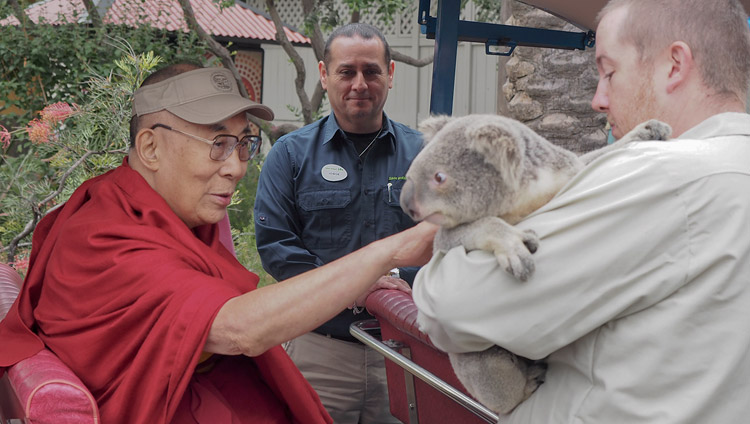
His Holiness the Dalai Lama petting an Australian koala bear during his visit to the San Diego Zoo in San Diego, CA, USA on June 18, 2017. Photo by Jeremy Russell/OHHDL

His Holiness rode in an electric buggy round the park from which he viewed various birds and animals. He was shown a Malayan tiger, a leopard, a lion and a cheetah among the big cats. He saw elephants being washed down and heard that San Diego is the destination of all the elephants in the USA when they retire. The Zoo looks after some very elderly elephants. Amongst the birds he saw condors, a peacock and hornbill, as well as a flock of flamingos. At one stop an Australian koala and a baby python were brought to him. Elsewhere he saw giraffes and rhinoceroses.

Back at reception His Holiness drank tea and talked about the Zoo’s work with the Mayor, the President, his staff and members of the board and returned to his hotel before the Zoo opened to the public.

Meeting with about 200 members of the San Diego Indian community after lunch, His Holiness was welcomed and introduced by Dr Suresh Subramani. There followed a brief musical interlude as Prof Karthik Seshadri gave a short sitar recital.

“Dear brothers and sisters,” His Holiness began, “you Indians were historically our gurus, so I’m very happy to meet with a group of you here. Among the ancient civilizations of China, Egypt and the Indus Valley, Indian civilization seems to have produced the greatest number of creative thinkers.

“I have great admiration for the spirit of ahimsa, non-violence, and secular pluralism that typify India. Because of these traditions, compared to her neighbours, India is remarkably stable and harmonious. It’s the only country I can think of where all our major religious traditions live amicably side by side. Advani told me that India’s secular respect extends even to those who have no faith, pointing out that although the Charvakas took a nihilist view, their teachers were still referred to as rishis or sages. Such a broad view is relevant when, of the 7 billion human beings alive today, 1 billion profess no faith.

“With regard to non-violence, it is worth remembering that the demarcation is not necessarily in the kind of the action so much as the motivation. Harsh words out of concern for another’s well-being are non-violent, but a smile and soft words with an intention to cheat and deceive can be seen as violent.”
His Holiness outlined his three commitments—promoting basic human values as a source of happiness, encouraging inter-religious understanding and, although he has retired and devolved his political responsibilities for Tibet to an elected leadership, preserving Tibet’s religion and culture, as well as its natural environment.

He explained that efforts to preserve Tibetan culture had begun in 1959, when he first came into exile. However, particularly after 1973, when he made his first visit to Europe, he began what have become extensive exchanges with modern scientists. He then started to appreciate that the ancient Indian knowledge of the workings of the mind and emotions could make a contribution to the well-being of humanity.  

“After 58 years, I am the Government of India’s longest standing guest. My mind is filled with Indian knowledge and my body has been nourished by Indian rice, dal and chapatis. This is why I sometimes call myself a Son of India. I consider it my duty to repay the kindness I have received by sharing the knowledge of the Nalanda tradition we Tibetans have kept alive.”

A member of the audience acknowledged that most religious traditions have resorted to violence at sometime in their history, but he’d been surprised to learn about what have been referred to as Buddhist terrorists in Burma. His Holiness agreed and told him he had recommended that when Buddhists in Burma felt antagonistic towards others they should pause and recall the face of the Buddha.

He added that although it was reported that monks had been involved in violence and persecution, if they had really behaved in such a way they could no longer be properly regarded as monks. He stressed that a terrorist is just a terrorist and that it is wrong to add a religious label, referring to Buddhist terrorists or Muslim terrorists, seeking to spoil the reputation of an entire religion.

He explained to another questioner that the ancient Indian knowledge he had been referring to is contained in the more than 300 volumes of the Kangyur and Tengyur.

Finally, an Indian woman thanked His Holiness for giving of himself all over the world. She asked if it would be acceptable if she requested her companions in the audience to join her in dedicating three recitations of the Gayatri mantra to his well-being.

Next, addressing more than 600 Tibetans, most of whom live locally, His Holiness told them:

“During this short visit to this area, I’m happy to be able to meet with some of you who have a special karmic connection with me, not just in this life but over many lifetimes. Tibetans in Tibet and in exile have shown remarkable loyalty and dedication—I’d like to thank you.

“We’ve been in exile for 58 years, which in the life of one individual is a long time. In Tibet temples and monasteries have been destroyed and many people have lost their lives. In terms of education, study of Tibetan language and culture are restricted in Tibet. Nevertheless, our Tibetan spirit remains strong and we are united—for which again I’d like to thank you.

“It’s important that we keep our language alive, not out of attachment, but because it is the best means for accurately conveying Buddhist philosophy, science and psychology. Over the last 30 years or more we’ve held discussions with scholars and scientists most of whom are not religious as such. They are intrigued that the Nalanda tradition is based not on blind faith, but on reason and logic.

“Whether you count yourself as a Buddhist or not, the study of logic is useful. In the past this was the province only of the monks, but these days the general public should be involved too. Haribadra wrote in his ‘Clear Meaning’ that those of dull faculties depend on faith, but those whose faculties are sharp depend on reason. If we follow the path of those with sharp faculties the prospects for the survival of our Buddhist tradition are bright. Remember that the Buddha advised his followers to accept what he’d taught not out of respect for him, but only after investigating and examining it as a goldsmith tests gold. Indian masters like Nagarjuna and Chandrakirti took this advice to heart and distinguished those scriptures that should be regarded as interpretable and those that could be regarded as definitive.

“Buddhism has survived for more than 2500 years. If we can pass it on to the next generation it will be good and a source of benefit.

“A few days ago I visited the Mayo Clinic for a check-up and the doctors gave me the all clear. They judge the prostate treatment I received last year to have been a success.

“Remain calm, stick together and stay united. Keep in mind that our Buddhist traditions can contribute to the wider world.”

original link and photos https://www.dalailama.com/news/2017/visit-to-san-diego-zoo-and-meetings-with-indians-and-tibetans

Friday, February 3, 2017

SATAN IS GOD/RULER OF THIS WORLD? What Does That Mean?

By Reverend Mark Hunnemann

What does it mean to say that Satan is the "god/ruler/prince (archon) of this world"?

"I will no longer talk much with you, for the ruler of this world is coming.(John 14:30, see 12:31; 16:11; 1 John 5:19)

"We know that we are from God, and the whole world lies in the power of the evil one." (1 John 5:19) 

Ummm...that is a pretty strong statement...has it puzzled you, as it has me?

Does it mean that God has delegated the whole earth to Satan--handed the deed over to him, as it were? And if this is the case, then does that mean that every aspect of human culture is intrinsically bad/satanic? Or worse, does it mean that Satan "stole" it from God? Or maybe, God still owns the earth, but has given control over the whole earth to Satan? It sure sounds like some kind of satanic kingdom on earth is being asserted. While in most places, Satan is referred to as the ruler (archon), but in 2 Cor.4:4 (ho theos tou aionos toutou) he is actually referred to as "the god of this world"..."In their case the god of this world as blinded the minds of the unbelievers, to keep them from seeing the light of the gospel of the glory of Christ, who is the image of God.". Yes, the same term used for GOD (theos) is used of Satan in this context...hmmm??!

I raise this question because, on the surface anyway, the phrase "ruler/god of this world" seems to imply some rather nasty or fearful scenarios.Have you ever wondered about this, because it seems to be giving Satan a whole lot of territorial control? (at least until the Last Judgment) And I have noticed that many Christians live in fear due to their interpretation of this phrase--or they have a very negative view of culture in general. It is one of those ideas that tends to color how we view everything else in the bible, so it is important that have a clear/accurate understanding of "the world" and that Satan is "the ruler of this world.".In John 15:18-19 the word kosmos (gk.world) is used  six times!

The bible uses the term world in different ways. Sometimes the world refers to the whole creation of God; or the inhabited earth without any reference to sin..the earth in general. However, the human world has fallen into sin, which the bible reminds us of frequently. So, it often uses the term world--either the spatial term kosmos or the temporal term  aion--(this is crucial) to designate everything opposed to God. Did you get that, because it vastly restricts and clarifies this notion.

Culture is a mixture of good and bad, so it is not referring to culture, per se. The word "world", is being used in an ethical sense--the world is entirely bad. The world is the kingdom of the Evil One; everything that is opposed to God. We should not be conformed to it.. (Rom 12:1-2)  Culture is a broader term than world, and the world is the bad part of culture. It is not our purpose today to discuss the biblical view of culture, but to further refine our understanding of what "god/ruler of this world" means (or does not mean), we need to realize that what we call culture, is not synonymous with world. Simply put, we were/are commanded by the Lord to build culture, in the what reformed theologians call the "cultural mandate." (Gen. 1:28) There are good and bad aspects of our culture, and the bad aspects comprise part of the world.

There is an antithesis, or opposition, between Christ and the world (and Christians are in opposition with the world too). The world hates Jesus because He exposes its evil (Jn. 7:7) The world cannot receive the Holy Spirit (Jn. 14:17) The world rejoiced when Jesus was killed (16:20) The disciples were not of the world, just as Jesus was not of the world (Jn 17:14), The most arresting antithesis is found in 1 John 2:15-17..."Do not love the world or the things of the world. If anyone loves the world, the love of the Father is not in him. For all that is in the world--the desires of the flesh and the desires of his eyes and pride in possessions--is not from the Father but is from the world. And the world is passing away along with its desires, but whoever does the will of God abides forever."

So, we may say that the world is all aspects of God's creation that are in opposition to God--be it individuals or aspects of culture. It is over this "realm" that Satan is ruler or god. Unbelievers are blinded by Satan and our sinfulness has corrupted much of the culture we live in. There are two kingdoms in opposition--the Kingdom of God/heaven versus the kingdom of darkness. The world versus the Kingdom of God.

I suppose we could say that the world (in this sense) began in the garden of Eden. Adam and Eve acted in opposition to God--they did the will of Satan and not God's will. In Genesis 4 we see the "world' in action--close up and ugly.Cain murders his own brother. In Heb 11:4 we see that Abel was justified by faith alone (faith in the future, coming Messiah) but Cain and his sacrifice were displeasing to God. In that tragic story we see the outworking of God's earlier assertion that there would be antithesis/opposition between the seed of the serpent (those whose master is Satan) and the seed of the woman--true believers (Jesus is their Lord). Adam and Eve knew the gospel, shared it with their kids--obviously, at least one of their children was an unbeliever, Cain.

Ever since the Fall, there have been two streams of humanity: those who are of the world, and those who are not of the world...unbelievers and believers. It is important to realize that those who do not serve Christ, are serving Satan whether they are aware of that or not. The world is the satanically energized, Christ hating, and law-despising individuals and aspects of culture. It is is almost by definition isn't it? Whatever is under Satan's influence, he is "ruler" over. The Devil is the ruler of the world only in the sense that he is ruler over any aspects aligned with him and in rebellion against God. And my response is, duh, of course he is! That should be comforting....I would think.

But we need to say more...more of what that phrase does NOT mean. Satan is not in sovereign control of even a square inch of the universe--the Lord, God Almighty is (Eph 1:11) in absolute control over every molecule in His vast creation...including any/all aspects of the world! He can take the wicked actions of wicked men (or demons) and bend them so that they will work together for our good (Rom.8:28)

God is the infinite/personal Creator of all things...including Lucifer, who rebelled in his free-will. The earth (Hebrews) and everything in it belongs to the Lord because He created it(Gen.1:1-2:3; Ps.24:1; 50:12 etc)
The earth is the palace of the Great King--which is also a theater displaying His glory!
Satan's very continued existence is by the word of God's power (Col. 1:16-17)

So, we should flee the world, right? Nope, against what we might think at first, Jesus prays that we would be protected from the Evil One, but  "...I do not ask that You take them out of the world." (John 17:15) We are not of the world, but the Father sends us into the world, just as He sent His Son into the world.(17:11-18) We are to shine as lights in the dark world (Matt. 5:14-16) So, we are to be in the world, but not of the world--which is difficult to keep that balance. As the world hated Jesus, so we shall be hated by the world. Maybe we need to remember that,and not go into an extended funk because our faith was not appreciated. I have resolved recently to persevere through trials better than I had been....and by God's grace, it has been liberating.....

Let me conclude by reminding us that Christ has won the victory over Satan and the world. In John 16:11 it says that Satan has been judged--perfect tense (kekritai) "Has been judged and continues in the state of resulting from that judgment." "Now is the judgment of this world (kosmou); now will the ruler of this world be cast out." (John 14:31)  "In the world you will have tribulation. But take heart; I have overcome the world." (Jn. 16:33)

Triple amen!!!

Mark Hunnemann is the author of Seeing Ghosts Through God's Eyes: A Worldview Analysis of Earthbound Spirits. It's also available in eBook format.

Monday, December 5, 2016

Dalai Lama: Interaction with Youth

Ulaanbaatar, Mongolia, 22 November 2016 – At the Culture House in downtown Ulaanbaatar this morning, His Holiness gave two brief interviews to local television channels.

In a message to young Mongolians, His Holiness said,

“Tibet and Mongolia have had friendly relations for more than 1000 years, especially since we embraced Buddhism. Despite the material development we see in the world, people still lack peace of mind. These days we also see conflict in the name of religion. At such a time, it is important to work to ensure international peace.

“I have visited many western countries and even in these highly developed societies people are unhappy. This is why, these days, there is such interest in what Buddhism has to say about the workings of the mind.

“Mongolia has historically been a Buddhist country. Under communist rule, despite great difficulties, you were still able to preserve your religious faith. Now that you are free once more, there is growing interest in your Buddhist heritage, especially the Nalanda tradition. You need to build on this interest.

“Even those without much interest in religion as such can benefit from what the Nalanda tradition has to teach. However, most of you have a fervent faith, so I appeal to you to make an effort to study the Nalanda tradition. In the monasteries, younger monks should not only learn how to perform rituals and prayers, they should also study hard.”

Asked what changes he has noticed in Mongolia since his last visit in 2011, His Holiness replied:

“Of course, I can see that externally there has been a great deal of development, many more houses have been built. However, whether the inhabitants of these houses have a deeper sense of peace of mind is another matter. It is quite clear that material development alone is not sufficient to bring us inner peace. This is why today in America, Europe, Japan and China, many people, including scientists, are showing increasing interest in the workings of the mind.

“Mongolia has historically been a Buddhist country, upholding the Nalanda tradition for more than 1000 years. You should not just take this for granted, but should make an effort to study yourselves. I believe Mongolia has great opportunities ahead. You are witnessing great material development, but your ancestors have also bequeathed you this great Buddhist tradition. Buddhist Psychology is very advanced and it is something that already belongs to you. Today, you have an opportunity to be the bridge between the Buddhist traditions of Nalanda and modern education.”

Speaking publicly about ‘Universal Values and Buddhism in the 21st Century’ His Holiness outlined his three commitments. The first involves the promotion of human happiness and peace in the world, the key to which is inner peace. He stressed that peace of mind is important if we are to be physically healthy. If we want to create a happier more peaceful world, we need to take inner peace seriously. We do not necessarily have to cultivate religious practice, we can rely on our common experience common sense supported by scientific findings.

“Cultivating compassion and inner peace is not the preserve of any particular religious tradition; it is rooted in universal values,” His Holiness advised. “Time is always moving forward so we cannot change the past. However, we can shape the future. During the 20th century more than 200 million people died violently. If that violence had ultimately left the world a better place, we could perhaps justify it, but that is not the case. The reality today is that we are so interdependent that war and the use of force is thoroughly out of date.

“We must act according to the new reality in which we find ourselves. The idea of complete victory for one side and the complete defeat of the other is entirely unrealistic. Taking an unrealistic approach yields no positive results. We have to remember that each and every one of us belong to the 7 billion human beings alive today. Considering the welfare of the whole humanity ultimately ensures our own benefit. Narrow selfish concern is unrealistic. Real happiness involves concern for others. Where the 20th century was fraught with bloodshed and conflict those of you who belong to the 21st century should cultivate a sense of the oneness of humanity and work to ensure this century becomes an era of compassion. If you can do that you’ll experience a happier world.”

After lunch where he was staying, His Holiness met members of the Tibetan community in Mongolia as well as the many Mongolians who came to see him.

Monday, November 7, 2016

Dalai Lama & Forum 2000--the Courage to Take Responsibility

Prague, Czech Republic, 18 October 2016 - The overcast skies and cold weather did not detract from the warmth of His Holiness the Dalai Lama’s reception by the Minister of Culture, Mr Daniel Herman, and a group of parliamentarians of the Christian and Democratic Union - Czechoslovak People's Party. The Minister and His Holiness first visited a chapel within the Ministry before sitting round a table to exchange views.

His Holiness remarked that human beings have a unique ability to extend their concern to all other beings. Scientists report findings that indicate that human nature is basically compassionate. He suggested that this accords with the idea of being creatures of a creator who embodies infinite compassion.

“Among 7 billion human beings none are free from problems,” he said, “but the best way to keep calm under such circumstances is to cultivate compassion for others. Religion should have a role in reducing violence by fostering a calm mind. Violence springs from anger, hatred and fear. However, in the world today, in addition to those who have no faith, there are those who only pay lip-service to religious belief and practice. If religion is to mean anything to us, we need to be serious about it.”

The Minister thanked His Holiness for his advice and told him he and his colleagues were interested in practical ways to move forward.

“In today’s world we have a quite materialistic culture,” His Holiness remarked, “but material goods only provide us with physical comfort. Compassion, on the other hand, brings inner strength and inner peace. No matter how prosperous or poor you may be, if you have compassion for others you can be a peaceful happy person. However, it seems there are those who attend their places of worship, but whose lives are relatively untouched by the religious teachings involved.”

His Holiness mentioned his admiration for Pope John Paul II and the inter-religious Assisi meeting he organised in 1986. He reported his telling the Pope it should be the beginning of a movement for religious groups to get to know each other and exchange their different experiences with each other. As the gathering broke up, members of the parliamentary group clustered round His Holiness, requesting him to sign books or take selfies with them.

Minister Herman accompanied His Holiness on the short drive to Manes Hall where they were both due to be panellists in a discussion of the Paradox of Religion as part of Forum 2000. Moderator of that meeting, Shlomo Avineri welcomed them on arrival. He introduced the panellists, who also included Egyptian author and journalist, Tarek Osman to the audience of 150 and invited the Minister to begin. He spoke of being a Roman Catholic with Jewish roots who found, as he grew up in Czechoslovakia, that religion gave him a freedom of heart that remains an inspiration in his work as an active politician.

His Holiness spoke of his own three commitments.

“As a human being I am concerned with encouraging people to be happy, to understand that if their minds are upset mere physical comfort won’t bring them peace. Whereas if their minds are at peace even physical pain won’t disturb their calm. Over the last 30 years I’ve had serious discussions with scientists. I take their finding evidence that basic human nature is compassionate as a source of hope.

“On the one hand, all major religious traditions convey the same message of love and compassion. On the other, more than 1 billion people today have little interest in religion. Therefore, we also need to find other ways to educate people about the importance of inner values, such as compassion.

“In seeking to promote harmony among our religious traditions, it is useful to realise that the once prevalent notion that there can only be one truth and one religion best applies to personal practice. In terms of community and the world at large, there are evidently several truths and a multiplicity religions. When I was still in Tibet, I considered Buddhism was best. But once I reached India and came into contact with people like Thomas Merton and Mother Teresa, as well as wonderful Hindu, Jewish and Muslim friends, I developed a real appreciation and respect for other traditions.”

In discussing a secular approach to ethics, His Holiness remarked that there are different ways to understand the word secular. He prefers to use it as it is understood in India to mean an unbiased respect for all religions and even the views of those who have no faith. He suggested that when Bolshevik and French revolutionaries historically advocate secularism, they were less opposed to religious teachings than to religious institutions.

In his contribution, referring particularly to the Middle or Near East, Tarek Osman spoke of its recent turbulent history. He suggested that in a climate of turbulence, religion has the appeal of providing order. Difficulties arise however when that sense of order becomes control.

Daniel Herman mentioned parallels he has drawn between experience of the collapse of communism and the biblical account of the Jews’ exodus from Egypt and their 40 years in the desert on the way to the Promised Land. A real change in mentality takes more than one generation to achieve.

His Holiness returned to his emphasis that too many problems facing humanity revolve around too great a focus on secondary differences of faith, race, nationality, economic status and so forth. The important thing to remember is that fundamentally we are all the same—we are all equally human beings. Challenges like climate change and upheavals of the global economy require us to acknowledge the oneness of humanity. Because we have to live together, we have to be more realistic.

Shlomo Avineri wound up the meeting by recalling what his friend Edward Said had said about the responsibility of intellectuals to speak truth to power, but added that power has to be open to dialogue.

After lunch at the Zofin Palace, His Holiness walked to the Forum Hall to attend a closing panel on The World and Its Current Challenges. He was joined on the panel by Prof Tomas Halik, President of the Czech Christian Academy and Manal al-Sharif, a Writer and Women’s Rights Activist from Saudi Arabia. She is a recipient of the Vaclav Havel Prize for Creative Dissent.

Moderator, Sociologist Surendra Munshi, took some time to give an overview of the conference so far that touched on issues of leadership, the role of intellectuals, and a sense of truth. He invited His Holiness to speak first.

“I feel that if looked at from a close and narrow perspective our problems can seem intractable. However, if we can step back and view them from a wider perspective and in the longer term, they don’t seem so grave and often reveal positive aspects.

“Since common sense and scientific findings indicate that anger, hatred and fear disturb our peace of mind, our education systems need to pay more attention to inner values like compassion and warm-heartedness. The need is to be more concerned about the whole of humanity, as well as concerned about our planet. I admire the spirit of the European Union in according greater concern to the larger community than to narrow national interests.

“If we can develop inner peace, we can build on it to create world peace. Many experts agree that current education systems are. What we require is a more universal approach to human values that can appeal to everyone. There are grounds for optimism.

He concluded: “I admired President Havel and is struggle for truth. And although he is no longer physically with us, we have a responsibility to carry his spirit forward and to fulfil his vision.”

In his remarks Prof Halik referred to the effects of globalisation and the need for confidence. He expressed the view that globalisation defeated communism, which as a monopoly could not withstand an open society. Today however, we are experiencing a less positive response to globalisation. The world is fragmenting and globalisation may have contributed to the outbreak of religious extremism. Halik added wryly that the invisible hand of the market has given rise to the hidden hand of corruption.

Manal al-Sharif mentioned that realisation has dawned that her country, Saudi Arabia, exports oil, but has also exported a brand of fundamentalist Islam. She reported that despite being informed that God had appointed guardians for them, women were now saying, “I am my own guardian.” She said it takes courage to take responsibility for your situation and it takes courage to take action.

His Holiness added that there are three aspects to religious traditions: basic religious practice of love and forgiveness; philosophical views such as whether or not to believe in a creator and cultural aspects. Cultural aspects relate to customs and ways of life from the past. Many of them are now out of date and so should change.

In answering one or two questions from the floor, Manal al-Sharif observed that there are 1.7 billion Muslims in the world, while ISIS comprises perhaps 4000 fighters. This is an example of the loud minority and quiet majority. In connection with resolving the growing gap between rich and poor, His Holiness stressed the importance of self-confidence in people’s ability to improve their lot. His final remark was that while killing in the name of religion is wrong, to remain indifferent to it is wrong too.

Surendra Munshi brought the meeting to a close with thanks to the panellists for sharing their thoughts. Once again members of the audience converged on the stage clamouring for His Holiness’s attention as they sought his signature, a handshake or the opportunity to take a photograph with him. He steadily met all requests before going into his final meeting of the day with the Forum 2000 International Advisory Board.

original link & photos http://www.dalailama.com/news/post/1477-forum-2000---the-courage-to-take-responsibility

Monday, June 6, 2016

An Interview with the Dalai Lama: Politics & Environment

Dalai Lama: In general, I feel that laws should serve as guidelines for the proper use of human initiative, creativity and ability.

Fabien: Do you think that democracy is helping laws to evolve in this way?

Dalai Lama: Yes, in democratic countries, legal systems should work that way and generally do. Bur these laws nevertheless partially contradict the Buddhist principle of interdependence, since they do not include "democratic rights" for the environment and the animal realm. Most legal systems refer only to human rights and do not consider the rights of animals or other beings that share the planet with us. Laws that protect human rights and values and indicate proper ways co use human ability are not in contradiction with karma or causality - not in the Western sense where the same causes have the same effect, but in the Buddhist sense where each effect proceeds from a cause that also needs to be considered.

In reality the problem is that for most "powerful" people there is a difference between the principle of the law and its application almost all legal systems condemn killing. This notion occurs in most countries of the world. Yet in practice, powerful people treat killing as they treat lying. For politicians, small lies are prohibited, but large lies are accepted. For a Buddhist, this is a very obvious Contradiction. The same applies to killing. When a man who is desperate kills another person, this small act is defined as murder. It is wrong. But the man who kills or gives orders to kill thousands of people is a hero! That is very unfortunate.

Most religious systems condemn murder, rape, and theft. In my opinion, religious principles are based on natural human attitudes and feelings. Their essential function is to inspire human beings to develop basic human qualities. Thus it seems logical that most laws would be consistent with the principles of positive karma. But in order for both religious and secular laws to conform to the principles of interdependence, we need to widen their perspective to include protection of the environment and the animal realm. This is how we can apply the Buddhist view of interdependence to a broader vision of law and order.

Dalai Lama: [...] In any case, all the natural resource specialists with whom I have spoken warn me that this gap between the "haves" and "have-nots" should be reduced. At present there are around 5.5 billion human beings on earth. If the living standard of the southerners were raised to 'the level the northerners are presently enjoying, what would happen to the world's natural resources? This situation would not be sustainable. China, for example, has a population of 1.2 billion. If each family were to have two cars, the environmental damage would be unimaginable. Nine hundred million people live in India.

The Western concept of increasing the GNP each year must change, and fast. The principle itself contradicts all natural and logical laws.

Fabien: Do you think Westerners should also have fewer cars?

Dalai Lama: Certainly. They need to develop a sense of contentment and more consideration towards others. Things should be done in a more just, equal manner. In the meantime, the birth control question must also be addressed. The southern countries must curb their population growth.

Fabien: Efficient birth control mainly depends on standard of living. The more access to education women have, the fewer children they 'produce, statistically speaking. So, education seems to be the best way to curb the population explosion.

Dalai Lama: That's very good. But what education? To tell you the truth, I think the first thing the southerners must do is recognize the negative consequences of the present Western concepts of life and economy. We have to correct or remould this erroneous belief in, the value of an ever-increasing GNP.                     
Likewise, although some factories and industries are now adopting, new ways to protect the environment, the northerners are inflicting a lot of damage on the world's environment. This prompts me to say that from a global point of view the money produced by the northern world is still insufficient.

[. . .] In the early part of this century, everyone foolishly thought that natUre's resources were limitless and at the disposal of humanity. Today ecological ideology even influences political parties. All these changes stem from the experience we have acquired as human beings. In the same way; the concept of human rights, whether individual or general, such as die right to self-determination for a given group, has evolved. These ideas are now universally recognized. Such progress gives me hope for the future.

Fabien: Do you think that one individual can change the world?

Dalai Lama: Yes.

Fabien: In that case, the best thing to do is to start trying to improve oneself.

Dalai Lama: It seems quite simple. First, it is important to realize we are part of nature. Ultimately, nature will always be more powerful than human beings, even with all their nuclear weapons, scientific equipment, and knowledge. If the sun disappears or the earth's temperature changes by a few degrees, then we are really in trouble. At, a deeper level, we should recognize that although we are part of nature, we can control and change things, to some extent, due to our intelligence. Among the thousands of species of mammals on earth, we humans have the greatest capacity to alter nature. As such, we have a twofold responsibility. Morally, as beings of higher intelligence, we must care for this world. The other inhabitants of the planet - ­insects and so on - do not have the means to save or protect this world. Our other responsibility is to undo the serious environmental degradation that is the result of incorrect human behaviour. We have recklessly polluted the world with chemicals and nuclear waste, selfishly consuming many of its resources. Humanity must take the initiative to repair and protect the world. 
    
Of course, when we say, "humanity" or "society", it's obvious the initiative must come from individuals. It is wrong to expect our governments, or even God, to give us any guidance on these matters.

[...] Actually, I'm quite optimistic. Take the example of environmental problems. The scientists and associations that defend the environment have repeatedly informed us about the ecological problems now facing the earth, like global warming and widespread pollution of our water and air. Now, awareness is growing worldwide. New techniques are evolving so that we can avoid pollution without changing the process of industry or the economy. During a recent visit to Stockholm, my friends told me that ten years before the fish had practically disappeared from the nearby river. Now they are regenerating, simply because the industrial plants along that river have made some efforts to protect the environment. In other words, they managed to improve the situation without destroying the industry. I was recently in the Rohr region of Germany, a centre of industry. One large company showed me a film on the different means they were raking to reduce pollution and recycle waste material. Without changing their entire structure, they were causing much less damage to the environment.

Concern for ecology grows with the proper and widespread dissemination of information. People have gradually become convinced what the situation is serious and what we must take care for our planet. I've noticed that now, in some hotels, we are asked to not waste electricity or water. This is a good start. Likewise the media must speak of the importance of altruism in every human activity. It must be discussed again and again, in newspapers, in the movies, on the radio, on TV. I think there is plenty of momentum to do this. Medical and scientific fields should support the theory of altruism. Ecologists will support it, as the peace movement, providing the educational systems are also improved so that children become less violent. Then, even the police force will change. and everyone will gradually begin to think and act with more kindness, altruism, and compassion.

Excerpt from the book Imagine All the People: A conversation with the Dalai Lama on Money Politics and Life as it Could Be, Wisdom Publications, Boston. 

Monday, November 23, 2015

The Dalai Lama Shows Faith in Youth of 21st Century

Phagwara — The spiritual leader of Tibet, His Holiness the Dalai Lama honored the 5th Convocation of Lovely Professional University as the chief guest in Punjab, On Saturday, November 14, 2015.

Recipient of a grand traditional Tibetan welcome, including performances by Tashi Shoelpa and Yak dancers, he was also presented with a Guard of Honor led by a sword wielding Sikh officer before whom he took the salute.

Responding to attendees at the press conference, he mentioned his three commitments: the promotion of basic human values and an understanding of the oneness of humanity to further human happiness; the fostering of inter-religious harmony, the preservation of Tibetan culture and the protection of Tibet's natural environment. Amongst several questions he answered one on the Paris attacks too, "Despite its many spectacular developments, the 20th century was also a period of unprecedented violence springing from the idea that problems can best be solved by force. Much of the violence of the early 21st century can be seen as spilling over from that. However, no wants to face problems. We only want to live a peaceful life, but we need to pursue a systematic programme of education, from KG to university, to bring this about. If we can do this, the 21st century could become a period of peace and dialogue."

Speaking briefly to the Tibetan and Bhutanese students, he emphasized on concentrating on "what we have in common, rather than dwelling on the secondary differences between us. As a child we do not care about status, faith, money etc., we only make friends with fellow human beings, this is what I always remind myself."

He shared his journey from labor for Tibetan affairs when he was 16 to when he relinquished political responsibility when he retired in 2011. His Holiness advised that it is not necessary to be a monk or nun to study Buddhist philosophy and encouraged them to take an interest in logic and knowledge. Furthermore, he encouraged the students to cultivate warmheartedness and live an ethical life.

His Holiness later joined the Governor of Punjab, Haryana & Chandigarh, Kaptan Singh Solanki to take part in the academic procession.

During his address to the audience, His Holiness said, "we are all the same as human beings, mentally, emotionally and physically, which is why it is important that we acknowledge the oneness of humanity. We all experience pleasure and pain. We all want to lead a happy life and indeed we all have a right to do so. We have to consider that we all belong to one human family. On that basis there is no ground for enmity between us, no room for killing, bullying or exploitation. There is no ground for looking down on others, because we are all equal as human beings. If we give in to our destructive emotions we only think of ourselves. We should feel fed up with the violence and killing going on around us. If a human being is killed by an animal, it's sad, but if a human being is killed by another human being it's unthinkable. We have to make a special effort to think of each other as fellow human beings, as our brothers and sisters."

Sharing his times with text books and commending the completion of their degrees, he told the students,"I'd like to thank you for inviting me here and for bestowing on me this Honorary Doctorate, particularly as I haven't done the study to earn it, unlike your degrees that you've earned as a result of your own efforts. Of course, I have studied in my own way. I began to memorize texts at the age of 8, but I am something of a lazy student and I only studied because my teacher kept a whip to impress me with. I began to study out of fear, but as I studied more I eventually developed a genuine interest. We have this marvelous brain and it is immensely important that we learn to use it to the full.

"What we need," His Holiness declared, "is a sense of secular ethics. Secular in the sense that it is understood here in India of respect for all religious traditions and even for the views of those who have no faith."

Reinstating his faith in the carriers of baton of the 21st century, he suggested students to channelize negative emotions for constructive and well intentioned tasks. He ended by suggesting the audience to lend his words a thought and "remain warm-hearted, always".


original link and photos http://thetibetpost.com/en/news-in-focus/4798-his-holiness-the-dalai-lama-shows-faith-in-youth-of-21st-century