Showing posts with label the book of joy. Show all posts

Monday, October 31, 2016

Dalai Lama & Desmond Tutu — The Best of Spiritual Friends

His Holiness The Dalai Lama and Archbishop Desmond Tutu — they’re two of the world’s best-known spiritual leaders, and dear, dear friends as well. It’s a friendship rooted in a shared sense of joy, and of purpose: to foster and spread that joy around the globe, in order to address and counter its despair. Here, from The Book of Joy, their new book with Douglas Abrams, we get an inside look at this one-of-a-kind spiritual friendship.

The Dalai Lama said, “I was very sad to miss your birthday. When I found out that you might come here, I was really surprised. I knew your health was not good and that you were also very old, and to reach here is not easy.”

“Yes,” the Archbishop said, “that’s quite right.”

“But,” the Dalai Lama continued, “when I heard that everything was finalized and the date and hour was approaching I really felt happy and excited.  I really appreciate your friendship and your sense of responsibility to do what you can for a better humanity.”

Earlier in the week, the Archbishop and the Dalai Lama had reflected on what was so special about their friendship with characteristic humor.
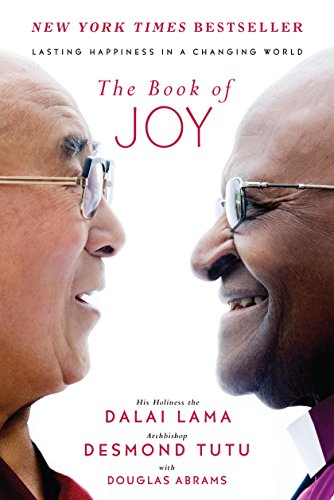
“He’s always teasing me,” the Archbishop laughed. “Almost the first time we met—do you remember? Maybe the first time you were a little reserved, but by the second time you were taking my cap off my head. I don’t know that you wake up in the morning and say I’m going to become a friend to the Dalai Lama.  It just happens. Scientists will come afterwards and analyze it. But I don’t think that he woke up either—at three—and said, “I think I’m going to be friends with that large-nosed black man from Africa.  I think it was a communication of the heart. When we kept quiet, our hearts discovered that they were kindred spirits.

The Dalai Lama erupted into a belly laugh and then began pointing at the Archbishop. “His face, his face,” he said, gesturing to the Archbishop’s bald head. “He looks like a monk now, doesn’t he?”

“I admire him enormously. Oh, he’s going to get proud. But I always say to people, after being in exile over 50 years how many would show the same serenity, the same joy, and the eagerness to spread goodness and compassion in the world.

“I think I would be very sulky, and I think there’d be a part of me that was always sad and it would show in my face. It doesn’t in his.  I mean I’m just saying, he is there for us as a beacon to tell us that you can, in fact, overcome some of the most horrendous circumstances, and, and emerge on the other side, not broken. So he is a very great gift to the world. And maybe the Chinese, without intending it, have given the world a wonderful gift.

“Thank you,” the Dalai Lama said quietly, perhaps humbled by the praise.

“Pay me, pay me,” the Archbishop said.

“I will pay. I will pay with a few nice words.”

“At our first meeting I notice this person. I always look at people, firstly, human level, so I do not consider importance of their rank or position.  So, on the human level, this person very nice, humble, I think very, very, very, joyful.

He was holding the Archbishop’s arm. “And then, you see, once you connect on the human level, you become close friends and that friendship never changes.  But on another level, this person is a very funny person,” he said slapping his arm playfully. “I love that. He is always teasing me, and also I am teasing him. So, we really become something quite special.

“And finally, right from the beginning, you always speak out about the truth and the justice of the Tibetan cause. As a Tibetan, I very much appreciate.

“Whenever he is at Nobel laureate meetings, they are full of joy. The atmosphere is something different. Then in recent years because of his age and also his physical condition, you see, he could not attend. Of course, many other Nobel laureates and many other Nobel laureates are wonderful ladies—“

“You are a monk, remember?” the Archbishop scolded.

“But when you are not there, something missing, really. Really, really. The other Nobel laureates also feel that, I think. So the relationship is something unique and something very special.”

“Thank you. I paid him,” the Archbishop said, as if pretending to stage whisper.

The Dalai Lama erupted into a belly laugh and then began pointing at the Archbishop. “His face, his face,” he said, gesturing to the Archbishop’s bald head. “He looks like a monk now, doesn’t he?” Then the Dalai Lama drew his hand into the shape of an eye.  “When I see your eyes—” Then he squeezed his nose playfully, “—and, of course, your nose—”

The Archbishop could not help but giggle at the mention of his nose.

Then the Dalai Lama’s playful tone changed, as he pointed at the Archbishop’s face warmly.  “This picture, special picture.”  Then he paused. “I think, at time of my death…” The word death hung in the air, his words a prophecy. “…I will remember you.”

I could hear everyone in the room, even the camera operators, gasp. The Archbishop looked down and hummed deeply, obviously humbled and moved by the Dalai Lama’s words. Could there be a truer sign of love: to see another’s face at the time of death.

“Thank you.  Thank you,” was all the Archbishop could say, all that could be said.

“So perhaps,” the Dalai Lama said, “according to your religious tradition, we may meet in heaven in the presence of God. You as a good Christian practitioner, you go first.” The Archbishop now chuckled heartily and the room seemed to breathe again. “You may help me and bring us together.” We laughed imagining the Archbishop bargaining with St. Peter at the pearly gates trying get special admission for the Dalai Lama.

“But from the Buddhist viewpoint,” the Dalai Lama continued, “once in a life, you develop some sort of special close connection, then that sort of impact will carry life after life. That’s Buddhist viewpoint. So maybe even then. But now, I’m looking forward to another occasion to see you again—somewhere that only God knows.”

Reprinted from The Book of Joy by arrangement with Avery Books, a member of Penguin Group (USA) LLC, A Penguin Random House Company. Copyright © 2016, The Dalai Lama Trust, Desmond Tutu, and Douglas Abrams.

Original link & photos http://www.lionsroar.com/the-dalai-lama-and-desmond-tutu-the-best-of-spiritual-friends/

Monday, May 25, 2015

Anaheim Mayor Spends 3 Days with Dalai Lama, Desmond Tutu

When Anaheim Mayor Tom Tait took up the Dalai Lama’s offer to hang out together with Bishop Desmond Tutu, he got a taste of His Holiness’ sense of humor.

“He talked about when he was a kid, he just wanted to play and they had to threaten to whip him so he would study,” Tait said. “But they had a special yellow whip for him.

“We laughed about that.”

Tait spent three days at the Dalai Lama’s Dharamshala, India, compound last month, having private talks with the Buddhist master, lunching with the Dalai Lama and Nobel Peace Prize laureate Tutu and sitting in on conversations between the two spiritual leaders.

“It’s so out of the box,” Tait said. “Sitting there, having a conversation with the Dalai Lama and Desmond Tutu about kindness, compassion, love, forgiveness, envy, greed. The biggest issues in life. It was great. Two of the greatest leaders for peace and justice of our time.”

As surprised as Tait was to get the phone call invitation from a Dalai Lama emissary a few weeks earlier, the mayor was hardly a random choice.

Tait has been leading efforts to make Anaheim a “city of kindness.” When first elected mayor in 2010, he ran on a campaign of “freedom and kindness.” It was idea he’d been working on since a 2004 meeting with a father who lost his 6-year-old daughter in a car accident.

The father, Edward Jaievsky, was inspired by the memory of his daughter talking about kindness and began putting up “Kindness is Contagious” signs in Anaheim. And it was contagious: Tait joined him in the project and then expanded it.

Among the noteworthy endeavors is a Million Acts of Kindness program launched in 2013 in the Anaheim City School District. Saying hello to a new student, picking up trash, collecting Christmas toys for underprivileged kids – students were asked to perform 50 such acts of kindness. Collectively, they hit the 1-million target in October.

Those efforts attracted the attention of the Dalai Lama and played a role in the Dalai Lama’s decision to celebrate his 80th birthday at Anaheim’s Honda Center on July 5. And the efforts prompted the invitation to Tait.

“The values of His Holiness are very much alive in Tom Tait,“ said Lama Tenzin Dhonden, a San Diego-based attache for the Dalai Lama. “Tom Tait is a very compassionate being. And Anaheim could become the model for many other cities.

The effects of Taits’ approach can come quickly. Anaheim school Superintendent Linda Wagner thinks the program has been largely responsible to the steady drop in suspensions, which this year are on track to be half of the 442 issued the year before the program started.

A token of kindness

When Tait first met the Dalai Lama at his compound April 22, he gave the Tibetan Buddhist one of Anaheim’s City of Kindness tokens. He also gave him a Ducks’ jersey, embroidered with “HHDL” – for His Holiness the Dalai Lama – and the number 80, for his 80th birthday.

“I didn’t know how much time we’d have, if it would just be a handshake,” Tait said. But it was quite a bit more, starting with a 45-minute conversation that included Tait’s wife, Julie, and a friend, Laguna Beach’s Paul Heeschem.

Tait said that the Dalai Lama started his day at 3:30 a.m., with five hours of meditation.

“He said he meditates because everyone he meets that day, he wants to bring joy, and he doesn’t want to act better or higher than anyone,” said Tait, who owns an engineering company. “He’s a joyful guy. He’s funny and humble. I was worried about how to greet him, but there’s no protocol. He doesn’t go for that.”

The Dalai Lama eats one meal a day, a 90-minute lunch. Tait joined him and Tutu for two meals. The two spiritual icons are writing a book together, “The Book of Joy,” and documentarians were filming their conversations, Tait said.

“Desmond Tutu talked about Nelson Mandela,” Tait recalled. “He said when he’d gone into prison, he was angry and aggressive, a kind of militant. He talked about how suffering can change people – how Mandela came out and was at peace, nonviolent.”

The two men’s message of joy and compassion was “impactful,” said Tait, a Catholic who believes the same values are key to most religions.

“The way to happiness is through kindness to others,” Tait recalled the Dalai Lama saying. “Compassion is especially important toward one’s enemies. It leads to understanding and inner peace.”

Small gestures are part of the equation.

“Every day, he pulled out (the token) to show me he was carrying it,” Tait said. “He loved it.”

Social conscience

The trip, paid for by Tait, was a break from City Council disputes that Tait sometimes puts himself in the middle of. He was the sole opponent of a $158 million tax subsidy for new luxury hotels and of the initial proposal for new stadium lease with the Angels. He also has been the council’s most outspoken advocate of a district election plan that would give Latinos a better chance at equal representation on the council.

But through it all, he has continued efforts to grow kindness.

“A CEO builds a new culture by establishing core values,” Tait said. “That’s what we’re trying to do in the city, build a culture of kindness. Then your crime will drops, your bullying at school will drop, your littering will drop. You stimulate the city to get better and all these good things begin to happen.”

Contact the writer: 714-796-6753 or mwisckol@ocregister.com